1.0 National Information Assurance Partnership 2020-09-30 WIDS/WIPS, Wireless Intrusion Detection/Prevention System 1.0 2020-09-30 Initial Release - PP-Module for NDcPP
This Protection Profile Module (PP-Module) describes security requirements for a 802.11 Wireless Intrusion Detection System (WIDS) defined to be an IEEE 802.11 network intrusion detection product located at the edge of a private network that can collect, inspect, and analyze real-time network traffic and alert the administrator of policy violations. This PP-Module is intended to provide a minimal baseline set of requirements that are targeted at mitigating well defined and described threats.
This PP-Module contains optional requirements for a Wireless
Intrustion
Intrusion Protection System (WIPS), a security product that in addition to the 802.11 WIDS capability, provides network security administrators with the additional ability to react in real-time to potentially malicious wireless (IEEE 802.11) network traffic.
collaborative Protection Profile for Network Devices (NDcPP), Version 2.2e
A TOE that conforms to a PP-Configuration containing this PP-Module must be a 'Distributed TOE' as defined in the NDcPP. The expectation for this PP-Module is that a WIDS must include distributed sensor nodes to ensure that the full physical range of a wireless network to ensure that user interactions with the network cannot evade detection.
A part or parts of the TOE that have to be relied upon for enforcing a closely related subset of the rules from the TSP. The security policy enforced by an SF.
1.2 Terms
The following sections list Common Criteria and technology terms used in this document.
1.2.1 Common Criteria Terms
Assurance
Grounds for confidence that a TOE meets the SFRs [CC].
Base Protection Profile (Base-PP)
Protection Profile used as a basis to build a PP-Configuration.
Collaborative Protection Profile (cPP)
A Protection Profile developed by international technical communities and approved by multiple schemes.
Common Criteria (CC)
Common Criteria for Information Technology Security Evaluation (International Standard ISO/IEC 15408).
Common Criteria Testing Laboratory
Within the context of the Common Criteria Evaluation and Validation Scheme (CCEVS), an IT security evaluation facility
,
accredited by the National Voluntary Laboratory Accreditation Program (NVLAP) and approved by the NIAP Validation Body to conduct Common Criteria-based evaluations.
Common Evaluation Methodology (CEM)
Common Evaluation Methodology for Information Technology Security Evaluation.
Distributed TOE
A TOE composed of multiple components operating as a logical whole.
Functional Package (FP)
A document that collects SFRs for a particular protocol, technology, or functionality.
Operational Environment (OE)
Hardware and software that are outside the TOE boundary that support the TOE functionality and security policy.
Protection Profile (PP)
An implementation-independent set of security requirements for a category of products.
A device that provides the network interface that enables 802.11 wireless client hosts to access a wired network.
End User Device (EUD)
An 802.11 enabled device that has the ability to process, transmit, and/or store information.
Service Set Identifier (SSID)
The primary name associated with an 802.11 wireless local area network (WLAN).
Wireless
Intrustion
Intrusion Detection System (WIDS)
A security product that provides network security administrators with the ability to monitor, collect, and log real-time to potentially malicious wireless (IEEE 802.11) network traffic.
Wireless
Intrustion
Intrusion Prevention System (WIPS)
A security product that provides network security administrators with the ability to monitor, collect, log, and react in real-time to potentially malicious wireless (IEEE 802.11) network traffic.
Wireless Local Area Network (WLAN)
An 802.11 wireless computer network that links two or more devices using wireless communication to form a local area network (LAN) within a limited area such as a home, school, computer laboratory, campus, office building etc.
1.3 Compliant Targets of Evaluation
1.3.1 TOE Boundary
This PP-Module specifically addresses WIDS/WIPS. A conformant WIDS is a product that can monitor, collect, inspect, and analyze real-time network traffic and alert the administrator of policy violations. WIPS functionality is not required to conform to this PP-Module, and it is optional for the TOE to have the additional ability to react in real-time to potentially malicious wireless (IEEE 802.11) network traffic.
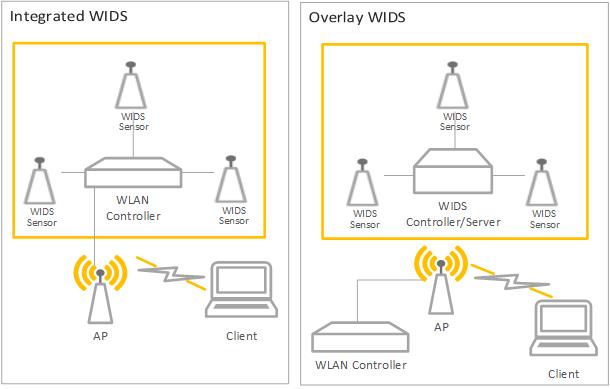
A WIDS/WIPSTOE consists of multiple sensors that passively scan the RF environment on the WLAN radio frequency spectrum and a centralized mechanism such as a Server or Controller that processes the data collected by the sensors. Conformant TOEsmust use a secure communication path(s) between WIDS/WIPS components.
A WIDS/WIPS can be Integrated (be part of the WLAN infrastructure) or Standalone (independent from WLAN) architecture depending on vendor implementation. The two different architectures are illustrated in Figure 1below. The TOE boundary is indicated by the yellow box.
A WIDS/WIPS is expected to inspect layers 1 and 2 network traffic, per the OSInetwork model, and monitor wireless frames in the RF spectrum utilized by IEEE 802.11 a, b, g, n, and ac. Monitoring and inspection of other technologies (e.g., cellular) and protocols are optional.
Conformant TOEswill detect potentially malicious network traffic using various approaches. Broadly speaking, the traffic analysis could be based on identification of 'known' threats, or 'unknown' threats. Identification of 'known' threats may be performed through pattern matching, (e.g. by matching strings of characters within a frame with known patterns, or by matching traffic patterns common with reconnaissance or denial of service (DoS) attacks). Identification of 'unknown' threats may be performed through use of various forms of anomaly detection whereby the WIDS/WIPS is provided with (or learns/creates) a definition of expected/typical traffic patterns, such that it’s able to detect and react to anomalous (unexpected/atypical) traffic patterns.
A WIDS consists of sensors (preferably dedicated) and a central controller working together to provide 24/7 monitoring, primarily to the 802.11 Wireless Local Area Network (WLAN) spectrum and protocol, to detect, identify, and
The WIDS may be capable of detecting or monitoring traffic other than 802.11 WLAN, such as 802.15.4 based protocols, which enhances the security of the controlled space. However, a WIDS is not required to monitor additional protocols outside of 802.11. A WIDS monitors all 802.11 WLAN traffic emanating from and traversing the controlled space, thus
inadvertant
inadvertent collection of any 802.11 signals is possible when operating a WIDS.
2 Conformance Claims
Conformance Statement
This PP-Module inherits exact conformance as required from the specified Base-PP and as defined in the CC and CEM addenda for Exact Conformance, Selection-
This Module is conformant to Parts 2 (extended) and 3 (conformant) of Common Criteria Version 3.1, Release Revision 5[CC].
PP Claim
This PP-Module does not claim conformance to any Protection Profile.
Package Claim
This Module does not claim conformance to any packages.
3 Security Problem Description
WIDS address a range of security threats related to detection of and reaction to potentially malicious WLAN traffic. The malicious traffic may pose a threat to one or more endpoints on the monitored networks, to the network infrastructure, or to the TOE itself. Attacks against a WLAN could compromise the confidentiality and integrity of WLAN users and system data as well as the availability of the WLAN to legitimate users.
The term “monitored network” is used here to represent any WLAN and/or wired network that the TOE is configured to monitor and detect intrusions on. This extends to the wired networks as intrusions on the wireless network can also be damaging to the wired infrastructure. The WIDS/WIPS also protect the wired infrastructure by detecting rogue devices that are directly connected to the wired infrastructure, which may expose the wired network, or unauthorized WLAN devices deployed in a no-wireless zone.
The proper installation, configuration, and administration of the WIDS is critical to its correct operation. A site is responsible for developing its security policy and configuring a rule set that the WIDS will enforce and provide an appropriate response to meet their needs, relative to their own risk analysis and their perceived threats.
Note that this PP-Module does not repeat the threats identified in the NDcPP, though they all apply given the conformance and hence dependence of this PP-Module on the NDcPP. Note also that while the NDcPP contains only threats to the ability of the TOE to provide its security functions, this PP-Module addresses only threats to resources in the operational environment. Together the threats of the NDcPP and those defined in this PP-Module define the comprehensive set of security threats addressed by a WIDSTOE.
3.1 Threats
T.UNAUTHORIZED_DISCLOSURE_OF_INFORMATION
A malicious actor may take advantage of unintended/unauthorized disclosure of sensitive information on a protected WLAN, such as sending unencrypted sensitive data, without detection. A malicious actor may also force the modification or disclosure of data in transit between distributed components of a WIDS to impede or gain visibility into its data collection capabilities.
T.UNAUTHORIZED_ACCESS
An attacker may attempt to gain unauthorized access to a network, endpoints, or services, by methods such as impersonation of an authorized AP to get an EUD to connect to the unauthorized AP If malicious external APsor EUDsare able to communicate with APsor EUDson the protected WLAN, then those devices may be susceptible to the unauthorized disclosure of information.
T.DISRUPTION
Attacks against the WLAN infrastructure might lead to denial of service (DoS) attacks within a protected WLAN. A wireless DoS may occur in two ways: at the physical layer through RF Jamming, or at the data link layer through packet injection.
3.2 Assumptions
These assumptions are made on the Operational Environment (OE) in order to be able to ensure that the security functionality specified in the PP-Module can be provided by the TOE. If the TOE is placed in an Operational Environment OEthat does not meet these assumptions, the TOE may no longer be able to provide all of its security functionality.
A.CONNECTIONS
It is assumed that the TOE is connected to distinct networks in a manner that ensures that the TOE's security policies will be enforced on all applicable network traffic flowing among the attached networks.
A.PROPER_ADMIN
The administrator of the WIDS is not careless, willfully negligent or hostile, and administers the WIDS within compliance of the applied enterprise security policy.
3.3 Organizational Security Policies
An organization deploying the TOE is expected to satisfy the organizational security policy listed below in addition to all organizational security policies defined by the claimed Base-PP.
P.ANALYZE
Analytical processes and information to derive conclusions about potential intrusions must be applied to WIDS data and appropriate response actions taken.
4 Security Objectives
4.1 Security Objectives for the TOE
O.SYSTEM_MONITORING
To be able to analyze and react to potential network policy violations, the WIDS must be able to collect and store essential data elements of network traffic on monitored networks. A conformant TOE may also implement a self-protection mechanism to ensure that undetected network policy violations cannot occur when a sensor is unavailable.
The WIDS must be able to analyze collected or observed WLAN activity on monitored network to identify potential violations of approved WLAN policies, unauthorized connections involving internal WLAN devices, and non-secure communications.
To address the threat of unauthorized administrator access that is defined in the Base-PP, conformant TOEswill provide the functions necessary for an administrator to configure the WIDS capabilities of the TOE. A conformant TOE may also implement a self-protection mechanism to ensure that a TSF failure cannot be used as a way to modify the TOE's configuration without authorization.
To further address the threat of untrusted communications channels that is defined in the Base-PP, conformant TOEswill provide trusted communications between distributed components if any exist.
4.2 Security Objectives for the Operational Environment
The Operational Environment OEof the TOE implements technical and procedural measures to assist the TOE in correctly providing its security functionality (which is defined by the security objectives for the TOE). The security objectives for the Operational Environment OEconsist of a set of statements describing the goals that the Operational Environment OEshould achieve. This section defines the security objectives that are to be addressed by the IT domain or by non-technical or procedural means. The assumptions identified in Section 3 are incorporated as security objectives for the environment. The following security objectives for the operational environment assist the TOE in correctly providing its security functionality. These track the assumptions about the environment.
OE.CONNECTIONS
TOE administrators will ensure that the TOE is installed in a manner that will allow the TOE to effectively enforce its policies on the network traffic of monitored networks.
OE.PROPER_ADMIN
The administrator of the WIDS is not careless, willfully negligent or hostile, and administers the WIDS within compliance of the applied enterprise security policy.
4.3 Security Objectives Rationale
This section describes how the assumptions, threats, and organization organizational security policies map to the security objectives.
This chapter describes the security requirements which have to be fulfilled by the product under evaluation. Those requirements comprise functional components from Part 2 and assurance components from Part 3 of [CC]. The following conventions are used for the completion of operations:
Refinement operation (denoted by bold text or strikethrough text): is used to add details to a requirement (including replacing an assignment with a more restrictive selection) or to remove part of the requirement that is made irrelevant through the completion of another operation, and thus further restricts a requirement.
Selection (denoted by italicized text): is used to select one or more options provided by the [CC] in stating a requirement.
Assignment operation (denoted by italicized text): is used to assign a specific value to an unspecified parameter, such as the length of a password. Showing the value in square brackets indicates assignment.
Iteration operation: is indicated by appending the SFR name with a slash and unique identifier suggesting the purpose of the operation, e.g. "/EXAMPLE1."
5.
0.0.1
1 NDcPP Security Functional Requirements Direction
In a PP-Configuration that includes NDcPP, the TOE is expected to rely on some of the security functions implemented by the Network Device as a whole and evaluated against the NDcPP. The following sections describe any modifications that the ST author must make to the SFRs defined in the NDcPP in addition to what is mandated by Section 5.2 TOE Security Functional Requirements.
5.1.1 Modified SFRs
The SFRs listed in this section are defined in the NDcPP and relevant to the secure operation of the TOE.
5.1.1.1 Security Audit (FAU)
FAU_GEN_EXT.1 Security Audit Data Generation for Distributed TOE Components
This PP-Module mandates the inclusion of this selection-based SFR because a TOE that conforms to this PP-Module will always be deployed in a configuration that requires this SFR to be claimed.
The TSF shall be able to generate audit records for each TOE component. The audit records generated by the TSF of each TOE component shall include the subset of security relevant audit events which can occur on the TOE component.
Application Note: This SFR is selection-based in the Base-PP but is mandated by this PP-Module because the ST author must claim a distributed TOE selection in FAU_STG_EXT.1.2.
Evaluation Activity
There is no change to the EAs specified for this SFR in the NDcPP SD. The PP-Module modifies this SFR to make its inclusion mandatory rather than selection-based, but there is no change to how the SFR must be implemented.
FAU_STG_EXT.1 Protected Audit Event Storage
This PP-Module modifies the Base-PPSFR to remove a selection that is not permitted by the TOE architecture that it specifies.
The TSF shall be able to store generated audit data on the TOE itself. In addition [selection:
The TOE shall be a distributed TOE that stores audit data on the following TOE components: [assignment: identification of TOE components]
,
The TOE shall be a distributed TOE with storage of audit data provided externally for the following TOE components: [assignment: list of TOE components that do not store audit data locally and the other TOE components to which they transmit their generated audit data]
].
Application Note: This SFR is modified from its definition in the Base-PP by removing the selection option for the TOE to be standalone. A TOE that conforms to this PP-Module is expected to be distributed.
Evaluation Activity
There is no change to the EAs specified for this SFR in the NDcPP SD. The PP-Module modifies this SFR to remove one of the possible selection items, but there is no change to how the SFR is to be implemented.
5.0.0
5.1.1.2 Communications (FCO)
FCO_CPC_EXT.1 Communication Partner Control
This PP-Module mandates the inclusion of this optional SFR because it is required to implement functionality required by this PP-Module.
The TSF shall enable a Security Administrator to disable communications between any pair of TOE components.
Application Note: This SFR is optional in the NDcPP but is mandated by this PP-Module because the WIDSTOE is expected to be a distributed system.
Evaluation Activity
There is no change to the EAs specified for this SFR in the NDcPP SD. The PP-Module modifies this SFR to make its inclusion mandatory rather than optional, but there is no change to how the SFR is to be implemented.
5.0.0
5.1.1.3 Protection of the TSF (FPT)
FPT_ITT.1 Basic Internal TSF Data Transfer Protection
This PP-Module mandates the inclusion of this optional SFR because it is required to implement functionality required by this PP-Module.
The TSF shall protect TSF data from disclosure and detect its modification when it is transmitted between separate parts of the TOE through the use of [selection: IPsec, SSH, TLS, DTLS, HTTPS].
Application Note:
FPT_ITT.1 is optional in NDcPP, however, since a WIDS/WIPSTOE is distributed, FPT_ITT.1 shall be included in the ST and is applicable to the data transmitted between the sensors and controller.
This requirement ensures all communications between components of a distributed TOE is protected through the use of an encrypted communications channel. The data passed in this trusted communication channel are encrypted as defined in the protocol chosen in the selection. The ST author chooses the mechanisms supported by the TOE, and then ensures that the detailed protocol requirements in Appendix B of NDcPP corresponding to their selection are included in the ST, if not already present.
Evaluation Activity
There is no change to the EAs specified for this SFR in the NDcPP SD. The PP-Module modifies this SFR to make its inclusion mandatory rather than optional, but there is no change to how the SFR is to be implemented.
5.0.0
5.1.1.4 Trusted Paths/Channels (FTP)
FTP_ITC.1 Inter-TSF trusted channel
This PP-Module refines the Base-PPSFR to add a selection for a specific external entity that may be applicable to a TOE that conforms to this PP-Module.
The TSF shall be capable of using [selection: IPsec, SSH, TLS, DTLS, HTTPS] to provide a trusted communication channel between itself and authorized IT entities supporting the following capabilities: audit server, [selection: authentication server, database server, [assignment: other capabilities], no other capabilities] that is logically distinct from other communication channels and provides assured identification of its end points and protection of the channel data from disclosure and detection of modification of the channel data.
Application Note:
This SFR is modified from its definition in the Base-PP by adding a selection for a database server capability. If the TSF uses a separate database server to support its security-relevant functionality, this selection must be included in the ST.
The intent of the database server is to store WIDS/WIPS data that must be queryable, such as events/alarms, triangulation calculations, wireless spectrum analysis (including RF jammer/Denial of Service (DoS)), and packet capture analysis. Authorized Administrators must be permitted to view alarms, raw event data, and any other data stored in the database. The Administrator must access the database through a trusted channel if done so remotely.
The intent of this requirement is to provide a means by which a cryptographic protocol may be used to protect external communications with authorized IT entities that the TOE interacts with to perform its functions. The TOE uses at least one of the listed protocols for communications with the server that collects the audit information.
If other authorized IT entities are protected, the ST author makes the appropriate assignments (for those entities) and selections (for the protocols that are used to protect those connections). The ST author selects the mechanism or mechanisms supported by the TOE, and then ensures that the detailed protocol requirements in Appendix B of NDcPP corresponding to their selection are included in the ST.
Evaluation Activity
There is no change to the EAs specified for this SFR in the NDcPP SD. If ‘database server’ is selected in FTP_ITC.1.1, the evaluator shall ensure that the required tests are performed on that external interface in addition to the other claimed interfaces.
The evaluator shall also perform test 4 for this SFR in the NDcPP SD, which is objective in NDcPP.
When this PP-Module extends the Network Device cPP, the TOE type for the overall TOE is still WIDS/WIPS products. 5.0
5.2 TOE Security Functional Requirements
The following section describes the SFRs that must be satisfied by any TOE that claims conformance to this PP-Module. These SFRs must be claimed regardless of which PP-Configuration is used to define the TOE.
5.2.1 Security Audit (FAU)
FAU_ARP.1 Security Alarms
This SFR defines operations to be performed on collected WIDS data, which is collected using an external interface defined in this PP-Module that extends the logical scope of the TOE beyond what the Base-PP defines.
The TSF shall display an alert to Authorized Administrator in sufficient detail to include identity of APsand EUDsinvolved, signal strength, accurate event timestamp, description of alert and severity level and [selection: capture raw frame traffic that triggered the violation, no other actions] upon detection of a potential security violation.
Application Note:
If "capture raw frame traffic that triggers the violation" is selected then FAU_STG_EXT.1/PCAP must be included in the ST.
FAU_SAA.1 defines the rules for monitoring the wireless traffic to detect for potential security violations. FAU_INV_EXT.2 defines the information the TOE needs to collect for all APsand EUDswithin range of the the TOE's sensors. Device attributes can then be individually filtered and/or selected in order to be displayed as part of the alert.
The evaluator shall verify that the TSS describes where to find the WIDS alerts on the Administrator console/interface.
Guidance
The evaluator shall use the operational guidance for instructions on where the alerts generated are displayed within the WIDS interface. If "capture raw frame traffic that triggers the violation is selected", the evaluator shall use the operational guidance to configure the traffic capture capabilities.
Tests
Test 1: The evaluator shall perform a series of events or generate traffic that would successfully trigger an alert for each of the rules defined in
FAU_
SAA.1. The evaluator should verify and record whether the TOE generated the alert for each rule, and provided sufficient details. The evaluator should also record the events or traffic that was generated as each alert was attempted to be triggered and record the details provided by the TOE in the alert.
Test 2: [conditional] If capturing of raw frames was selected, verify that the packet capture was triggered and stored as appropriate.
This family defines requirements for suppression of audit events. It is intended to complement the FAU_
This SFR defines operations to be performed on collected WIDS data, which is collected using an external interface defined in this PP-Module that extends the logical scope of the TOE beyond what the Base-PP defines. requires the TSF to implement a filtering mechanism to selectively suppress the generation of security alarms. No specific management functions have been identified. There are no auditable events foreseen.
The evaluator shall verify that the TSS describes the ability of the TOE to filter WIDS/WIPS alerts.
Guidance
The evaluator shall verify that the operational guidance includes instructions on enabling and disabling alerts.
Tests
Test 1:
Step 1: The evaluator shall use the operational guidance to enable/disable detection of available detection capabilities through the WIDS administrator interface. The evaluator shall then generate traffic that would successfully trigger the alert. The evaluator should verify that the TOE generated the alert.
Step 2: The evaluator shall disable the alert. The evaluator shall then generate events as in previous test that should successfully trigger the alert. The evaluator shall verify that the TOE did not generate an alert.
MAC Address, device type, classification of device, sensor(s) that detected device, signal strength as received by detecting sensor(s), proximity to detecting sensor(s)
Detection of network devices operating in selected RF bands
Frequency band, channel used within frequency band, identification information (MAC address if applicable or other similar unique ID), device technology (i.e., cellular), sensor(s) that detected devices
Description of violation, type of containment used, was containment triggered manually or automatically, sensor performing the containment (if wireless), details about the device (s) being contained (classification, device type, MAC address)
2are for the SFRsthat are explicitly defined in this PP-Module and are intended to extend FAU_GEN.1 in the Base-PP. The events in the Auditable Events table should be combined with those of the NDcPP in the context of a conforming Security Target.
The TSF shall record within each audit record at least the following information:
Date and time of the event, type of event, and subject identity (if applicable);
For each audit event type, based on the auditable event definitions of the functional components included in the PP/ST, [auditable events listed in Auditable Events table (Table 12)].
Application Note: The subject identity in this case is the allowlisted inventory item.
There are no TSS evaluation activities for this SFR.
Guidance
There are no operational guidance activities for this SFR.
Tests
The evaluator shall test the TOE’s ability to correctly generate audit records by having the TOE generate audit records in accordance with the evaluation activities associated with the functional requirements in this PP-Module. When verifying the test results, the evaluator shall ensure the audit records generated during testing match the format specified in the administrative guide, and that the fields in each audit record have the proper entries.
Note that the testing here can be accomplished in conjunction with the testing of the security mechanisms directly.
This family defines requirements for supported methods of intrusion detection.
FAU_IDS_EXT.1 Intrusion Detection System - Intrusion Detection Methods
This SFR defines operations to be performed on collected WIDS data, which is collected using an external interface defined in this PP-Module that extends the logical scope of the TOE beyond what the Base-PP defines. requires the TSF to specify the methods of intrusion detection that it supports. No specific management functions are identified. There are no auditable events foreseen. No dependencies.
The TSF shall provide the following methods of intrusion detection detect intrusions using[selection: anomaly-based, signature-based, [assignment: other detection method]] methods.
Application Note:
At least one detection method must be selected. If multiple detection methods are supported, each supported method must be selected.
If anomaly-based detection is selected, then FAU_ANO_EXT.1 shall be included in the ST. If signature-based detection is selected, then FAU_SIG_EXT.1 shall be included in the ST.
The evaluator shall verify that the TSS includes which intrusion detection method(s) the TOE utilizes. If multiple methods are selected, the evaluator shall confirm that the TSS describes how the different methods are incorporated.
Guidance
The evaluator shall verify that the operational guidance provides instructions on how to configure the TOE in order for it to detect such intrusions.
Tests
Depending on the detection technique used by the TOE, the evaluator shall confirm and note the existence of the capability and test for the appropriate selection-based requirements.
This family defines requirements for detection and inventorying of network assets in the TOE’s operational environment.
FAU_INV_EXT.1 Environmental Inventory
This SFR defines operations to be performed on assets in the TOE’s operational environment, which is behavior defined in this PP-Module that extends the logical scope of the TOE beyond what the Base-PP defines. requires the TSF to determine if inventoried objects are authorized or unauthorized. The following actions could be considered for the management functions in FMT:
Definition of inventory of authorized APs based on MAC address
Definition of inventory of authorized EUDs based on MAC address
The TSF shall detect the presence of non-allowlisted EUDsand APsin the Operational Environment.
Application Note:
This inventory is used as an allowlist to indicate to the WIDS which APsand EUDsare authorized members of the wireless network. The inventory of authorized APsand EUDsis configured by FMT_SMF.1/WIDS.
The terminology used to describe an inventoried or allowlisted device may vary by vendor product. This PP-Module utilizes allowlisted to describe APsand EUDsthat are part of the inventory and non-allowlisted to describe APsand EUDsthat are not part of the inventory.
The evaluator shall verify that the TSS describes how the presence of authorized EUDs and APs is presented by the TOE. The evaluator shall verify that the TSS includes where in the WIDS interface the list of detected APs and EUDs is displayed.
Guidance
The evaluator shall verify that the operational guidance provides instructions on how to view authorized and unathorized APs and EUDs that are within range of the TOE sensors.
Tests
Test 1:
Step 1: Per guidance in FMT_SMF.1/WIDS, add MAC Addresses or other unique device identifier for an AP and EUD to the allowlist.
Step 2: Deploy the AP and EUD that were added to allowlist within the range of the TOE's sensors.
Step 3: Verify that the devices are classified as authorized.
Step 7: Verify that the AP is classified as unauthorized.
Test 2:
Step 1: Deploy an allowlisted AP and EUD, and connect the EUD to the AP.
Step 2: Verify that the list of detected APs and EUDs contains the allowlisted AP and EUD that were just deployed.
Step 3: If the AP and EUD are detected verify that they are classified as allowlisted devices.
Test 3:
Step 1: Deploy a non-allowlisted AP and EUD and connect the EUD to the AP.
Step 2: Verify that the list of detected APs and EUDs contains the non-allowlisted AP and EUD that were just deployed.
Step 3: If the AP and EUD are detected verify that they are not classified as allowlisted devices.
FAU_INV_EXT.2 Characteristics of Environmental Objects
This SFR defines operations to be performed on assets in the TOE’s operational environment, which is behavior defined in this PP-Module that extends the logical scope of the TOE beyond what the Base-PP defines. requires the TSF to discover network assets in its operational environment and maintain an inventory of them based on collected attributes. The following actions could be considered for the management functions in FMT:
Definition of classification rules to detect rogue APs
There are no auditable events foreseen. No dependencies.
Application Note: For detection of encryption type, the TSF should be able to differentiate between the different WLAN encryption methods and when no encryption is in use.
The evaluator shall verify that the TSS explains the capability of detecting the information specified in the requirements for all APs and EUDs within the TOE's wireless range.
Guidance
The evaluator shall review the operational guidance in order to verify that there are instructions that show how to locate the device inventory mentioned above.
Tests
Test 1:
Step 1: Deploy an allowlisted AP, non-allowlisted AP and two allowlisted EUDs.
Step 2: Connect one allowlisted EUD to the allowlisted AP and one to the non-allowlisted AP.
Step 3: Check the WIDS user interface for a list of detected APs and EUDs.
Step 4: Verify that current RF band, current channel, MAC Address, received signal strength, device detection timestamps, classification of device, are part of the information presented on the WIDS user interface for all the APs and EUDs detected. For APs verify that encryption, number of connected EUDs, SSID (if not hidden), received frames/packets and beacon rate are presented. For EUDs verify that the SSID and BSSID of AP it is connected and DHCP configuration is presented.
FAU_INV_EXT.3 Location of Environmental Objects
This SFR defines operations to be performed on assets in the TOE’s operational environment, which is behavior defined in this PP-Module that extends the logical scope of the TOE beyond what the Base-PP defines. requires the TSF to approximate the physical location of network assets in its operational environment based on triangulation of wireless emissions. No specific management functions are identified. The following actions should be auditable if
The TSF shall detect received signal strength and [selection: RF power levels above a predetermined threshold, no other characteristics] of hardware operating within range of the TOE’s wireless sensors. Evaluation Activity
The evaluator shall verify that the TSS includes information on location tracking, optimal number of sensors and sensor placement to meet the required level of accuracy.
The evaluator shall verify that the TSS contains information regarding the TSF’s ability to record signal strength of hardware operating within range of its sensors.
Guidance
The evaluator shall review the operational guidance for instructions on how to configure location tracking, how to load a location map (if applicable), and where in the TSF administrator interface the location of APs and EUDs can be viewed.
If the option for detection of RF power levels above a predetermined threshold is selected, the evaluator shall use the operational guidance to set or check what the threshold is in a given test. The evaluator should also verify that the operational guidance provides instruction on how to configure the TOE to generate an alert when the threshold is exceeded.
Step 2: Check the WIDS user interface for a list of detected APs and EUDs.
Step 3: Verify that the current received signal strength is part of the information presented on the WIDS user interface about the APs and EUDs.
This family defines requirements for the format of generated reports.
FAU_RPT_EXT.1 Intrusion Detection System - Reporting Methods
This SFR defines operations to be performed on collected WIDS data, which is collected using an external interface defined in this PP-Module that extends the logical scope of the TOE beyond what the Base-PP defines. requires the TSF to implement a specified reporting mechanism for collected data for compatibility with third parties that may consume this data. No specific management functions are identified. There are no auditable events foreseen.
The TSF shall provide the ability to import data, such as an allowlist of APsand EUDs, and WIDS/WIPS configuration files from the system using [selection: custom API, Syslog, common log format, comma separated values (CSV), [assignment: vendor detection method]].
Application Note: The system must provide the ability to interact with an extensible interface to a third party wireless monitoring system for the purposes of importing data from the wireless system.
The evaluator shall verify that the TSS includes which method the TOE utilizes.
Guidance
There are no operational guidance activities for this SFR.
Tests
Depending on the detection technique used by the TOE, the evaluator shall confirm and note the existence of the capability.
Test 1:
Step 1: Deploy an allowlisted AP and connect it to the protected wired infrastructure via wire.
Step 2: Confirm that the TSF can observe and capture traffic and events generated by the AP.
Step 3: Confirm that the TSF can use the reporting mechanisms specified in the TSS.
Step 4: Verify that the TSF can import and export observable event data in each of the formats specified in the TSS.
FAU_SAA.1 Potential Violation Analysis
This SFR defines operations to be performed on collected WIDS data, which is collected using an external interface defined in this PP-Module that extends the logical scope of the TOE beyond what the Base-PP defines.
These rules are used to detect a potential security violation. Maintenance of the rules by adding, modifying or deletion of rules from the set of rules is handled by FMT_SMF.1/WIDS.
If a potential security violation is detected the alert generated for the Administrator is handled by FAU_ARP.1.
The evaluator shall verify that the TSS describes the ability of the TOE to detect the network behavior described by the SFR. The evaluator shall verify that the TSS describes the methods that the TOE uses to detect the presence of unauthorized connections and unauthorized network traffic. The evaluator shall examine the TSS to verify that it describes the denial of service attacks that can be detected by the TOE. The evaluator shall verify that the TSS describes the ability of the TOE to detect when unauthorized WLAN authentication schemes and encryption schemes are used. The evaluator shall verify that the TSS describes the ability of the TOE to detect when unauthorized APs and EUDs send or receive unencrypted data.
Guidance
If the ability of the TSF to detect the different potential security violations is configurable, the evaluator shall verify that the operational guidance provides instructions on how to configure the TOE.
Step 2: Verify that the EUD is detected as an non-allowlisted EUD.
Test 3: Detection of authorized EUD establishing peer-to-peer connection with any other EUD:
Test 3.1: Create the following connections between two allowlisted EUDs.
Windows Ad Hoc Connection
Mac OS Ad Hoc
Linux Ad Hoc
Wi-Fi Direct
Test 3.2: Create the following connections between one allowlisted EUD and a non-allowlisted EUD
Windows Ad Hoc Connection
Mac OS Ad Hoc
Linux Ad Hoc
Wi-Fi Direct
Verify that alerts were generated by each of the connections in each test.
Test 4: Detection of EUD bridging two network interfaces: Bridge two network interfaces on an allowlisted EUD (one must be the wireless card listed as allowlisted).
Step 1: Create a Windows Hosted Network with an allowlisted EUD.
Step 2: Connect a different allowlisted EUD to the network.
Verify that alerts were generated by each of the connections in each test.
Test 5: Detection of unauthorized point to point wireless bridges by allowlisted APs:
Step 1: Setup a point-to-point wireless bridge using allowlisted APs in the range of the wireless sensors.
Step 3: Send an flood of CTS frames to reserve RF medium.
Step 4: Verify that the TSF detects the CTS abuse.
Test 20: Detection of unauthorized authentication scheme use: The evaluator shall configure the TOE, per FMT_SMF.1/WIDS, with 802.1x authentication as the only mode of authorized WLAN authentication scheme.
Test 20.1:
Step 1: Deploy an allowlisted AP with open authentication.
This SFR defines operations to be performed on assets in the TOE’s operational environment, which is behavior defined in this PP-Module that extends the logical scope of the TOE beyond what the Base-PP defines. requires the TSF to implement a mechanism to distinguish between authorized and unauthorized network assets. The following actions could be considered for the management functions in FMT:
The TSF shall distinguish between benign and malicious APsand EUDsbased on if the APsand EUDsare authorized and [selection: automatic detection metrics, no other method].
Application Note: FAU_INV_EXT.1 defines that an AP or EUD is authorized based on if the AP/EUD is allowlisted as configured in FMT_SMF.1. A non-allowlisted device does not always have to be conducting malicious activity. However, it is acceptable to equate an allowlisted AP/EUD as both authorized/benign and a nonallowlisted non-allowlisted AP/EUD as both not authorized and thus malicious. If the TOE supports automatic malicious device detection, based on in-depth network traffic analysis, "automatic detection metrics" must be selected. This can be used to further distinguish if the AP/EUD is benign or malicious. If the TOE does not support automatic detection metrics, "no other method" must be selected.
The evaluator shall verify that the TSS describes how the TOE detects malicious APs/EUDs and whether the TOE supports automatic detection. The evaluator shall verify that the TSS includes how the TOE determines if a given SSID is authorized.
Guidance
If TOE supports automatic detection, the evaluator shall verify that the operational guidance contains instructions for configuring the automatic detection metrics. The evaluator shall verify that the operational guidance provides instructions on how to configure SSIDs as authorized.
Tests
For test 1 and 2 below the evaluator shall verify that the TOE detects and appropriately classifies the APs and EUDs. It is acceptable if the TOE uses different but equivalent descriptors for the classification. If the TOE does not support automatic detection metrics and equates a non-allowlisted AP/EUD as malicious, than it is sufficient that the the classification given to the AP/EUD in step 1 is the same as in step 2. If the TOE supports automatic detection metrics and distinguishes between a non-allowlisted AP/EUD and a malicious AP/EUD, then the classification for the AP/EUD should differ between step 1 and step 2.
Test 1:
Step 1: Deploy a non-allowlisted AP in the area of the WIDS sensor, but take no action against the network. Verify that the AP is classified as non-authorized.
Step 2: Deploy a non-allowlisted AP in the area of the WIDS sensor and launch an attack against the network. This can be any variation of Fake AP, Spoof AP, Flood or DoS attack.
Step 3: Verify that the AP is classified as malicious.
Test 2:
Step 1: Deploy a non-allowlisted EUD in the area of the WIDS sensor, but take no action against the network. Verify that the EUD is classified as non-authorized.
Step 2: Launch an RF Flooding, DoD/DDoS, masqueraded or spoofing attack against authorized AP with an unauthorized EUD.
Step 3: Verify that the EUD is classified as malicious.
Test 3:
Step 1: Deploy an AP with an unauthorized SSID in the area of the WIDS sensor.
Step 2: Verify that the TOE detects the unauthorized SSID.
FAU_WID_EXT.2 Wireless Intrusion Detection - Passive Information Flow Monitoring
This SFR defines operations to be performed on assets in the TOE’s operational environment, which is behavior defined in this PP-Module that extends the logical scope of the TOE beyond what the Base-PP defines. requires the TSF to surveil certain wireless frequency bands and perform stateful inspection of traffic on them. The following actions could be considered for the management functions in FMT:
Definition of authorized and unauthorized TCP/IP and UDP traffic
Definition of known malicious activity ports
Definition of the amount of time that a sensor monitors a specific frequency or channel
The TSF shall [selection: simultaneously, nonsimultaneously] monitor and analyze network traffic matching the 802.11 monitoring SFPfor all channels in the following RF frequencies:
2.4 GHz
5.0 GHz
6.0 GHz
and [selection:
[assignment: specified Wi-Fi channels] in the 4.9 GHz regulatory domain
The "802.11 monitoring SFP" is a security function policy and the SFRsthat reference this policy describe what the policy does. The "802.11 monitoring SFP" is established in FDP_IFC.1 and defined through FAU_WID_EXT.1, FAU_WID_EXT.2, in addition to optional SFRsFAU_WID_EXT.3 and FAU_WID_EXT.4. A vendor does not have to formally define this policy, it only needs to comply with the SFRs.
The TSF shall provide wireless sensors to detect network traffic matching the 802.11 monitoring SFPthat [selection: can be configured to prevent transmission of data, does not transmit data].
Application Note:
If "can be configured to prevent transmission of data" is selected then "Enable/Disable transmission of data by wireless sensor" must be selected in FMT_SMF.1/WIDS.
The intent of this SFR is to employ WIDS sensors that can have all wireless transmission capabilities disabled for instances where a site wishes to implement a no wireless policy.
The "802.11 monitoring SFP" is a security function policy and the SFRsthat reference this policy describe what the policy does. The "802.11 monitoring SFP" is established in FDP_IFC.1 and defined through FAU_WID_EXT.1, FAU_WID_EXT.2, in addition to optional SFRsFAU_WID_EXT.3 and FAU_WID_EXT.4. A vendor does not have to formally define this policy, it only needs to comply with the SFRs.
The TSF shall perform stateful frame inspection and log attacks spanning multiple frames.
Application Note: Attackers possess the capability to distribute an attack across multiple frames in an attempt to avoid traditional detection measures that solely focus on packet headers. Stateful frame inspection will allow for the identification of obfuscation techniques centered around spreading an attack across multiple frames.
The evaluator shall verify that the TSS includes which channels the TOE can detect and monitor. Additionally, the TSS shall include whether the TOE simultaneously or nonsimultaneously monitors network traffic across these channels. The evaluator shall verify that the TSS includes information on if the sensors are completely passive, by default, or if the sensors ability to transmit data is configurable.
Guidance
The evaluator shall review the operational guidance for how to configure the TOE to monitor the channels as selected in the SFR. If the sensor ability to transmits data is configurable, the evaluator shall review the operational guidance for how to disable wireless transmissions from the sensor. The evaluator shall verify that the operational guidance provides instructions on how to specify and confirm that stateful frame capture and inspection is being performed.
Tests
Channels Monitored
Test 1: Channels on On 5GHz band
Step 1: Configure the TSF to monitor the channels as selected in the SFR.
Step 2: Deploy an AP on at least 2 different channels within the regulatory domain on 5GHz band.
Step 3: Deploy an AP on at least 2 different channels outside the regulatory domain on 5GHz band.
Step 4: Verify that the AP gets detected on each channel tested.
Test 2: Channels on 2.4GHz band
Step 1: Configure the TSF to monitor the channels as selected in the SFR.
Step 2: Deploy AP on at least 2 different channels within the regulatory domain on 2.4GHz band.
Step 3: Deploy AP on at least 2 different channels outside the regulatory domain on 2.4GHz band.
Step 4: Verify that the AP gets detected on each channel tested.
Test 3: Channels on 4.9GHz band (if selected)
Step 1: Configure the TSF to monitor the channels specified in the SFR.
Step 2: Deploy AP and set to channels within the 4.9 GHz band outlined in the TSS.
Step 3: Verify that the AP gets detected on each channel tested.
Test 4: Non-standard channel frequencies (if selected)
Step 1: Configure the TSF to monitor the channels as selected in the SFR.
Step 2: Deploy AP on at least 2 different channels on non-standard channel frequencies.
Step 3: Verify that the AP gets detected on each channel tested.
Wireless Sensor Transmission of Data
If the TOE provides the ability to disable wireless transmission, the evaluator shall follow the operational guidance to configure the sensor to not transmit wirelessly. The evaluator shall then deploy a signal analyzer in order to check for wireless emanations from the TOE. Repeat the two tests below, for both the 2.4GHz and the
5
GHz band
.
Test 1:
Step 1: Boot a sensor and using the signal analyzer observe to check if any eminations are coming from the sensor.
Step
2
: Verify that the signal analyzer does not pick up emanations from the sensor
.
Test
2
:
Step 1: During normal sensor operations, observe the analyzer for about 10 minutes to check if any eminations are coming from the sensor.
Step 2: Verify that the signal analyzer does not pick up emanations from the sensor.
Step 3: Deploy a protocol analyzer or native capability within the WIDS Controller between the AP and EUD.
Step 4: Verify from the network traffic packet capture that all frames are being inspected to validate their connection state from the TSF
5.0.2 User Data Protection (FDP)
FDP_IFC.1 Subset Information Flow Control
This SFR defines operations to be performed on assets in the TOE’s operational environment, which is behavior defined in this PP-Module that extends the logical scope of the TOE beyond what the Base-PP defines.
"Authorized" EUDs/APsare those that are assigned to the allowlist as defined by FMT_SMF.1/WIDS.
The "802.11 monitoring SFP" is a security function policy and the SFRsthat reference this policy describe what the policy does. The "802.11 monitoring SFP" is established in FDP_IFC.1 and defined through FAU_WID_EXT.1, FAU_WID_EXT.2, in addition to optional SFRsFAU_WID_EXT.3 and FAU_WID_EXT.4. A vendor does not have to formally define this policy, it only needs to comply with the SFRs.
There are no TSS evaluation activities for this SFR.
Guidance
If this functionality is configurable, the evaluator shall verify that the operational guidance provides instructions on how to configure the TOE to monitor different types of IEEE 802.11 frame types and subtypes.
[selection: enable, disable] transmission of data by wireless sensor
,
Define attack signatures
,
Define rules for overwriting previous packet captures
,
Define the amount of time sensor monitors a specific
[selection: frequency, channel],
frequency
Define the amount of time sensor monitors a specific channel
Define authorized and unauthorized TCP/IP and UDP traffic
,
Define known malicious activity ports
,
No other capabilities
].
Application Note:
Define authorized WLAN authentication and encryption schemes does not enforce, but rather establishes a baseline to determine if an unauthorized scheme is used.
If FAU_ANO_EXT.1 is included in the ST, "Specification of periods of network activity that constitute baseline of expected behavior" must be selected. If FAU_ANO_EXT.1 is included in the ST and "manual configuration by administrators" is selected in FAU_ANO_EXT.1, then "Definition of anomaly activity" must be selected.
If "can be configured to prevent transmission of data" is selected in FAU_WID_EXT.2 then "Enable/Disable transmission of data by wireless sensor" must be selected.
It is expected that an Authorized Administrator will be responsible for configuring the AP to operate on a specific frequency pursuant to the 802.11 standard. The TSF will have the ability to adjust the amount of time it passively monitors and captures WLAN traffic on a given frequency and channel.
The evaluator shall review the TSS to verify that it includes information the ability of the TOE to define inventory of authorized APs and EUDs.
The evaluator shall verify that the TSS describes the ability of the TOE to allow authorized administrators to define authorized WLAN authentication schemes.
Guidance
The evaluator shall review the operational guidance for instructions on how to configure and change clasification of APs and EUDs to indicate that they are part of the allowlist.
The evaluator shall review the operational guidance to determine how to configure which SSIDs are permitted on the network.
The evaluator shall examine the operational guidance to verify that it provides instructions on how to define a WLAN authentication scheme as authorized or unauthorized for the purposes of detection.
The evaluator shall examine the operational guidance to verify that it provides instructions on how to define a WLAN encryption scheme as authorized or unauthorized for the purposes of detection.
Tests
Test 1: The evaluator shall define an inventory of authorized APs and EUDSs. The ability to detect allowlisted and non-allowlisted APs and EUDs will be tested in FAU_INV_EXT.1 and FAU_SAA.1.
Test 2: The evaluator shall define authorized SSIDs. The ability to detect authorized and unauthorized SSIDs will be tested in FAU_WID_EXT.2.3 and FAU_SAA.1.
Test 3: The evaluator shall configure the TSF with a set of allowed authentication and encryption schemes. The ability to detect violation of this policy will be tested in FAU_SAA.1.
Test 4: (conditional): If "Define the amount of time sensor monitors a specific frequency or channel" is selected:
Step 1: Deploy an allowlisted AP and connect it to the protected wired infrastructure via wire.
Step 2: Confirm that the TSF can observe and capture traffic and events generated by the AP.
Step 3: Verify that the TSF can be configured to capture traffic on a specific channel for specific interval of time, and assign a specified frequency and time interval.
Step 4: Confirm that the TSF remains on the frequency and channel for the time period specified.
5.3 TOE Security Functional Requirements Rationale
The following rationale provides justification for each security objective for the TOE, showing that the SFRs are suitable to meet and achieve the security objectives:
FAU_RPT_EXT.1 supports the objective by requiring the TSF to implement an external import and reporting mechanism for its monitoring data to integrate with third-party components.
FPT_FLS.1 supports the objective by ensuring that a potential sensor failure triggers the TOE to fail into a secure state which prevents undetected wireless communications.
FAU_INV_EXT.3 supports the objective by requiring the TSF to implement measures that can be used to determine the physical location of inventoried devices.
FAU_SAA.1 supports the objective by defining the specific conditions that the TSF must apply to determine if collected data is indicative of potential malicious activity.
FAU_WID_EXT.1 supports the objective by requiring the TSF to implement a method to distinguish between benign and malicious devices in its operational environment.
FAU_WID_EXT.3 supports the objective by optionally requiring the TSF to detect network devices operating on frequency bands beyond what is required by FAU_WID_EXT.2.
FAU_ANO_EXT.1 supports the objective by defining the specific anomaly-based detection mechanisms that the TSF is required to implement if it claims to support anomaly-based detection.
FAU_SIG_EXT.1 supports the objective by requiring the TSF to support user-defined and customizable attack signatures if it claims to support signature-based detection.
FAU_INV_EXT.4 supports the objective by optionally requiring the TSF to detect when unauthorized wireless devices connect to a protected network over a wired interface.
FPT_FLS.1 supports the objective by ensuring that a potential compromise of the TSF triggers the TOE to fail into a secure state, which prevents unauthorized administration.
FTP_ITC.1 supports the objective by defining the trusted communications protocol used to secure communications between the TOE and its operational environment.
5.4 TOE Security Assurance Requirements
This PP-Module does not define any SARs beyond those defined within the Base-PP to which it can claim conformance. It is important to note that a TOE that is evaluated against this PP-Module is inherently evaluated against the NDcPP as well. This PP includes a number of EAs associated with both Security Functional Requirements (SFRs) and SARs. Additionally, this PP-Module includes a number of SFR-based EAs that similarly refine the SARs of the Base-PP. The evaluation laboratory will evaluate the TOE against the chosen Base-PP and supplement that evaluation with the necessary SFRs that are taken from this PP-Module.
6 Consistency Rationale
6.1 Collaborative Protection Profile for Network Device
6.1.1 Consistency of TOE Type
When this PP-Module extends the Network Device cPP, the TOE type for the overall TOE is still WIDS/WIPS products.
This threat is similar to the T.UNDETECTED_ACTIVITY threat in the Base-PP but it applies to the attacker performing malicious actions on the network monitored by the TOE rather than against the TOE itself.
This threat is similar to the T.UNAUTHORIZED_ADMINISTRATOR_ACCESS threat in the Base-PP but it applies to the attacker gaining unauthorized access to an asset on the network monitored by the TOE rather than against the TOE itself.
This threat is for a denial-of-service attack against an asset on the network monitored by the TOE. The Base-PP does not define any threats for availability but there is no consistency issue here because the threat applies to an interface that does not exist in the Base-PP.
This assumption defines the TOE’s placement in a network such that it is able to perform its required security functionality. The Base-PP does not define any assumptions about the TOE’s architectural deployment so there is no conflict here.
This assumption is comparable to the A.TRUSTED_ADMINISTRATOR assumption from the Base-PP, applied to the specific administrative functions defined in this PP-Module.
This organizational security policy expects the data produced by the TSF about the behavior of external entities to be used in an organization’s analytical process. There is no conflict with the Base-PP because the Base-PP does not define any functionality for the TOE to produce data about any entities other than itself.
6.1.3 Consistency of Objectives
The objectives for the TOEs are consistent with the NDcPP based on the following rationale:
The Base-PP does not define any TOE objectives. However, it does define requirements for the collection and secure remote transmission of audit data. The PP-Module adds requirements for the similar handling of network traffic data.
The Base-PP does not define any TOE objectives. However, it does define requirements for the execution of security-relevant management functions. The PP-Module expands upon this by adding requirements for the security-relevant management functions that are introduced by the PP-Module.
The Base-PP does not define any TOE objectives. However, it clearly intends to ensure that communications are trusted because the SFRs the PP-Module uses to demonstrate this objective is satisfied are derived from the Base-PP.
The objectives for the TOE's OE are consistent with the NDcPP based on the following rationale:
This objective expects the TOE to be placed in a network such that it is able to perform its required security functionality. The Base-PP does not define any objectives about the TOE’s architectural deployment so there is no conflict here.
This objective is comparable to the OE.TRUSTED_ADMIN objective from the Base-PP, applied to the specific administrative functions defined in this PP-Module.
6.1.4 Consistency of Requirements
This PP-Module identifies several SFRs from the NDcPP that are needed to support Wireless Intrusion Detection/Prevention Systems (WIDS/WIPS) functionality. This is considered to be consistent because the functionality provided by the NDcPP is being used for its intended purpose. The PP-Module also identifies a number of modified SFRs from the NDcPP that are used entirely to provide functionality for Wireless Intrusion Detection/Prevention Systems (WIDS/WIPS). The rationale for why this does not conflict with the claims defined by the NDcPP are as follows:
This PP-Module mandates the inclusion of this selection-based SFR because a TOE that conforms to this PP-Module will always be deployed in a configuration that requires this SFR to be claimed.
This PP-Module refines the Base-PPSFR to add a selection for a specific external entity that may be applicable to a TOE that conforms to this PP-Module.
This SFR defines operations to be performed on collected WIDS data, which is collected using an external interface defined in this PP-Module that extends the logical scope of the TOE beyond what the Base-PP defines.
This SFR defines operations to be performed on collected WIDS data, which is collected using an external interface defined in this PP-Module that extends the logical scope of the TOE beyond what the Base-PP defines.
This SFR defines operations to be performed on collected WIDS data, which is collected using an external interface defined in this PP-Module that extends the logical scope of the TOE beyond what the Base-PP defines.
This SFR defines operations to be performed on assets in the TOE’s operational environment, which is behavior defined in this PP-Module that extends the logical scope of the TOE beyond what the Base-PP defines.
This SFR defines operations to be performed on assets in the TOE’s operational environment, which is behavior defined in this PP-Module that extends the logical scope of the TOE beyond what the Base-PP defines.
This SFR defines operations to be performed on assets in the TOE’s operational environment, which is behavior defined in this PP-Module that extends the logical scope of the TOE beyond what the Base-PP defines.
This SFR defines operations to be performed on collected WIDS data, which is collected using an external interface defined in this PP-Module that extends the logical scope of the TOE beyond what the Base-PP defines.
This SFR defines operations to be performed on collected WIDS data, which is collected using an external interface defined in this PP-Module that extends the logical scope of the TOE beyond what the Base-PP defines.
This SFR defines operations to be performed on assets in the TOE’s operational environment, which is behavior defined in this PP-Module that extends the logical scope of the TOE beyond what the Base-PP defines.
This SFR defines operations to be performed on assets in the TOE’s operational environment, which is behavior defined in this PP-Module that extends the logical scope of the TOE beyond what the Base-PP defines.
This SFR defines operations to be performed on assets in the TOE’s operational environment, which is behavior defined in this PP-Module that extends the logical scope of the TOE beyond what the Base-PP defines.
This SFR defines operations to be performed on assets in the TOE’s operational environment, which is behavior defined in this PP-Module that extends the logical scope of the TOE beyond what the Base-PP defines.
This SFR defines an optional capability for a distributed component to be dedicated to one particular function. This function (wireless spectrum analysis) is defined in this PP-Module that extends the logical scope of the TOE beyond what the Base-PP defines.
This SFR defines operations to be performed on collected WIDS data, which is collected using an external interface defined in this PP-Module that extends the logical scope of the TOE beyond what the Base-PP defines.
This SFR defines operations to be performed on collected WIDS data, which is collected using an external interface defined in this PP-Module that extends the logical scope of the TOE beyond what the Base-PP defines.
This SFR defines operations to be performed on assets in the TOE’s operational environment, which is behavior defined in this PP-Module that extends the logical scope of the TOE beyond what the Base-PP defines.
requires the TSF to surveil certain radio frequency bands that fall outside the typical wireless spectrum used by consumer-grade electronics. No specific management functions are identified. The following actions should be auditable if FAU_GEN Security Audit Data Generation is included in the PP/ST:
Detection of network devices operating in selected RF bands
This SFR defines operations to be performed on assets in the TOE’s operational environment, which is behavior defined in this PP-Module that extends the logical scope of the TOE beyond what the Base-PP defines.
This SFR defines operations to be performed on assets in the TOE’s operational environment, which is behavior defined in this PP-Module that extends the logical scope of the TOE beyond what the Base-PP defines.
This SFR defines WIPS behavior in response to detection of potential malicious activity in the TOE’s operational environment. This extends the logical scope of the TOE beyond what the Base-PP defines.
This SFR defines preservation of a secure state in the event that a failure condition is detected. The Base-PP does not define an SFR for this behavior but this SFR mitigates the T.SECURITY_FUNCTIONALITY_FAILURE threat defined in the Base-PP, so it is clear that this behavior is consistent with the security expectations of the Base-PP.
The TSF shall detect the presence of network devices that operate in the following RF bands: [selection: 3.6 GHz, 60 GHz, sub-GHz (0-900 MHz), all cellular bands].
Application Note: This SFR refers to Non-WLAN (IEEE 802.11 a, b, g, n, and ac) network devices that operate in the specified frequencies. There is an understanding that this capability requires a TOE to use specialized, licensed radio systems. This SFR will allow for the introduction of an open API, set of defined interoperability standards, or other proprietary solution(s), to allow for third-party integrationsintegration.
The evaluator shall verify that the TSS includes the set of RF bands and technologies that the TSF can detect the use of. The TSS should also include instructions on how to enable and the hardware that is necessary for the additional band detection.
Guidance
The evaluator shall verify that the operational guidance describes how to enable and configure detection of the technologies included in the ST as well as the hardware that is needed to perform this function.
Tests
The evaluator shall enable and configure detection of the selected technologies.
Test 1: Deploy a device within the given technology and verify that the TSF detects the device.
This SFR defines an optional capability for a distributed component to be dedicated to one particular function. This function (wireless spectrum analysis) is defined in this PP-Module that extends the logical scope of the TOE beyond what the Base-PP defines. requires the TSF to implement wireless spectrum analysis in a dedicated physical component. No specific management functions are identified. There are no auditable events foreseen. [FAU_WID_EXT.2 Wireless Intrusion Detection - Passive Information Flow Monitoring, or
The evaluator shall verify that the TSS to verify that the TOE provides a dedicated sensor for wireless spectrum analysis.
Guidance
The evaluator shall verify that the operational guidance describes how to enable and configure dedicated spectrum analysis as well as the hardware that is needed to perform this function.
Tests
The evaluator shall enable and configure dedicated spectrum analysis and test the capabilities listed in the TSS.
5.0.5 Security Audit (FAU)
This family defines requirements for detection of malicious network activity based on anomalous behavior.
The TSF shall detect when two sensors in non-overlapping locations receive traffic from the same MAC address simultaneously.
Application Note: The intent of this SFR is to detect MAC spoofing where an attacker is able to cause the allowlisted EUD to disconnect and promptly connects a non-allowlisted device using the MAC address of the allowlisted EUD.
The TSF shall detect when two sensors in non-overlapping locations receive traffic from the MAC addresses of non-allowlisted EUDs within an Authorized administrator-configurable timeframe based on distance between sensors.
Application Note: The intent of this SFR is to allow the administrator to determine the time that should be allowed between an allowlisted EUD connecting in two distant locations.
The TSF shall allow an Authorized Administrator to isolate a wireless AP or EUD from the network monitored by the TSF using the following methods: [selection: wireless containment, wire-side containment of an unauthorized AP connected to the internal corporate wired network ].
Application Note:
It is expected that an Authorized Administrator will be responsible for confirming the AP or EUD as a rogue AP or EUD to initiate wireless containment.
In this SFR the containment of an an unauthorized AP connected to the internal corporate wired network refers to an unauthorized AP that is physically connected (via wire) to the protected internal wired infrastructure.
A.2.2 Protection of the TSF (FPT)
FPT_FLS.1 Basic Internal TSF Data Transfer Protection
The TSF shall preserve a secure state when the following types of failures occur: [sensor functionality failure, potential compromise of the TSF].
Application Note: At minimum, the preservation of a secure state requires the generation of audit records when the defined failure conditions occur.
A.3 Implementation-dependent Requirements
This PP-Module does not define any Implementation-dependent SFRs.
Appendix B - Selection-based Requirements
B.1 Security Audit (FAU)
FAU_ANO_EXT.1 Anomaly-Based Intrusion Detection
This SFR defines operations to be performed on collected WIDS data, which is collected using an external interface defined in this PP-Module that extends the logical scope of the TOE beyond what the Base-PP defines. requires the TSF to define how it determines anomalous network traffic that may be indicative of malicious activity. The following actions could be considered for the management functions in FMT:
Specification of periods of network activity that constitute baselines of expected behavior
Definition of anomaly activity
There are no auditable events foreseen.
The inclusion of this selection-based component depends upon selection in FAU_IDS_EXT.1
Intrusion Detection System - Intrusion Detection Methods
The TSF shall support the definition of [selection: baselines ('expected and approved'), anomaly ('unexpected') traffic patterns] including the specification of [selection:
throughput (data elements (e.g. bytes, packets, etc.) per time period (e.g. minutes, hours, days))
The TSF shall support the definition of anomaly activity through [selection: manual configuration by administrators, automated configuration].
Application Note: The "baseline" and "anomaly" can be something manually defined/configured by a TOE administrator (or importing definitions), or something that the TOE is able to automatically define/create by inspecting network traffic over a period of time (a.k.a. "profiling").
The evaluator shall verify that the TSS describes the composition and construction of baselines or anomaly-based attributes specified in the SFR. The evaluator shall verify that the TSS provides a description of how baselines are defined and implemented by the TSF, or a description of how anomaly-based rules are defined and configured by the administrator.
The evaluator shall verify that the TSS describes the available modes of configuration (manual or automatic) and how to configure or import the baseline.
Guidance
The evaluator shall verify that the operational guidance describes how to configure baseline and/or anomalous traffic patterns based on what is stated in the TSS.
The evaluator shall verify that the operational guidance describes how to perform automatic and/or manual definition of anomaly activity based on what is selected in the ST.
Tests
The evaluator shall use the instructions in the operational guidance to configure baselines or anomaly-based rules through automated and/or manual means based on what is selected in the ST. The evaluator shall send traffic that does not match the baseline or matches the anomaly-based rule and verify the TSF detects the anomalous behavior and generates an alert.
This family defines requirements for detection of malicious network activity based on traffic signatures.
FAU_SIG_EXT.1 Signature-Based Intrusion Detection
This SFR defines operations to be performed on collected WIDS data, which is collected using an external interface defined in this PP-Module that extends the logical scope of the TOE beyond what the Base-PP defines. requires the TSF to support the definition of traffic signatures that can be compared to observed network traffic for the purpose of identifying potential malicious activity. The following actions could be considered for the management functions in FMT:
Definition of attack signatures
There are no auditable events foreseen.
The inclusion of this selection-based component depends upon selection in FAU_IDS_EXT.1
Intrusion Detection System - Intrusion Detection Methods
The evaluator shall verify that the TSS describes the user-defined and customizable attack signatures that the TOE can define.
Guidance
The evaluator shall verify that the operational guidance provides information on how to configure user-defined and customizable attack signatures, including a description of the customization options that are available.
Tests
Test 1:
Step 1: Craft a signature with the available fields indicated in the TSS.
Step 2: Send a crafted frame that matches the signature to an allowlisted EUD
Step 3: Verify that the TSF triggers an alert based on the newly defined signature.
The TSF shall be able to transmit the generated packet captures to an external IT entity hosting a protocol analyzer using a trusted channel according to FTP_ITC.1.
The TSF shall be able to store generated packet captures on the TOE itself. In addition [selection:
The TOE shall be a distributed TOE that stores packet capture data on the following TOE components: [assignment: identification of TOE components]
,
The TOE shall be a distributed TOE with storage of packet capture data provided externally for the following TOE components: [assignment: list of TOE components that do not store packet capture data locally and the other TOE components to which they transmit their generated packet capture data]
The TSF shall [selection: drop new packet capture data, overwrite previous packet captures according to the following rule: [assignment: rule for overwriting previous packet captures], [assignment: other action]] when the local storage space for packet capture data is full. Evaluation Activity
The evaluator shall verify that the TSS includes the list of trusted channels (as specified in FTP_ITC.1) available in the TSF to transmit packet captures to an external entity. The evaluator shall verify that the TSS describes the ability of the TOE to store packet capture data within itself, how much storage space is available for packet capture data and where that data is stored. The evaluator shall verify that the TSS describes the behavior of the TOE when local storage space for packet capture data is exhausted and whether this behavior is configurable.
Guidance
The evaluator shall verify that the operational guidance provides instructions on how to configure the trusted channel. If the behavior of the TOE when local storage space for packet capture data is exhausted is configurable, the evaluator shall verify that the operational guidance provides information on what the configurable behaviors are and how they can be set.
Tests
Test 1: The evaluator shall configure packet captures according to the guidance specified. The evaluator shall then trigger an event that starts a capture and verify through the tests in FTP_ITC.1 that the captured traffic being sent to the external device is being sent through a trusted channel.
Test 2: The evaluator shall configure packet captures to be stored on the TSF according to the guidance specified. The evaluator shall then trigger an event that starts a capture and verify that the packet capture was stored on the TSF.
Test 3: The evaluator shall define packet data retention and deletion rules on the TSF according to the guidance specified and test the functionality of the specified rules.
5.0.6 Security Audit (FAU)
FAU_INV_EXT.4 Detection of Unauthorized Connections
This SFR defines operations to be performed on assets in the TOE’s operational environment, which is behavior defined in this PP-Module that extends the logical scope of the TOE beyond what the Base-PP defines. requires the TSF to identify if an unauthorized network asset in its inventory is attempting to access a protected network using a wired connection. No specific management functions are identified. There are no auditable events foreseen. FAU_INV_EXT.
Appendix C - Extended Component Definitions
This appendix contains the definitions for all extended requirements specified in the Module.
C.1 Extended Components Table
All extended components specified in the Module are listed in this table:
This Module defines the following extended components as part of the FAU class originally defined by CC Part 2:
C.2.1.1 FAU_ARP_EXT Security Alarm Filtering
Family Behavior
This family defines requirements for suppression of audit events. It is intended to complement the FAU_ARP family already defined in CC Part 2.
Component Leveling
FAU_ARP_EXT.1, Security Alarm Filtering, requires the TSF to implement a filtering mechanism to selectively suppress the generation of security alarms.
Management: FAU_ARP_EXT.1
No specific management functions have been identified.
The TSF shall provide the ability to apply [assignment: methods of selection] to selectively exclude alerts from being generated.
C.2.1.2 FAU_IDS_EXT Intrusion Detection Methods
Family Behavior
This family defines requirements for supported methods of intrusion detection.
Component Leveling
FAU_IDS_EXT.1, Intrusion Detection System - Intrusion Detection Methods, requires the TSF to specify the methods of intrusion detection that it supports.
Management: FAU_IDS_EXT.1
No specific management functions are identified.
Audit: FAU_IDS_EXT.1
There are no auditable events foreseen.
FAU_IDS_EXT.1 Intrusion Detection System - Intrusion Detection Methods
Hierarchical to: No other components.
Dependencies to: No dependencies.
FAU_IDS_EXT.1.1
The TSF shall detect intrusions using [assignment: detection strategies] methods.
C.2.1.3 FAU_INV_EXT Environmental Inventory
Family Behavior
This family defines requirements for detection and inventorying of network assets in the TOE’s operational environment.
Component Leveling
FAU_INV_EXT.1, Environmental Inventory, requires the TSF to determine if inventoried objects are authorized or unauthorized.
FAU_INV_EXT.2, Characteristics of Environmental Objects, requires the TSF to discover network assets in its operational environment and maintain an inventory of them based on collected attributes.
FAU_INV_EXT.3, Location of Environmental Objects, requires the TSF to approximate the physical location of network assets in its operational environment based on triangulation of wireless emissions.
FAU_INV_EXT.4, Detection of Unauthorized Connections, requires the TSF to identify if an unauthorized network asset in its inventory is attempting to access a protected network using a wired connection.
FAU_INV_EXT.5, Signal Library, requires the TSF to maintain a signal library.
Management: FAU_INV_EXT.1
The following actions could be considered for the management functions in FMT:
Definition of inventory of authorized APs based on MAC address
Definition of inventory of authorized EUDs based on MAC address
Audit: FAU_INV_EXT.1
The following actions should be auditable if FAU_GEN Security Audit Data Generation is included in the PP/ST:
Presence of allowlisted device
FAU_INV_EXT.1 Environmental Inventory
Hierarchical to: No other components.
Dependencies to: FAU_INV_EXT.2 Characteristics of Environmental Objects
FAU_INV_EXT.1.1
The TSF shall determine if a given AP is authorized based on [selection: MAC addresses, [assignment: other unique device identifier] ]
FAU_INV_EXT.1.2
The TSF shall determine if a given EUD is authorized based on [selection: MAC addresses, [assignment: other unique device identifier] ]
FAU_INV_EXT.1.3
The TSF shall detect the presence of non-allowlisted EUDs and APs in the Operational Environment.
Management: FAU_INV_EXT.2
The following actions could be considered for the management functions in FMT:
Definition of classification rules to detect rogue APs
Audit: FAU_INV_EXT.2
There are no auditable events foreseen.
FAU_INV_EXT.2 Characteristics of Environmental Objects
Dependencies to: FAU_INV_EXT.2 Characteristics of Environmental Objects
FAU_INV_EXT.3.1
The TSF shall detect the physical location of APs and EUDs to within [assignment: value equal or less than 25] feet of their actual location.
FAU_INV_EXT.3.2
The TSF shall detect received signal strength and [selection: RF power levels above a predetermined threshold, no other characteristics ] of hardware operating within range of the TOE’s wireless sensors.
Management: FAU_INV_EXT.4
No specific management functions are identified.
Audit: FAU_INV_EXT.4
There are no auditable events foreseen.
FAU_INV_EXT.4 Detection of Unauthorized Connections
Hierarchical to: No other components.
Dependencies to: FAU_INV_EXT.1 Environmental Inventory
FAU_INV_EXT.4.1
The TSF shall detect when non-allowlisted APshave a wired connection to the internal corporate network.
The evaluator shall verify that the TSS includes guidance on whether the TSF has the capability of detecting APs connecting to the protected wired network infrastructure. If the capability is present the TSS shall include configuration guidance for this feature.
Guidance
The evaluator shall review the operational guidance for instructions on how to configure the WIDS to detect unauthorized APs connected to the protected wired infrastructure.
Step 2: Connect the AP via wire to the protected network infrastructure.
Step 3: Check the WIDS user interface for a list of detected APs and EUDs.
Step 4: Verify that the rogue AP is detected and an alert generated on the detection of an AP connected to the protected wired infrastructure.
FAU_INV_EXT.5 Signal Library
This SFR defines operations to be performed on assets in the TOE’s operational environment, which is behavior defined in this PP-Module that extends the logical scope of the TOE beyond what the Base-PP defines. requires the TSF to maintain a signal library. No specific management functions are identified. There are no auditable events foreseen. No dependencies.
There are no TSS evaluation activities for this SFR.
Guidance
The evaluator shall review the operational guidance for instructions on how to locate and verify that the WIDS comes preloaded with a signal library, as well as possesses the ability to import, export, and update the existing signal library if present.
Tests
Depending on operation guidance provided for the TOE, the evaluator shall confirm and note the existence of the signal library, and test for the ability to import, export, and update the signal library.
Test 1:
Step 1: Deploy an allowlisted AP and connect it to the protected wired infrastructure via wire.
Step 2: Confirm and note whether the TSF has an existing signal library.
Step 3: If existence is confirmed, verify that the TSF can import, export, and update the existing signal library.
This family defines requirements for the format of generated reports.
Component Leveling
FAU_RPT_EXT.1, Intrusion Detection System - Reporting Methods, requires the TSF to implement a specified reporting mechanism for collected data for compatibility with third parties that may consume this data.
Management: FAU_RPT_EXT.1
No specific management functions are identified.
Audit: FAU_RPT_EXT.1
There are no auditable events foreseen.
FAU_RPT_EXT.1 Intrusion Detection System - Reporting Methods
Syslog using [selection: defined API, Syslog, [assignment: other detection method] ]
SNMP trap reporting using [selection: defined API, Simple Network Management Protocol (SNMP), [assignment: other detection method] ]
] for reporting of collected data.
FAU_RPT_EXT.1.2
The TSF shall provide the ability to import data, such as an allowlist of APs and EUDs, and WIDS/WIPS configuration files from the system using [selection: custom API, Syslog, common log format, comma separated values (CSV), [assignment: vendor detection method] ].
C.2.1.5 FAU_WID_EXT Wireless Intrusion Detection
Family Behavior
This family defines requirements for data collection of potentially malicious wireless network activity.
Component Leveling
FAU_WID_EXT.1, Wireless Intrusion Detection - Malicious Environmental Objects, requires the TSF to implement a mechanism to distinguish between authorized and unauthorized network assets.
FAU_WID_EXT.2, Wireless Intrusion Detection - Passive Information Flow Monitoring, requires the TSF to surveil certain wireless frequency bands and perform stateful inspection of traffic on them.
FAU_WID_EXT.3, Wireless Intrusion Detection - Non-Wireless Spectrum Monitoring, requires the TSF to surveil certain radio frequency bands that fall outside the typical wireless spectrum used by consumer-grade electronics.
FAU_WID_EXT.4, Wireless Intrusion Detection - Wireless Spectrum Analysis, requires the TSF to implement wireless spectrum analysis in a dedicated physical component.
Management: FAU_WID_EXT.1
The following actions could be considered for the management functions in FMT:
Dependencies to: FAU_INV_EXT.1 Environmental Inventory
FAU_WID_EXT.1.1
The TSF shall distinguish between benign and malicious APs and EUDs based on if the APs and EUDs are authorized and [selection: automatic detection metrics, no other method ].
FAU_WID_EXT.1.2
The TSF shall provide the ability to determine if a given SSID is authorized.
Management: FAU_WID_EXT.2
The following actions could be considered for the management functions in FMT:
Definition of authorized and unauthorized TCP/IP and UDP traffic
Definition of known malicious activity ports
Definition of the amount of time that a sensor monitors a specific frequency or channel
Audit: FAU_WID_EXT.2
The following actions should be auditable if FAU_GEN Security Audit Data Generation is included in the PP/ST:
Sensor wireless transmission capabilities
FAU_WID_EXT.2 Wireless Intrusion Detection - Passive Information Flow Monitoring
Hierarchical to: No other components.
Dependencies to: No dependencies.
FAU_WID_EXT.2.1
The TSF shall [selection: simultaneously, nonsimultaneously ] monitor and analyze network traffic matching the 802.11 monitoring SFP for all channels in the following RF frequencies: [assignment: a list of frequency ranges] .
FAU_WID_EXT.2.2
The TSF shall provide wireless sensors to detect network traffic matching the 802.11 monitoring SFP that [selection: can be configured to prevent transmission of data, does not transmit data ].
FAU_WID_EXT.2.3
The TSF shall perform stateful frame inspection and log attacks spanning multiple frames.
Management: FAU_WID_EXT.3
No specific management functions are identified.
Audit: FAU_WID_EXT.3
The following actions should be auditable if FAU_GEN Security Audit Data Generation is included in the PP/ST:
Detection of network devices operating in selected RF bands
This family defines requirements for detection of malicious network activity based on anomalous behavior.
Component Leveling
FAU_ANO_EXT.1, Anomaly-Based Intrusion Detection, requires the TSF to define how it determines anomalous network traffic that may be indicative of malicious activity.
Management: FAU_ANO_EXT.1
The following actions could be considered for the management functions in FMT:
Specification of periods of network activity that constitute baselines of expected behavior
Definition of anomaly activity
Audit: FAU_ANO_EXT.1
There are no auditable events foreseen.
FAU_ANO_EXT.1 Anomaly-Based Intrusion Detection
Hierarchical to: No other components.
Dependencies to: FAU_IDS_EXT.1 Intrusion Detection System - Intrusion Detection Methods
FAU_ANO_EXT.1.1
The TSF shall support the definition of [selection: baselines ('expected and approved'), anomaly ('unexpected') traffic patterns ] including the specification of [selection:
throughput (data elements (e.g. bytes, packets, etc.) per time period (e.g. minutes, hours, days))
time of day
frequency
thresholds
[assignment: other methods]
] and the following network protocol fields:
all management and control frame header elements.
FAU_ANO_EXT.1.2
The TSF shall support the definition of anomaly activity through [selection: manual configuration by administrators, automated configuration ].
This family defines requirements for detection of malicious network activity based on traffic signatures.
Component Leveling
FAU_SIG_EXT.1, Signature-Based Intrusion Detection, requires the TSF to support the definition of traffic signatures that can be compared to observed network traffic for the purpose of identifying potential malicious activity.
Management: FAU_SIG_EXT.1
The following actions could be considered for the management functions in FMT:
Definition of attack signatures
Audit: FAU_SIG_EXT.1
There are no auditable events foreseen.
FAU_SIG_EXT.1 Signature-Based Intrusion Detection
Hierarchical to: No other components.
Dependencies to: FAU_IDS_EXT.1 Intrusion Detection System - Intrusion Detection Methods
FAU_SIG_EXT.1.1
The TSF shall support user-defined and customizable attack signatures.
C.2.1.8 FAU_MAC_EXT Device Impersonation
Family Behavior
This family defines requirements for detection of potential device impersonation on the basis of MAC address spoofing.
This SFR defines operations to be performed on assets in the TOE’s operational environment
,
which is behavior defined in this PP-Module that extends the logical scope of the TOE beyond what the Base-PP defines.
requires the TSF to detect possible MAC address spoofing using various methods.
Management: FAU_MAC_EXT.1
No specific management functions are identified.
Audit: FAU_MAC_EXT.1
There are no auditable events foreseen.
FAU_MAC_EXT.1 Device Impersonation
Hierarchical to: No other components.
Dependencies to: FAU_INV_EXT.2 Characteristics of Environmental Objects
FAU_MAC_EXT.1.1
The TSF shall detect when two sensors in non-overlapping locations receive traffic from the same MAC address simultaneously.
Application Note: The intent of this SFR is to detect MAC spoofing where an attacker is able to cause the allowlisted EUD to disconnect and promptly connects a non-allowlisted device using the MAC address of the allowlisted EUD.
FAU_MAC_EXT.1.2
The TSF shall detect when two sensors in non-overlapping locations receive traffic from the MAC addresses of non-allowlisted EUDswithin an Authorized administrator-configurable timeframe based on distance between sensors.
Application Note: The intent of this SFR is to allow the administrator to determine the time that should be allowed between an allowlisted EUD connecting in two distant locations. Evaluation Activity
The evaluator shall verify that the TSS describes the behavior of the TOE when two sensors in non-overlapping locations receive traffic from the same MAC address simultaneously.
Guidance
The evaluator shall verify that the operational guidance provides instructions on how to deploy the TOE in a manner that allows the TSF to detect when two sensors in non-overlapping locations receive traffic from the same MAC address simultaneously (i.e. information about the range and placement of sensors to ensure non-overlapping coverage).
The evaluator shall verify that the operational guidance provides instructions on how to configure the timeframe that should be allowed between two subsequent attempts for an EUD to connect from two separate locations.
Step 3: Setup a second allowlisted AP and a non-allowlisted EUD in a separate non-overlapping location where the WIDS also has sensors. Or simulate the distant non-verlapping locations by deploying the second AP in a shielded environment connected to the valid network (Location 2).
Step 4: Spoof the MAC address of the EUD in location 1 with the EUD in location 2 and connect it to the allowlisted AP in location 2. Make sure both EUDs are connected at the same time.
Step 5: Verify that the TSF detected and generated an alert.
Test 2:
Step 1: Configure the timeframe allowed between connection of two EUDs in two separate locations (Location 1, Location 2).
Step 4: Setup a second allowlisted AP and a non-allowlisted EUD in a separate non-overlapping location where the WIDS also has sensors. Or simulate the distant non-verlapping locations by deploying the second AP in a shielded environment connected to the valid network (Location 2).
Step 5: Spoof the MAC address of the EUD in location 1 with the EUD in location 2 and connect it to the allowlisted AP in location 2. Make sure that the time between connections is shorter than the time timeframe allowed/configured.
Step 6: Verify that the TSF detected and generated an alert.
C.2.1.9 FAU_WIP_EXT Wireless Intrusion Prevention
Family Behavior
This family defines requirements for wireless intrusion prevention.
This SFR defines WIPS behavior in response to detection of potential malicious activity in the TOE’s operational environment. This extends the logical scope of the TOE beyond what the Base-PP defines.
, requires the TSF to support reactive behavior if potential malicious traffic is observed to be originating from or targeted to a particular network asset.
Management: FAU_WIP_EXT.1
The following actions could be considered for the management functions in FMT:
Enabling or disabling transmission of data by wireless sensor
Audit: FAU_WIP_EXT.1
The following actions should be auditable if FAU_GEN Security Audit Data Generation is included in the PP/ST:
Dependencies to: FAU_WID_EXT.1 Wireless Intrusion Detection - Malicious Environmental Objects
FAU_WIP_EXT.1.1
The TSF shall allow an Authorized Administrator to isolate a wireless AP or EUD from the network monitored by the TSF using the following methods: [selection: wireless containment, wire-side containment of an unauthorized AP connected to the internal corporate wired network].
Application Note: It is expected that an Authorized Administrator will be responsible for confirming the AP or EUD as a rogue AP or EUD to initiate wireless containment.
In this SFR the containment of an an unauthorized AP connected to the internal corporate wired network refers to an unauthorized AP that is physically connected (via wire) to the protected internal wired infrastructure. Evaluation Activity
The evaluator shall verify that the TSS includes a list of available containment methods on the TSF and how to configure them.
Guidance
There are no operational guidance activities for this SFR.
Tests
Configure the containment methods available on the TSF and perform the following test for each method.
Test 1:
Step 1: Deploy a non-allowlisted AP and connect to the protected wired infrastructure via wire (make sure it gets classified as rogue, or manually classify as such).
Step 3: Verify that TSF generates an alert, breaks the connection of the allowlisted EUD from the rogue AP, and contains the rogue AP.
5.0.7 Protection of the TSF (FPT)
FPT_FLS.1 Basic Internal TSF Data Transfer Protection
This SFR defines preservation of a secure state in the event that a failure condition is detected. The Base-PP does not define an SFR for this behavior but this SFR mitigates the T.SECURITY_FUNCTIONALITY_FAILURE threat defined in the Base-PP, so it is clear that this behavior is consistent with the security expectations of the Base-PP.
The evaluator shall review the TSS section to determine that the TOE’s implementation of the fail secure functionality is documented. The evaluator shall examine the TSS section to ensure that all failure modes specified in the ST are described.
Guidance
The evaluator shall review the operational guidance to verify that it identifies the potential TOE failures, how the TSF preserves a secure state following these failures, and any actions that are required to restore the TOE to normal operation following the transition to a failure state.
Tests
Test 1: For each failure mode specified in the ST, the evaluator shall ensure that the TOE attains a secure state after initiating each failure mode type.
Appendix A Appendix D - Implicitly Satisfied Requirements
This appendix lists requirements that should be considered satisfied by products successfully evaluated against this Protection Profile. However, these Module. These requirements are not featured explicitly as SFRsand should not be included in the ST. They are not included as standalone SFRsbecause it would increase the time, cost, and complexity of evaluation. This approach is permitted by [CC] Part 1, 8.2 Dependencies between components.
This information benefits systems engineering activities which call for inclusion of particular security controls. Evaluation against the Protection Profile PPprovides evidence that these controls are present and have been evaluated.
Requirement
Rationale for Satisfaction
FDP_IFF.1 - Information Flow Control Functions
CC Part 2 specifies FDP_IFF.1 as a dependency of FDP_IFC.1 because the TSF must define the information flow control SFPrules associated with a given SFP. This dependency is implicitly addressed through FAU_WID_EXT.2, which defines the rules for the 802.11 monitoring SFPdefined by FDP_IFC.1.
Appendix B E - Allocation of Requirements in Distributed TOEs
For a distributed TOE, the security functional requirements in this PP-Module need to be met by the TOE as a whole, but not all SFRswill necessarily be implemented by all components. The following categories are defined in order to specify when each SFR must be implemented by a component:
All Components ("All") - All components that comprise the distributed TOE must independently satisfy the requirement.
At least one Component ("One") - This requirement must be fulfilled by at least one component within the distributed TOE.
Feature Dependent ("Feature Dependent") - These requirements will only be fulfilled where the feature is implemented by the distributed TOE component (note that the requirement to meet the PP-Module as a whole requires that at least one component implements these requirements if they are claimed by the TOE).
The table below specifies how each of the SFRsin this PP-Module must be met, using the categories above.
 first
first