The scope of this PP-Module is to describe the security functionality of a Voice/Video over IP (VVoIP)
endpoint in terms of
[CC]
and to define functional and assurance requirements for such products. This PP-Module is intended for use with the following Base-PPs:
f
Protection Profile for Application Software, Version 2.0
Network Device collaborative Protection Profile, Version 4.0
These Base-PPs are both valid because a VVoIP endpoint is a specific type of network device or software
application that carries sensitive data over remote channels and uses protocols to do so that a typical
network device or software application does not implement. Therefore, additional security requirements
are necessary to ensure that sensitive communications are not subject to unauthorized disclosure to
unintended recipients.
Note that the NDcPP defines an optional architecture for a “distributed TOE” that allows for security
functionality to be spread across multiple distinct components. However, a TOE that conforms to the
NDcPP and this PP-Module will not be a distributed TOE. All security functionality will be contained within
a single physical device.
1.2 Terms
The following sections list Common Criteria and technology terms used in this document.
1.2.1 Common Criteria Terms
Assurance
Grounds for confidence that a TOE meets the SFRs [CC].
Base Protection Profile (Base-PP)
Protection Profile used as a basis to build a PP-Configuration.
Collaborative Protection Profile (cPP)
A Protection Profile developed by
international technical communities and approved by multiple schemes.
Common Criteria (CC)
Common Criteria for Information Technology Security Evaluation (International Standard ISO/IEC 15408).
Common Criteria Testing Laboratory
Within the context of the Common Criteria Evaluation and Validation Scheme (CCEVS), an IT security evaluation facility
accredited by the National Voluntary Laboratory Accreditation Program (NVLAP) and approved by the NIAP Validation Body to conduct Common Criteria-based evaluations.
Common Evaluation Methodology (CEM)
Common Evaluation Methodology for Information Technology Security Evaluation.
Direct Rationale
A type of Protection Profile, PP-Module, or Security Target in which the security
problem definition (SPD) elements are mapped directly to the SFRs and possibly to the
security objectives for the operational environment. There are no security objectives
for the TOE.
Distributed TOE
A TOE composed of multiple components operating as a logical whole.
Functional Package (FP)
A document that collects SFRs for a particular protocol, technology,
or functionality.
Operational Environment (OE)
Hardware and software that are outside the TOE boundary that support the TOE functionality and security policy.
Protection Profile (PP)
An implementation-independent set of security requirements for a category of products.
A comprehensive set of security requirements for a product type that consists of at least one Base-PP and at least one PP-Module.
Protection Profile Module (PP-Module)
An implementation-independent statement of security needs for a TOE type complementary to one or more Base-PPs.
Security Assurance Requirement (SAR)
A requirement to assure the security of the TOE.
Security Functional Requirement (SFR)
A requirement for security enforcement by the TOE.
Security Target (ST)
A set of implementation-dependent security requirements for a specific product.
Target of Evaluation (TOE)
The product under evaluation.
TOE Security Functionality (TSF)
The security functionality of the product under evaluation.
TOE Summary Specification (TSS)
A description of how a TOE satisfies the SFRs in an ST.
1.2.2 Technical Terms
Basic telephony functions
The basic functions a VVoIP phone must provide – pick up, dial tone, dial, talk.
Call control
The packets exchanged between devices to establish, maintain, and tear down a
telephony call.
Client
A VVoIP endpoint.
Enterprise Session Controller (ESC)
A VVoIP call control server for VVoIP devices.
H.323
A communications protocol defined by ITU-T that is used for creating, modifying, and
terminating multimedia sessions with multiple participants.
Peer-to-Peer (P2P)
A VVoIP architecture that forces each peer to be a server and client at the same time.
SDES-SRTP
A method of key negotiation for SRTP.
Secure Real-Time Transport Protocol (SRTP)
A protocol that is used to provide multimedia (voice/video) streaming services with
added security of encryption, message authentication and integrity, and replay
protection.
Sensitive Data
Call control/signal data, media data, and audit/management data that must be
protected while in transit to prevent unauthorized disclosure.
Session Initiation Protocol (SIP)
A communications protocol defined by IETF that is used for creating, modifying, and
terminating multimedia sessions with multiple participants.
Software/firmware update delivery channel
A trusted channel between a client and file server (which may be the same server as
the call control server) for secure file download of software/firmware updates.
State
A configuration of a VVoIP endpoint based on how the user is currently using or not
using the endpoint. Examples include:
Hook state: whether the endpoint is active (off-hook) or inactive (on-hook)
Mute state: the endpoint is active but is deliberately not transmitting data
Hold state: the endpoint is active but is deliberately not transmitting or
receiving data
Streaming media
The voice/video exchanged between VVoIP endpoints.
VVoIP Call Control Server
A VVoIP infrastructure device that performs call control functions between a client and
other VVoIP endpoints; this may be either a dedicated device such as an ESC or a VVoIP
device itself when using P2P.
1.3 Compliant Targets of Evaluation
This PP-Module specifically addresses a dedicated network device or software application that facilitates
the exchange of voice or video communication across an Internet Protocol (IP) network. The endpoint is
a client (TOE) that communicates with a VVoIP call control server and may serve as its own call control
server when using P2P. The VVoIP endpoint shall be able to secure file download from a file server to
update VVoIP endpoint software and configuration, to establish secure communication for call control
with the call control server, and to secure streaming media to other devices.
The combination of the NDcPP and this PP-Module is a network device that provides VVoIP endpoint
functionality in addition to all of the security functionality expected of a network device as mandated by
the NDcPP. The combination of the App PP and this PP-Module is a software application running on a
general-purpose operating system that includes VVoIP endpoint capabilities in addition to all of the
security functionality expected of a software application as mandated by the App PP.
This PP-Module describes the functional requirements and threats specific to the VVoIP endpoint. The
most notable additions are requirements for the call control protocol (SIP, H.323) and streaming media
protocol (SRTP, RTP). A conformant TOE is expected to be a standalone device or application; distributed
TOE’s are not permitted.
1.3.1 TOE Boundary
The TOE boundary includes the VVoIP-capable device or application (VVoIP endpoint). A VVoIP-capable
device is a dedicated phone whereas a VVoIP endpoint application is just one of many applications that
runs on a general-purpose device such as a smartphone, tablet, or PC. Regardless of whether the TOE is a
hardware appliance or a client application on an operating system, it will be deployed in the same
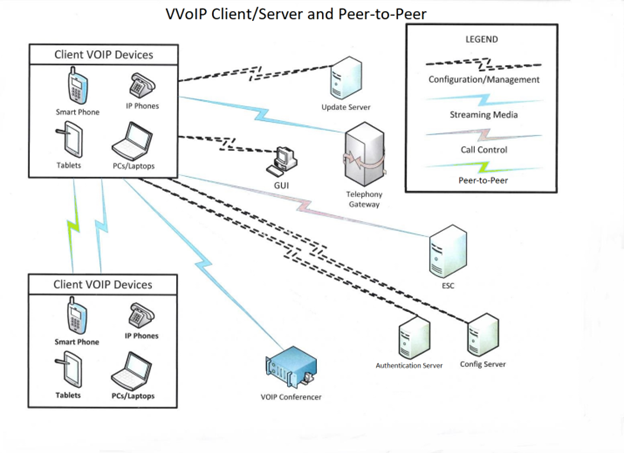
environment. The figure below shows a typical VVoIP infrastructure from the perspective of the TOE.
Many of the environmental components have direct connections between one another, but since these
are not visible to the TOE, these connections have not been depicted.
The TOE uses a VVoIP call control server, either by connecting to an ESC or acting as one itself when using
P2P, in order to set up connections with other VVoIP endpoint devices or other telephony equipment such
as a conference bridge. The call control server also may have the ability to deliver software/firmware
updates to the TOE, but this can alternatively be performed by a file server. The TOE must be able to
process Internet Protocol version 4 (IPv4) and/or IPv6 packets.
To be able to initiate communications in a client-server architecture, the TOE needs at minimum an IP
address, network mask, gateway address, configuration server address, update server address (or may
rely on platform for updates if it is a software application configured to do so), and call control server
address. The address may be obtained by Dynamic Host Configuration Protocol (DHCP), manually entered
on the VVoIP endpoint, or inherited from the device the TOE resides on (if it is a software application);
addresses can belong to the same device if it performs multiple functions (such as an ESC which also
performs updates). The TOE should allow basic telephony functions. Once the IP addresses are obtained,
the TOE downloads any VVoIP application updates, downloads VVoIP endpoint configuration, and
connects to the call control server as a VVoIP client. When a call is finished or the line is otherwise not in
use, the TOE will ensure that streaming media communication paths/ports are closed while call control
remains open.
To be able to initiate communications in P2P, the TOE needs at minimum an IP address, network mask,
gateway address, and update server address (or may rely on platform for updates if it is a software
application configured to do so). The address may be obtained by DHCP, manually entered on the VVoIP
endpoint, or inherited from the device the TOE resides on (if it is a software application). The TOE should
allow basic telephony functions. Once the IP addresses are obtained, the TOE downloads any VVoIP application updates. The endpoint configuration for P2PTOE of telephony functions is local. When the
TOE initiates a call, the TOE connects to the other peer’s call control (which is active) and the TOE is a
client. When the TOE receives a call, the other peer acts as a client and connects to the TOE’s call control.
When a call is finished or the line is otherwise not in use, the TOE will ensure that streaming media
communication paths/ports are closed while call control remains open.
The TOE has three paths for three different functions that need to execute: streaming media path that
contains voice, video, and session control (endpoint to endpoint); call control path to control the endpoint
(endpoint to VVoIP call control server), and configuration/management path to configure and manage the
TOE (software/firmware updates, configuration updates, audit).
1.4 Use Cases
This PP-Module defines four potential use cases for the VVoIPTOE, defined below. The first two use cases
define the physical embodiment of the TOE, while the latter two define its role in a telecommunications
deployment.
Regardless of the physical embodiment of the TOE, the expected functional capabilities are similar.
However, when the TOE is deployed in a peer-to-peer architecture, it must perform auditing and call
control functions that a client-server TOE does not need to perform because the Enterprise Session
Controller provides those functions in that architecture. A client-server TOE may also perform its own
auditing, but it is not required.
[USE CASE 1] Dedicated Appliance
The VVoIP endpoint is sold and packaged as a standalone network appliance that does not have
a direct interface to the underlying platform operating system. In this use case, conformance to
the NDcPP and this PP-Module is sufficient to ensure security. Note that the NDcPP defines
optional functionality for “distributed TOEs” – for a TOE to conform to this PP-Module, it must be
a single device and not a distributed TOE.
[USE CASE 2] Software Application
The VVoIP endpoint is sold and packaged as an application that is installed on a general-purpose
computer or mobile device running a modifiable operating system (such as Windows or Linux).
This computer may run end user applications above and beyond those used for VVoIP
communications since it functions as a user workstation. In this case, the VVoIP endpoint
application is expected to conform to both this PP-Module and the App PP.
[USE CASE 3] Client-Server Architecture
The VVoIP endpoint, whether hardware or software, is deployed in an environment where it
interacts with an Enterprise Session Controller to facilitate call control functions.
[USE CASE 4] Peer-to-Peer Architecture
The VVoIP endpoint, whether hardware or software, is deployed in an environment where it
interacts directly with other VVoIP endpoints without the use of an Enterprise Session Controller
as an intermediary.
1.5 Package Usage
This section contains selections and assignments that are required when the listed Functional Packages are claimed by this PP-Module.
Package Usage guidance defined in the TOE's relevant Base-PP applies to the usage of the packages for this module, unless explicitly stated otherwise in this section.
Functional Package for X.509, Version 1.0
Certificate Verification and Assertion Required in FIA_XCU_EXT.1.1Because this PP-Module mandates support for mutual authentication for media channels, the ST author shall select the options to both verify and assert certificate identities in FIA_XCU_EXT.1.1.
Limitations on Signature Algorithms in FIA_X509_EXT.1.1The TOE must utilize appropriate cryptographic algorithms that conform to CNSA standards. Thus, the TOE shall utilize no other algorithms outside of those specified in RFC 8603 for certificate or CRL signatures.
Additionally, the TOE shall not use ECDSA with SHA-512 signatures for OCSP responses, and shall utilize no other algorithms for OCSP responses.
Required Extension Processing for FIA_X509_EXT.1.2The ST author shall select the options to process the basicConstraints and extendedKeyUsage extensions. Other extensions may be selected as appropriate without restriction.
CRL or OCSP-based Revocation Required for FIA_X509_EXT.1.3 The TOE must support revocation that only involves CRL or OCSP. Accordingly, the TOE shall select only from options involving CRL or OCSP in FIA_X509_EXT.1.3 (e.g., the selection to treat all certificates older than a given short timeframe is not an acceptable substitute or alternative for supporting CRL or OCSP).
Connections to CRL or OCSP Servers Required for FIA_X509_EXT.1.4Because the TOE is required to support CRL or OCSP, the TSF shall support an appropriate mechanism for obtaining revocation status information. In the case of CRL, the ST author shall claim that revocation status information is obtained via network connection to a CRL distribution point. In the case of OCSP, the ST author shall claim that revocation status information is obtained via network connection to an OCSP responder, via OCSP stapling, or via OCSP multi-stapling.
Restrictions on Acceptable Key Usage Values for FIA_X509_EXT.1.5The TOE will always support the use of extendedKeyUsage values to verify that X.509 certificates are used in accordance with their intended purpose. Accordingly, the ST author shall claim that the TOE supports the processing of extendedKeyUsage fields in the leaf certificate (as opposed to application of trust store context rules or passing the certification path or other supported context information to an external function) and shall select all values that are relevant to the claimed uses of X.509 in the ST. In particular, since the PP does not define any functions that require the use of S/MIME, the ST author shall not select this as an extendedKeyUsage value to be validated.
Requirements on Functions for FIA_X509_EXT.2.1The ST author shall additionally ensure that the selections and assignments in this requirement reflect the TOE's usage of X.509 certificate validation for TLS. Other assignments and selections may be made as applicable for other TOE functions.
Functional Package for Transport Layer Security (TLS), Version 2.1
DTLS or TLS Server and Client Functionality RequiredThe ST author shall select the option to utilize TLS as a client. The ST author shall additionally select the option to utilize DTLS as a client if support for DTLS is claimed in FTP_ITC.1.
DTLS or TLS Mutual Authentication RequiredThe ST shall select the option to support mutual authentication in FCS_TLSC_EXT.1 and FCS_TLSS_EXT.1, or FCS_DTLSC_EXT.1 and FCS_DTLSS_EXT.1, according with the protocol support claimed in FTP_ITC.1.
1.6 Implementation-Based Features
The following features of the TOE are implementation-based. A TOE is not required to implement these features to conform to this PP-Module, but if the feature is implemented, it is expected that associated implementation-based requirements are claimed as part of the TSF.
An ST must claim exact conformance
to this PP-Module.
The evaluation methods used for evaluating the TOE are a combination of the workunits
defined in [CEM] as well as the Evaluation Activities for ensuring that individual SFRs
and SARs have a sufficient level of supporting evidence in the Security Target and guidance
documentation and have been sufficiently tested by the laboratory as part of completing
ATE_IND.1. Any functional packages this PP claims similarly contain their own Evaluation
Activities that are used in this same manner.
CC Conformance Claims
This PP-Module is conformant to
Part 2 (extended)
and Part 3 (extended)
of Common Criteria CC:2022, Revision 1.
PP Claim
This PP-Module does not claim conformance to
any Protection Profile.
Network Device collaborative Protection Profile Version 4.0
Protection Profile for Application Software Version 2.0
Package Claim
This PP-Module is
Functional Package for TLS, version 2.0 conformant.
This PP-Module does not conform to any
assurance packages.
The functional packages to which the PP conforms may include SFRs that are not mandatory
to claim for the sake of conformance. An ST that claims one or more of these functional
packages may include any non-mandatory SFRs that are appropriate to claim based on the
capabilities of the TSF and on any triggers for their inclusion based inherently on the SFR
selections made.
3 Security Problem Definition
The security problem is described in terms of the threats that the TOE is expected to address, assumptions
about its operational environment, and any organizational security policies that the TOE is expected to
enforce.
3.1 Threats
The following threats defined in this PP-Module extend the threats defined by the Base-PP.
T.MEDIA_DISCLOSURE
An attacker can use the encrypted variable rate vocoder frames to their advantage to decode
transmitted data. An attacker can also use improperly protected data to discern sensitive information.
T.UNDETECTED_TRANSMISSION
An attacker may cause the TOE to exfiltrate audio or video media over a remote channel while in a
state where the user has a reasonable expectation that no media is being transmitted.
3.2 Assumptions
These assumptions are made on the Operational Environment (OE) in order to be able to ensure that the
security functionality specified in the PP-Module can be provided by the TOE.
If the TOE is placed in an OE that does not meet these assumptions, the TOE may no longer be able to
provide all of its security functionality.
The following assumptions that are defined in this PP-Module extend the assumptions that are defined
by the Base-PPs.
A.UPDATE_SOURCE
It is assumed that TOE software/firmware updates will be made available on either the call control
server that the TOE connects to or a separate file server managed by the organization.
Note that because this PP-Module specifically disallows distributed TOEs, a conformant TOE will not claim
A.COMPONENTS_RUNNING when NDcPP is the Base-PP.
3.3 Organizational Security Policies
This PP defines no Organizational Security Policies beyond those defined in the claimed Base-PP(s).
4 Security Objectives
4.1 Security Objectives for the Operational Environment
The following environmental security objectives that are defined in this PP-Module extend the objectives
that are defined by the Base-PPs.
OE.UPDATE_SOURCE
The operational environment will have TOE software/firmware made available on either the call
control server that the TOE connects to or a separate file server managed by the organization.
Note that because this PP-Module specifically disallows distributed TOEs, a conformant TOE will not claim
OE.COMPONENTS_RUNNING when NDcPP is the Base-PP.
4.2 Security Objectives Rationale
This section describes how the assumptions and organizational
security policies map to operational environment security objectives.
The objective satisfies the assumption
by ensuring that TOE updates are
made available in the intended location.
5 Security Requirements
This chapter describes the security requirements which have to be fulfilled by the product under evaluation.
Those requirements comprise functional components from Part 2 and assurance components from Part 3 of
[CC].
The following conventions are used for the completion of operations:
Refinement operation (denoted by bold text or strikethrough
text): Is used to add details to a requirement or to remove part of the requirement that is made irrelevant
through the completion of another operation, and thus further restricts a requirement.
Selection (denoted by italicized text): Is used to select one or more options
provided by the [CC] in stating a requirement.
Assignment operation (denoted by italicized text): Is used to assign a
specific value to an unspecified parameter, such as the length of a password. Showing the
value in square brackets indicates assignment.
Iteration operation: Is indicated by appending the SFR name with a slash and unique identifier
suggesting the purpose of the operation, e.g. "/EXAMPLE1."
5.1 Collaborative
Protection Profile for Network Devices
Security Functional Requirements Direction
In a PP-Configuration that includes the NDcPP, the VVoIP client is expected to rely on some of the security
functions implemented by the network device as a whole and evaluated against the NDcPP. In this case,
the following sections describe any modifications that the ST author must make to the SFRs defined in the
NDcPP in addition to what is mandated by section 5.3.
5.1.1 Modified SFRs
The SFRs listed in this section are defined in the NDcPP and relevant to the secure operation of the TOE.
5.1.1.1 Class FAU: Security Audit
FAU_STG_EXT.1: Protected Audit Event Storage
This SFR is modified to prohibit the selection of distributed TOE options. Any element not specified in this section is unchanged from its definition in the Base-PP.
The text of FAU_STG_EXT.1.2 is replaced with:
FAU_STG_EXT.1.2
The TSF shall be able to store generated audit data on the TOE
itself. In addition,
[The TOE shall consist of a single standalone component that stores audit
data locally].
Application Note:
This PP-Module modifies the existing FAU_STG_EXT.1 SFR in the NDcPP to prohibit
the selection of any “distributed TOE” behavior in FAU_STG_EXT.1.2. The SFR is
otherwise unchanged.
5.1.1.2 Class FCS: Cryptographic Support
FCS_NTP_EXT.1: NTP Protocol
This SFR is selection-based in the NDcPP and remains selection-based in this PP-Module. However, an
additional trigger for this SFR’s inclusion is added for the selection of “register the TOE to an ESC…” in
FMT_SMF.1/VVoIP if the TOE is a hardware device. This is because any hardware-based VVoIPTOE that can be registered to an ESC is required to use the ESC as an NTP time source.
If the TOE is not registered to an ESC, it is not relevant to this PP-Module whether or not NTP is
implemented, and in this case this SFR remains selection-based on FPT_STM_EXT.1.2, which is not
modified by this PP-Module (i.e. a peer-to-peer TOE does not register to an ESC but may still receive time
data from a separate NTP source).
5.1.1.3 Class FPT: Protection of the TSF
FPT_TUD_EXT.1: Trusted Update
This PP-Module does not modify this SFR as it is defined in the NDcPP. However, note that this PP-Module
expects that either the call control server or a separate file server managed by the organization to function
as the source of TOE software/firmware updates. The evaluator shall ensure that the test environment is
configured appropriately.
Evaluation Activities:
There is no change to the EAs specified for this SFR in the NDcPP Supporting Document. Note however
that the following additional configuration steps are necessary in order for this testing to be performed:
The evaluator shall deploy a call control server or dedicated file server in the TOE’s operational environment
The evaluator shall load valid and invalid candidate updates to the call control server or dedicated file server
The evaluator shall configure the TOE to use the call control server or dedicated file server as its
source for software/firmware updates
5.1.1.4 Class FTP: Trusted Path
FTP_ITC.1: Inter-TSF Trusted Channel
This SFR is modified to mandate the inclusion of TLS. Any other protocols may additionally be claimed.
Any element that is not included in this section is unchanged from its definition in the Base-PP.
The text of the requirement is replaced with:
FTP_ITC.1.1
The TSF shall be capable of using
TLS as defined in the Functional Package for TLS and
[selection:
IPsec, SSH as defined in the Functional Package for SSH, DTLS
as defined in the Functional Package for TLS, HTTPS,
no other protocols]
to provide a trusted communication channel between itself and authorized IT entities supporting the following capabilities: audit server,
streaming media channel, call control channel, software/firmware update delivery channel,
[selection:
authentication server,
[assignment:
other capabilities], no other capabilities
] that is logically distinct from other communication channels and provides assured identification
of its end points and protection of the channel data from disclosure and detection of modification of the channel data.
Application Note:
The NDcPP provides the ability for the ST author to specify the protocols used to
establish trusted communications in FTP_ITC.1.1. This PP-Module mandates the inclusion of TLS because it is the underlying protocol used to secure
communications with the ESC and other VVoIP endpoints. Additional protocols
should be selected if they are used for securing other trusted channels. For
example, the TSF may communicate with an ESC using TLS for call control
functions but some other protocol for remote transmission of audit data. This PP-Module also specifies
additional uses for the trusted channel beyond what the NDcPP defines.
The remainder of the SFR is unchanged from its definition in the Base-PP.
5.2
Protection Profile for Application Software
Security Functional Requirements Direction
In a PP-Configuration that includes the App PP, the VVoIP client is expected to rely on some of the security
functions implemented by the software application as a whole and evaluated against the App PP. In this
case, the following sections describe any modifications that the ST author must make to the SFRs defined
in the App PP in addition to what is mandated by section 5.3.
5.2.1 Modified SFRs
The SFRs listed in this section are defined in the APP PP and relevant to the secure operation of the TOE.
5.2.1.1 Class FPT: Protection of the TSF
FPT_TUD_EXT.1: Trusted Update
This PP-Module does not modify this SFR as it is defined in the App PP. However, note that this PP-Module
expects that either the call control server or a separate file server managed by the organization to function
as the source of TOE software/firmware updates. A vendor provided source should only be used if a call control server
or separate file server cannot be configured.
Evaluation Activities:
There is no change to the EAs specified for this SFR in the App PP. Note however that the following
additional configuration steps may be necessary when relying on a call control server or dedicated file server in order for this testing to be performed:
The evaluator shall deploy a call control server or dedicated file server in the TOE’s operational environment
The evaluator shall load valid and invalid candidate updates to the call control server or dedicated file server
The evaluator shall configure the TOE or its operational environment (whichever is selected to implement the security functions)
to use the call control server or dedicated file server as its source for software/firmware updates.
5.2.1.2 Class FTP: Trusted Path/Channel
FTP_DIT_EXT.1: Protection of Data in Transit
This SFR is modified from its definition in the Base-PP to mandate the inclusion of TLS as a method to protect data
and to add support for the use of SRTP to protect data in transit.
The text of the requirement is replaced with:
FTP_DIT_EXT.1.1
The application shall [selection:
not transmit any [selection, choose one of: data, sensitive
data]
encrypt all transmitted [selection, choose one of:
sensitive data, data] with
TLS as a server as defined in the Functional Package for Transport Layer Security (TLS),
version 2.1 and also supports functionality for [selection:
mutual authentication, none]
and TLS as a client as defined in the Functional Package for Transport Layer Security (TLS), version 2.1
and
[selection:
HTTPS as a client in accordance with FCS_HTTPS_EXT.1 and FCS_HTTPS_EXT.2
HTTPS as a server in accordance with FCS_HTTPS_EXT.1
HTTPS as a server with support for mutual authentication in accordance with FCS_HTTPS_EXT.1
and FCS_HTTPS_EXT.2
DTLS as a server defined in the Functional Package for Transport Layer Security (TLS),
version 2.1 and also supports functionality for [selection:
mutual authentication,
none]
DTLS as a client defined in the Functional Package for Transport Layer Security (TLS), version 2.1
SSH as defined in the Functional Package for Secure Shell (SSH), version 2.0
IPsec as defined in the VPN Client PP-Module, version 3.0
] for [assignment:
function(s)] using certificates as defined in the Functional
Package for X.509
invoke platform-provided functionality to encrypt all transmitted sensitive data with
TLS and
[selection:
HTTPS, DTLS, SSH, IPsec] for [assignment:
function(s)]
using certificates as defined in the Functional Package for X.509
invoke platform-provided functionality to encrypt all transmitted data with
TLS and
[selection:
HTTPS, DTLS, SSH, IPsec] for [assignment:
function(s)]
using certificates as defined in the Functional Package for X.509
] between itself and another trusted IT product.
Application Note:
The App PP provides the ability for the ST author to specify the protocols used to
establish trusted communications and the behavior that trusted communications
are used to protect. This PP-Module mandates the inclusion of TLS because it is
the underlying protocol used to secure communications with a VVoIP call control
server and other VVoIP endpoints. Additional protocols may be selected if they are
used for securing other channels. For example, the TSF may communicate with an ESC using TLS for call control functions but some other protocol for remote
transmission of audit data.
Since the App PP does not define separate SFRs for trusted channel (TOE to trusted
third party) and trusted path (administrator to TOE), FTP_DIT_EXT.1 is expected
to cover both use cases. The proper protocols should be selected accordingly.
Sensitive data includes at minimum call control/signal data, media data, and
audit/management data.
The following section describes the SFRs that must be satisfied by any TOE that claims conformance to this PP-Module.
These SFRs must be claimed regardless of which PP-Configuration is used to define the TOE.
5.3.1 Auditable Events for Mandatory SFRs
Table 2: Auditable Events for Mandatory Requirements
The TSF shall transmit voice media using a constant bit rate voice vocoder.
Application
Note:
A constant bit rate vocoder provides a constant output length that does not have
the vulnerabilities that a variable bit rate vocoder contains when encrypted.
The evaluator shall verify that the TSS specifies each vocoder used. The evaluator shall then examine the
specification for each vocoder in order to verify that no variable rate vocoders are claimed by the TSF.
Guidance
There are no additional Guidance evaluation activities for this component.
Tests
The evaluator shall set up a test environment that contains the TOE, a call control server (which may be
the TOE itself), a network switch, a packet capture tool, and a second VVoIP endpoint.
The evaluator shall then perform the following test:
Step 1: The evaluator shall ensure the TOE and the second VVoIP endpoint are registered to a call
control server or are using P2P.
Step 2: .The evaluator shall use the TOE to dial the second VVoIP endpoint to establish a call and verify
the call is established by holding a voice conversation.
Step 3: The evaluator shall review the captured traffic to verify that a fixed rate vocoder is used.
If multiple vocoders are supported, the evaluator shall reconfigure the TOE to use each individual vocoder and repeat steps 1-3 for each vocoder.
The TSF shall enforce the [media transmission policy] based on the following
types of subject and information security attributes: [TOE hook state, VVoIP call
connection status, and VVoIP call control server status].
The TSF shall permit an information flow between a controlled subject and
controlled information via a controlled operation if the following rules hold: [
The TOE is [selection: registered with a VVoIP call control server, acting as a VVoIP call control server when using P2P],
A call has been established with a telephony device (VVoIP endpoint),
The TSF shall explicitly deny an information flow based on the following rules:
[all TCP and UDP ports used by the TOE are closed when not in active use].
The evaluator shall verify that the TSS describes the TOE’s enforcement of the media transmission policy
and describes the conditions that are necessary for the TSF to transmit voice/video data to the operational
environment.
Guidance
There are no additional Guidance evaluation activities for this component.
Tests
The evaluator shall set up a test environment that contains the TOE, a call control server (which may be
the TOE itself), a network switch, a traffic capture tool, and a second VVoIP endpoint.
The evaluator shall then perform the following tests:
Step 1: The evaluator shall place the TOE into the on-hook state without registering it to the call control
server or using P2P. The evaluator shall use the traffic capture tool to verify that the TOE does
not transmit any streaming media traffic.
Step 2: The evaluator shall place the TOE into the off-hook state and use the traffic capture tool to
verify that the TOE does not transmit any streaming media traffic.
Step 1: The evaluator shall execute the VVoIP application without registering it to the call control server
or using P2P. The evaluator shall use the traffic capture tool to verify that the TOE does not
transmit any streaming media traffic.
Step 2: The evaluator shall place the TOE into the off-hook state (e.g., by performing a call without
specifying any destination data). The evaluator shall use the traffic capture tool to verify that the
TOE does not transmit any streaming media traffic.
Step 1: The evaluator shall ensure the TOE is using P2P or register the TOE with the call control server
and verify that the TOE is registered by checking the call control server screen with current TOE
connections and by viewing the call control path traffic using the traffic capture tool.
Step 2: The evaluator shall place the TOE into the on-hook state and verify using the traffic capture tool
that no streaming media traffic is transmitted by the TOE.
Step 3: The evaluator shall place the TOE into the off-hook state. The evaluator shall then verify that the
TOE continues to not transmit streaming media traffic.
Step 1: The evaluator shall ensure the TOE is using P2P or shall register the TOE with the call control
server and verify that it is registered by checking the call control server with current connections
and using the traffic capture tool to verify the call control path traffic.
Step 2: The evaluator shall ensure the TOE is using P2P or shall register the second VVoIP endpoint with
the call control server and verify that it has been registered by checking the call control server
with current connections and using the traffic capture tool to verify the call control path traffic.
Step 3: The evaluator shall use the TOE to dial the second VVoIP endpoint and connect a call. The
evaluator shall verify that the connection is made by having a voice/video conversation with the
endpoint and using the traffic capture tool to verify that a steady stream of traffic is being
transmitted between the two endpoints over the media channel.
Step 4: The evaluator shall use the TOE to put the call on mute and verify that no traffic is transmitted
from the TOE over the media channel to the second VVoIP endpoint. If the TOE is registered to a
call control server, the evaluator shall also verify that a mute control message is sent to the call
control server and it responds.
Step 5: The evaluator shall use the TOE to take the call off mute and verify that the streaming media
traffic between the TOE and the second VVoIP endpoint is resumed.
Step 1: The evaluator shall ensure the TOE is using P2P or register the TOE to the call control server and
place it in the on-hook state.
Step 2: The evaluator shall use a fuzzing tool to attempt to connect to the TOE on the full range of TCP
ports used by the TSF. All ports used by the TOE should be closed except for the port that is used
to communicate with the ESC.
Step 1: The evaluator shall ensure the TOE and the second VVoIP endpoint are registered to a call
control server or are using P2P.
Step 2: The evaluator shall place the TOE in the on-hook state.
Step 3: The evaluator shall use a fuzzing tool to attempt to connect to the TOE on the full range of UDP
ports used by the TSF. All ports used by the TOE should be closed.
Step 4: The evaluator shall place a call to the second VVoIP endpoint and verify the call is established.
The evaluator shall capture the traffic to determine the port used by the TOE to carry the media
traffic.
Step 5: The evaluator shall hang up the call and verify that the TOE has returned to the on-hook state.
Step 6: The evaluator shall perform fuzzing activities to verify that the port used to carry media traffic in
step 4 has been closed.
Step 1: The evaluator shall use the TOE to put the call on hold and verify that no streaming media traffic
is transmitted from the TOE over the media channel. If the TOE is registered to a call control
server, the evaluator shall also verify that the VVoIP endpoint on-hold call control is sent to the
call control server and it responds.
Step 2: The evaluator shall use the TOE to take the call off hold and verify that the streaming media
traffic between the TOE and the second VVoIP endpoint is resumed.
5.3.4 Class FMT: Security Management
FMT_SMF.1/VVoIP Specification of Management Functions (VVoIP Communications)
Ability to specify the ports to be used for SRTP communications;
no other capabilities
]].
Application
Note:
This SFR defines additional management functions for the TOE beyond what is
defined in each of the supported Base-PPs as FMT_SMF.1. The TOE may have all
management functionality implemented in the same logical interface; it is not
necessary for the Base-PP management functions and the PP-Module’s
management functions to be implemented separately.
The audit-related sections are duplicates of those in the NDcPP’s definition of
FMT_SMF.1. If the VVoIP audit functionality is configurable separately from the
auditing for the device as a whole, the relevant selections should be made or
omitted in each iteration as needed.
If the TOE claims conformance to the NDcPP and “register the TOE to an ESC…” is
selected, the selection-based NDcPP SFR FCS_NTP_EXT.1 must additionally be claimed since
connectivity to an ESC implies that the TSF will use it as an NTP server.
In this case, the TOE does not need to implement two distinct time services for different
purposes. The same time service defined by FPT_STM_EXT.1 may be used here as well. Note
however, for this PP-Module, the TOE must use ESCs to which it is registered as its NTP time sources.
The evaluator shall verify that the TSS provides a description of the TOE initial configuration and describes
the ability of the TSF to manage the functions that are defined in the SFR, including how each function is
managed (e.g., manually configured, applied via downloaded configuration file).
Guidance
The evaluator shall verify that the operational guidance provides instructions on configuring any
functionality specifically related to VVoIP.
Tests
The evaluator shall perform the following tests, depending on the selections made:
Step 1: On the TOE, input IP address, gateway address, and subnet mask.
Step 2: If the operational environment is deployed in a manner such that the configuration server and
ESC are two distinct servers, input the addresses for each; otherwise, input the ESC address.
Test EAs to verify that the TOE can act as a VVoIP call control server when using P2P (if it is selected) are performed as part of testing for FDP_IFF.1/CALLCONTROL. Test EAs to verify the configuration of audit behavior are performed as part of testing for FAU_STG.1 and FAU_STG.5. Test EAs to verify the modification of transmission of audit data to an external IT entity are performed as part of testing for FAU_STG.1. Test EAs to verify that the idle call termination period can be specified are performed as part of testing for FTA_SSL.3/MEDIA, specifically Test 2 and Test 3. Test EAs to verify that the vocoder can be specified are performed as part of testing for FCO_VOC_EXT.1.
The TSF shall terminate
voice/video transmission
after [inactivity longer than
[selection: [assignment:
default number of seconds] seconds, an administrator-configurable interval]].
Application
Note:
This SFR is intended to mitigate the potential unauthorized disclosure of media
data in the case where connectivity with the peer is lost. The ST author should
choose one or both selections if applicable. Note that if “an administrator-configurable interval” is selected, the ST author must select “configure the
termination period for idle calls” in FMT_SMF.1.1/VVoIP.
The evaluator shall verify that the TSS specifies whether idle calls are terminated by default after a certain
amount of time or by an administrator-configurable interval.
Guidance
If the idle call timeout period is administrator-configurable, the evaluator shall verify that the operational
guidance includes instructions for how to configure this, as well as what the minimum and maximum
allowed values are.
Tests
The evaluator shall set up a test environment that contains the TOE, a call control server (which may be
the TOE itself), a configuration server (if used to communicate configuration changes to idle timeout
period), a network switch, a traffic capture tool, and a second VVoIP endpoint.
The evaluator shall then perform the following tests:
Step 1: Deploy the TOE in a default configuration (i.e. without any administrative override applied to
the idle timeout value).
Step 2: Ensure the TOE is using P2P or register the TOE with the call control server and verify that it is
registered by viewing its status on the ESC and capturing the call control path traffic.
Step 3: Ensure the second VVoIP endpoint is using P2P or register the second VVoIP endpoint with the
call control server and verify that it is registered by viewing its status on the call control server
and capturing the call control path traffic.
Step 4: Use the TOE to dial the second VVoIP endpoint and establish a call. Verify the call was
established by holding a conversation between the two peers and capturing the streaming
media traffic that is transmitted between them.
Step 5: Power down the second VVoIP endpoint while the call is active. Observe that the TOE stops
transmitting media after the default period of time specified in the ST.
Step 1: Deploy the TOE in a default configuration (i.e. without any administrative override applied to
the idle timeout value).
Step 2: Ensure the TOE is using P2P or register the TOE with the call control server and verify that it is
registered by viewing its status on the call control server and capturing the call control path
traffic.
Step 3: Configure the TOE’s idle timeout period for the shortest period of time that is supported.
Step 4: Ensure the second VVoIP endpoint is using P2P or register the second VVoIP endpoint with the
call control server and verify that it is registered by viewing its status on the call control server
and capturing the call control path traffic.
Step 5: Use the TOE to dial the second VVoIP endpoint and establish a call. Verify the call was
established by holding a conversation between the two peers and capturing the streaming
media traffic that is transmitted between them.
Step 6: Power down the second VVoIP endpoint while the call is active. Observe that the TOE stops
transmitting media after the period of time configured in Step 3.
Test FTA_SSL.3/MEDIA:3:
(Conditional - "an administrator-configurable interval" is selected in FTA_SSL.3.1/MEDIA) Repeat Test 2 but in Step 3, configure the idle timeout value to be the longest period of time that is supported as opposed to the shortest.
The TSF shall
be capable of using
[selection: Session Initiation Protocol (SIP), H.323]
to
provide a
trusted
communication channel between itself and
a VVoIP
call control server
that is logically distinct from other communication channels
and provides assured identification of its end points and protection of the channel
data from disclosure and detection of modification of the channel data.
Application
Note:
Both the SIP and H.323 protocols rely on TLS. This SFR defines the application layer
protocol used to secure call control functions.
The evaluator shall verify that the TSS describes the ability of the TOE to use SIP and/or H.323 with TLS.
Guidance
There are no additional Guidance evaluation activities for this component.
Tests
The vendor shall provide to the evaluator application layer configuration settings for all secure
communication mechanisms specified by the FTP_ITC.1/CONTROL requirement. This information should be
sufficiently detailed to allow the evaluator to determine the application layer timeout settings for each
cryptographic protocol. There is no expectation that this information must be recorded in any public-facing document or report.
The evaluator shall perform the following tests:
Test FTP_ITC.1/CONTROL:1:
The evaluators shall ensure that communications using each protocol with a call control server is tested during the course of the evaluation, setting up the connections as described in the guidance documentation and ensuring that communication is successful.
Test FTP_ITC.1/CONTROL:2:
For each protocol that the TOE can initiate as defined in the requirement, the evaluator shall follow the guidance documentation to ensure that in fact the communication channel can be initiated from the TOE.
Test FTP_ITC.1/CONTROL:3:
The evaluator shall ensure, for each communication channel with an authorized IT entity, the channel data is not sent in plaintext.
Objective: The objective of this test is to ensure that the TOE reacts appropriately to any
connection outage or interruption of the route to the external IT entities.
The evaluator shall, for a connection to a call control server using each claimed protocol, physically
interrupt the connection to the call control server for the following durations: i) a duration that exceeds
the TOE’s application layer timeout setting, ii) a duration shorter than the application layer timeout but
of sufficient length to interrupt the MAC layer.
The evaluator shall ensure that, when the physical connectivity is restored, communications are
appropriately protected and no TSF data is sent in plaintext.
In the case where the TOE is able to detect when the cable is removed from the device, another physical
network device (e.g., a core switch) shall be used to interrupt the connection between the TOE and the
call control server. The interruption shall not be performed at the virtual node (e.g., virtual switch) and
must be physical in nature.
Further EAs are associated with the specific protocols.
The TSF shall
be capable of using
[selection: SRTP, H.235/H.323]
to
provide a trusted communication channel between itself and
another VVoIP
endpoint or other telephony device
that is logically distinct from other communication channels
and provides assured identification of its end points and protection of the channel
data from disclosure and detection of modification of the channel data.
Application
Note:
This SFR defines the application layer protocol used to secure voice/video
transmissions once a call is established between another VVoIP endpoint or other
telephony device such as a call conference device.
The TSF shall initiate communication via the trusted channel for [transmission of voice/video media].
Application
Note:
The corresponding trusted media channel must be chosen to match the trusted
control channel: SIP – SRTP, H.323 – H.235/H.323.
If “SRTP” is selected in FTP_ITC.1.1/Media, the selection-based SFRsFCS_COP.1/SRTP and FCS_SRTP_EXT.1 must be claimed.
The evaluator shall verify that the trusted channel will use SRTP or H.323/H.235 in accordance with the selections made in the SFR.
Guidance
There are no additional Guidance evaluation activities for this component.
Tests
The vendor shall provide to the evaluator application layer configuration settings for all secure
communication mechanisms specified by the FTP_ITC.1/MEDIA requirement. This information should be
sufficiently detailed to allow the evaluator to determine the application layer timeout settings for each
cryptographic protocol. There is no expectation that this information must be recorded in any public-facing document or report.
The evaluator shall perform the following tests:
Test FTP_ITC.1/MEDIA:1:
The evaluators shall ensure that communications using each protocol with another VVoIP endpoint is tested during the course of the evaluation, setting up the connections as described in the guidance documentation and ensuring that communication is successful.
Test FTP_ITC.1/MEDIA:2:
For each protocol that the TOE can initiate as defined in the requirement, the evaluator shall follow the guidance documentation to ensure that in fact the communication channel can be initiated from the TOE.
Test FTP_ITC.1/MEDIA:3:
The evaluator shall ensure, for each communication channel with an authorized IT entity, the channel data is not sent in plaintext.
Objective: The objective of this test is to ensure that the TOE reacts appropriately to any
connection outage or interruption of the route to the external IT entities.
The evaluator shall, for a connection to another VVoIP endpoint device using each claimed protocol, physically
interrupt the connection to that remote endpoint for the following durations: i) a duration that exceeds
the TOE’s application layer timeout setting, ii) a duration shorter than the application layer timeout but
of sufficient length to interrupt the MAC layer.
The evaluator shall ensure that, when the physical connectivity is restored, communications are
appropriately protected and no TSF data is sent in plaintext.
In the case where the TOE is able to detect when the cable is removed from the device, another physical
network device (e.g., a core switch) shall be used to interrupt the connection between the TOE and the
call control server. The interruption shall not be performed at the virtual node (e.g., virtual switch) and
must be physical in nature.
Further EAs are associated with the specific protocols.
5.4 TOE Security Functional Requirements Rationale
The following rationale provides justification for each SFR for the TOE,
showing that the SFRs are suitable to address the specified threats:
Mitigates the threat by defining the use of a fixed-rate vocoder to prevent the exposure of encryption vulnerabilities that are present with variable-rate vocoders.
Mitigates the threat by defining a policy for protection of call control information in cases where the TOE can act as a VVoIP call control server in a peer-to-peer configuration.
Mitigates the threat by defining the implementation of the call control policy in cases where the TOE can act as a VVoIP call control server in a peer-to-peer configuration.
Mitigates the threat by defining how the TSF obtains system time in certain cases, which is then used as an input to other functions that support this objective.
Mitigates the threat by optionally allowing a client-server TOE to provide an audit trail of administrative actions, which could diagnose misconfiguration of the TOE that could lead to unattended transmissions.
Mitigates the threat by requiring a peer-to-peer TOE to provide an audit trail of administrative actions, which could diagnose misconfiguration of the TOE that could lead to unattended transmissions.
Mitigates the threat by requiring the TSF to specify how it obtains system time in certain cases, which is then used as an input to other functions that support this objective.
Mitigates the threat by requiring the TSF to terminate idle sessions.
6 Consistency Rationale
6.1 Collaborative
Protection Profile for Network Devices
6.1.1
Consistency of TOE Type
When this PP-Module is used to extend the NDcPP, the TOE type for the overall TOE is still a network
device. The TOE boundary is simply extended to include VVoIP endpoint functionality that is provided by
the network device.
6.1.2
Consistency of Security Problem Definition
The threats and assumptions defined by this PP-Module (see sections 3.1 and 3.2) supplement those
defined in the NDcPP as follows:
Table 4: Consistency of Security Problem Definition (NDcPP base)
The NDcPP defines a threat for untrusted communications channels. The
threat of media disclosure through vocoder frames is a type of side channel attack that is unique to the functions of a VVoIP endpoint.
However, it is consistent with the overall threat of unintended disclosure
of sensitive data.
The NDcPP defines threats for insecure communications and undetected
activity. Unauthorized and undetected use of a communications channel is
consistent with these threats.
The NDcPP does not have any assumptions for the source of TOE updates,
only that the updates have adequate integrity protections. There is no
conflict with this Module assuming that TOE updates will be retrieved
from a particular location.
6.1.3
Consistency of OE Objectives
The objectives for the TOE’s operational environment are consistent with the NDcPP based on the following rationale:
Table 5: Consistency of OE Objectives (NDcPP base)
The NDcPP requires the TOE to be able to apply software/firmware updates
but does not define any specific way that these updates need to be made
available. This PP-Module defines an objective that allows for an assumption
that TOE updates will be made available in a specific location.
A.UPDATE_SOURCE is consistent with the Base-PP objectives for the same
reason.
6.1.4
Consistency of Requirements
This PP-Module identifies several SFRs from the
NDcPP that are needed to support
VVoIP functionality.
This is considered to be consistent because the functionality provided by the
NDcPP is being used for its intended purpose.
The rationale for why this does not conflict with the claims
defined by the
NDcPP are as follows:
This SFR defines a policy for when data will or will not be transmitted by the
TSF. The NDcPP defines requirements for how data is transmitted but a
policy governing when an external interface may be invoked is beyond its
scope.
This SFR defines the rules for a policy for when data will or will not be
transmitted by the TSF. The NDcPP defines requirements for how data is
transmitted but a policy governing when an external interface may be
invoked is beyond its scope.
This PP-Module defines a new iteration of FMT_SMF.1 to add additional
management functions that relate specifically to VVoIP functionality. The
addition of these functions does not prevent any of the original functions
from being implemented. This iteration does include two duplicates of
management functions specified in the Base-PP; this is consistent because it
is possible that auditing is handled differently for the VVoIP functionality as
it is for the rest of the TOE’s auditing. These functions are also selectable so
it is not required that a conformant TOE implement this.
This SFR defines session termination behavior for the TOE’s media channel.
This interface is specific to this PP-Module and is not within the scope of the
NDcPP.
This SFR defines the trusted communications protocol used by the TOE’s
signaling channel, which is specific to the VVoIP technology and does not
conflict with the functionality defined in the NDcPP.
This SFR defines the trusted communications protocol used by the TOE’s
media channel, which is specific to the VVoIP technology and does not
conflict with the functionality defined in the NDcPP.
The NDcPP already defines an audit generation function. This PP-Module
adds redundant audit events for administrative actions (with respect to
those defined in the NDcPP) to be required for software-only TOEs. A TOE
that conforms to the NDcPP satisfies this SFR by default.
The NDcPP already defines an audit generation function. This PP-Module
adds an iteration of FAU_GEN.1 for the auditable events that relate
specifically to VVoIP endpoint behavior that may apply for client-server
TOEs.
This SFR is implementation-dependent and is explicitly not claimed when the
NDcPP is the Base-PP. Therefore there is no conflict between this SFR and
the NDcPP.
This SFR is implementation-dependent and is explicitly not claimed when the
NDcPP is the Base-PP. Therefore there is no conflict between this SFR and
the NDcPP.
The NDcPP already defines an audit generation function. This PP-Module
adds redundant audit events for administrative actions (with respect to
those defined in the NDcPP) to be required for software-only TOEs. A TOE
that conforms to the NDcPP satisfies this SFR by default.
The NDcPP already defines an audit generation function. This PP-Module
adds an iteration of FAU_GEN.1 for the auditable events that relate
specifically to VVoIP endpoint behavior that must apply for peer-to-peer
TOEs.
This SFR defines the AES functionality used to support SRTP. This does not
conflict with the NDcPP because the TOE can still use
FCS_COP.1/DataEncryption to make claims related to all other uses of AES.
This SFR defines support for the SRTP protocol, which is specific to VVoIP
technology. The TSF’s implementation of this protocol does not prevent the
enforcement of any NDcPP SFRs.
This SFR defines the TOE’s reliance on ESCs to act as its NTP servers in
deployments where the TOE is registered to them. It is duplicative of the
FPT_STM_EXT.1 SFR defined in the Base-PP but is refined to identify the use
of the ESC as a specific NTP server, which is a restriction not present in the
Base-PP.
6.2
Protection Profile for Application Software
6.2.1
Consistency of TOE Type
When this PP-Module is used to extend the App PP, the TOE type for the overall TOE is still a software
application. The TOE boundary is simply extended to include the VVoIP endpoint functionality that is
supported by the application.
6.2.2
Consistency of Security Problem Definition
The threats and assumptions defined by this PP-Module (see sections 3.1 and 3.2) supplement those
defined in the App PP as follows:
Table 7: Consistency of Security Problem Definition (APP PP base)
The App PP defines a threat for network eavesdropping. The threat of media
disclosure through vocoder frames is a type of side-channel attack that is
unique to the functions of a VVoIP endpoint. However, it is consistent with
the overall threat of unintended disclosure of sensitive data.
The App PP defines threats for network attack and network eavesdropping.
Unauthorized and undetected use of a communications channel is
consistent with these threats.
The App PP does not have any assumptions for the source of TOE updates,
only that the updates have adequate integrity protections. There is no
conflict with this Module assuming that TOE updates will be retrieved from a
particular location.
6.2.3
Consistency of OE Objectives
The objectives for the TOE’s operational environment are consistent with the App-PP based on the following rationale:
Table 8: Consistency of OE Objectives (APP PP base)
The App PP requires the TOE to be able to apply software/firmware updates
but does not define any specific way that these updates need to be made
available. This PP-Module defines an objective that allows for an assumption
that TOE updates will be made available in a specific location.
A.UPDATE_SOURCE is consistent with the Base-PP objectives for the same
reason.
6.2.4
Consistency of Requirements
This PP-Module identifies several SFRs from the
APP PP that are needed to support
VVoIP functionality.
This is considered to be consistent because the functionality provided by the
APP PP is being used for its intended purpose.
The PP-Module also identifies a number of modified SFRs from the
APP PP
that are used entirely to provide functionality for
VVoIP.
The rationale for why this does not conflict with the claims
defined by the
APP PP are as follows:
Table 9: Consistency of Requirements (APP PP base)
This PP-Module does not modify this SFR; it only specifies that the source of
TOE software/firmware updates must be a specific type of server.
FTP_DIT_EXT.1
This PP-Module modifies the App PPSFR by mandating the use of trusted
communications to secure transmitted data, mandating support for TLS, and
permitting support for SRTP. The first two modifications are derived from
selections that are already present in the App PP version of the SFR. The
addition of SRTP does not prevent any of the other protocols from being
used if supported.
This SFR defines a policy for when data will or will not be transmitted by the
TSF. The App PP defines requirements for how data is transmitted but a
policy governing when an external interface may be invoked is beyond its
scope.
This SFR defines the rules for a policy for when data will or will not be
transmitted by the TSF. The App PP defines requirements for how data is transmitted but a policy governing when an external interface may be
invoked is beyond its scope.
This PP-Module defines a new iteration of FMT_SMF.1 to add additional
management functions that relate specifically to VVoIP functionality. The
addition of these functions does not prevent any of the original functions
from being implemented. This iteration does include two duplicates of
management functions specified in the Base-PP; this is consistent because it
is possible that auditing is handled differently for the VVoIP functionality as
it is for the rest of the TOE’s auditing. These functions are also selectable so
it is not required that a conformant TOE implement this.
This SFR defines session termination behavior for the TOE’s media channel.
This interface is specific to this PP-Module and is not within the scope of the
App PP.
This SFR defines the trusted communications protocol used by the TOE’s
signaling channel, which is specific to the VVoIP technology and does not
conflict with the functionality defined in the App PP.
This SFR defines the trusted communications protocol used by the TOE’s
media channel, which is specific to the VVoIP technology and does not
conflict with the functionality defined in the App PP.
This PP-Module specifies an iteration of FAU_GEN.1 for the auditable events
that relate specifically to the administration of the VVoIP endpoint. The App
PP does not mandate that the TOE include an audit function but it is not
prohibited by the PP.
This PP-Module specifies an iteration of FAU_GEN.1 for the auditable events
that relate specifically to VVoIP endpoint behavior. The App PP does not
mandate that the TOE include an audit function but it is not prohibited by
the PP.
This SFR defines the ability of the TOE to protect, store, and transmit audit
data to a remote server using a secure channel. The App PP does not define
its own requirements for auditing but it does not prohibit audit functionality,
so this PP-Module’s inclusion of an audit function does not conflict with the PP.
This SFR defines the ability of the TOE to handle log space overruns in a defined manner.
The App PP does not define its own requirements for auditing but it does not prohibit audit functionality,
so this PP-Module’s inclusion of an audit function does not conflict with the PP.
This PP-Module specifies an iteration of FAU_GEN.1 for the auditable events
that relate specifically to the administration of the VVoIP endpoint. The App
PP does not mandate that the TOE include an audit function but it is not
prohibited by the PP.
This PP-Module specifies an iteration of FAU_GEN.1 for the auditable events
that relate specifically to VVoIP endpoint behavior. The App PP does not
mandate that the TOE include an audit function but it is not prohibited by
the PP.
This SFR defines the AES functionality used to support SRTP. This does not
conflict with the App PP because the TOE can still use
FCS_COP.1/DataEncryption to make claims related to all other uses of AES.
This SFR defines support for the SRTP protocol, which is specific to VVoIP
technology. The TSF’s implementation of this protocol does not prevent the
enforcement of any App PPSFRs.
This SFR defines the TOE’s reliance on ESCs to act as its NTP servers in
deployments where the TOE is registered to them. The App PP does not
define a specific method for how a conformant TOE is expected to receive
time data so there is no contradiction here.
Appendix A - Optional SFRs
A.1 Strictly Optional Requirements
A.1.1 Class FAU: Security Audit
FAU_GEN.1/CSADMIN Audit Data Generation (Client-Server Admin Events)
The
[selection: TSF, TOE platform]
shall be able to generate audit data of the following auditable events:
Start-up and shutdown of the audit functions;
All auditable events for the [selection, choose one of: minimum, basic, detailed, not specified] level of audit;
[All administrative actions comprising:
Administrative login and logout (name of user account shall be
logged if individual user accounts are required for
Administrators).
Changes to TSF data related to configuration changes (in
addition to the information that a change occurred it shall be
logged what has been changed).
Generating/import of, changing, or deleting of cryptographic
keys (in addition to the action itself a unique key name or key
reference shall be logged).
Resetting passwords (name of related user account shall be logged).
[selection: [assignment:
list of other uses of privileges], no other actions]
].
Application
Note:
This SFR defines the same auditable events as FAU_GEN.1/P2PADMIN in
Appendix B below. It is defined as a separate iteration because when the TOE
is deployed in a client-server architecture, the Enterprise Session Controller is
expected to be responsible for the relevant auditing, so this capability is
optional when the TOE is not peer-to-peer.
If the TOE claims this SFR and conforms to the App PP, the implementation-dependent SFRsFAU_STG.1 and FAU_STG.5 must also be claimed. This does not need to
be claimed when the TOE conforms to the NDcPP because that PP already
defines
FAU_STG.1
as a mandatory requirement.
The TSF shall record within the audit data at least the following information:
Date and time of the auditable event, type of event, subject identity (if applicable), and the outcome (success or failure) of the event;
For each auditable event type, based on the auditable event definitions of the functional components included
in the PP, PP-Module, functional package or ST, [no additional information].
There are no additional TSS evaluation activities for this component.
Guidance
The evaluator shall make a determination of the administrative actions related to TSF data related to
configuration changes. The evaluator shall examine the guidance documentation and make a
determination of which administrative commands, including subcommands, scripts, and configuration
files, are related to the configuration (including enabling or disabling) of the mechanisms implemented in
the TOE that are necessary to enforce the requirements specified in the PP-Module. The evaluator
shall document the methodology or approach taken to TSF data related to configuration changes. The
evaluator may perform this activity as part of the activities associated with ensuring that the
corresponding guidance documentation satisfies the requirements related to it.
Tests
For each administrative action identified in FAU_GEN.1.1/CSADMIN, the evaluator shall perform an action
either on the TOE or on the operational environment that causes the event to occur. The evaluator shall
verify in each case that an auditable event was generated in a format consistent with the guidance
documentation and that all audit record details specified in the SFR are present.
Note that the testing here can be accomplished in conjunction with the testing of the security mechanisms directly.
FAU_GEN.1/CSVVOIP Audit Data Generation (Client-Server VVoIP Events)
The TSF shall record within the audit data at least the following information:
Date and time of the auditable event, type of event, subject identity (if applicable), and the outcome (success or failure) of the event;
For each auditable event type, based on the auditable event definitions of the functional components included
in the PP, PP-Module, functional package or ST, [information specified in column three of the Auditable Events table
in which the event was defined].
Application
Note:
This SFR defines the same auditable events as FAU_GEN.1/P2P-VVoIP in
Appendix B below. It is defined as a separate iteration because when the
TOE is deployed in a client-server architecture, the Enterprise Session
Controller is expected to be responsible for the relevant auditing, so this
capability is optional when the TOE is not peer-to-peer.
If the TOE claims this SFR and conforms to the App PP, the
implementation-dependent SFRsFAU_STG.1 and FAU_STG.5 must also be claimed.
This does not need to be claimed when the TOE conforms to the NDcPP
because that PP already defines FAU_STG.1 as a mandatory
requirement.
There are no additional TSS evaluation activities for this component.
Guidance
The evaluator shall check the guidance documentation and ensure that it provides an example of each
auditable event required by the PP-Module (i.e. at least one instance of each auditable event – comprising
the mandatory, optional and selection-based SFR sections as applicable – shall be provided from the actual
audit record).
Tests
For each administrative action identified in the Auditable Events table in the PP-Module, the evaluator
shall perform an action on the TOE that causes the event to occur. The evaluator shall verify in each case
that an auditable event was generated in a format consistent with the guidance documentation and that
all audit record details specified in the SFR are present.
Note that the testing here can be accomplished in conjunction with the testing of the security mechanisms directly.
The TSF shall be able to store generated audit data on the [ [selection: TOE itself, TOE platform], transmit the generated audit data to [selection: an Enterprise Session Controller that the TOE is registered to, an external IT entity] using a trusted channel according to FTP_DIT_EXT.1.]
Application
Note:
This SFR is modified from its definition in [CC] Part 2 to define storage for audit data. Specifically, it is required that this data be stored both on the TOE itself
and that it be transmitted securely to an external entity. Note that this SFR is only applicable for software application TOEs that implement logging, because the NDcPP
specifies log data storage requirements itself. This SFR should not be claimed when the NDcPP is the Base-PP.
The evaluator shall examine the TSS to ensure it describes the means by which the audit data are
transferred to the external audit server, and how the trusted channel is provided.
The evaluator shall examine the TSS to ensure it describes the amount of audit data that are stored locally and
whether that data is stored by the TOE or through the TOE’s invocation of a platform auditing mechanism.
The evaluator shall examine the TSS to ensure that it details whether the transmission of audit information
to an external IT entity can be done in real-time or periodically. In case the TOE does not perform
transmission in real-time the evaluator needs to verify that the TSS provides details about what event
stimulates the transmission to be made as well as the possible acceptable frequency for the transfer of
audit data.
Guidance
The evaluator shall examine the guidance documentation to ensure it describes how to establish the
trusted channel to the audit server, as well as describe any requirements on the audit server (particular
audit server protocol, version of the protocol required, etc.), as well as configuration of the TOE needed
to communicate with the audit server.
The evaluator shall also examine the guidance documentation to determine that it describes the
relationship between the local audit data and the audit data that are sent to the audit log server. For
example, when an audit event is generated, is it simultaneously sent to the external server and the local
store, or is the local store used as a buffer and “cleared” periodically by sending the data to the audit
server.
Tests
Testing of the trusted channel mechanism for audit will be performed as specified in the associated EAs
for the particular trusted channel mechanism. The evaluator shall perform the following additional tests
for this requirement:
The evaluator shall establish a session between the TOE and the audit server according to the
configuration guidance provided. The evaluator shall then examine the traffic that passes between the
audit server and the TOE during several activities of the evaluator’s choice designed to generate audit
data to be transferred to the audit server. The evaluator shall observe that these data are not able to be
viewed in the clear during this transfer, and that they are successfully received by the audit server. The
evaluator shall record the particular software (name, version) used on the audit server during testing. The
evaluator shall verify that the TOE is capable of transferring audit data to an external audit server
automatically without administrator intervention.
If the ability to modify this behavior is configurable (e.g., if the TOE can be configured to transmit audit
data either to an ESC to which it is registered or to an external trusted IT entity that is not an ESC), the
evaluator shall repeat this test as necessary to show that changing the available configuration options will
result in the TOE performing the expected behavior in each case.
FAU_STG.5 Prevention of audit data loss
This component must be included in the ST if the TOE implements any of the following features:
The TSF shall [selection: ignore audited events, overwrite the oldest stored audit records, [assignment:
other actions to be taken in case of audit storage failure and conditions for the actions]] if the audit data storage is full.
Application
Note:
Note that this SFR is only applicable for software application TOEs that implement logging, because the NDcPP
specifies log data storage requirements itself. This SFR should not be claimed when the NDcPP is the Base-PP.
The evaluator shall examine the TSS to ensure it describes what happens when the local audit data store is full; and how these records are protected against
unauthorized access.
The evaluator shall examine the TSS to ensure that it details the behavior of the TOE when the storage
space for audit data is full. When the option ‘overwrite the oldest stored audit records’ is selected this description
should include an outline of the rule for overwriting audit data. If ‘other actions...’ are chosen such as
sending the new audit data to an external IT entity, then the related behavior of the TOE shall also be
detailed in the TSS.
Guidance
The evaluator shall ensure that the guidance documentation describes all possible configuration
options for FAU_STG.5 and the resulting behavior of the TOE for each possible configuration. The
description of possible configuration options and resulting behavior shall correspond to those described
in the TSS.
The evaluator shall perform operations that generate audit data and verify that this data is stored
locally. The evaluator shall perform operations that generate audit data until the local storage space is
exceeded and verifies that the TOE complies with the behavior defined in FAU_STG.5. Depending
on the configuration this means that the evaluator has to check the content of the audit data when the
audit data is just filled to the maximum and then verifies that:
The audit data remains unchanged with every new auditable event that should be tracked but
that the audit data is recorded again after the local storage for audit data is cleared (for the
option ‘ignore audited events’ in FAU_STG.5).
The oldest audit data is overwritten with every new auditable event that should be tracked
according to the specified rule (for the option ‘overwrite the oldest stored audit records’ in
FAU_STG.5).
The TOE behaves as specified (for the option ‘other action’ in FAU_STG.5).
If the behavior of the TOE when the local audit storage space is full is configurable, the evaluator shall
repeat this test for each configuration option and observe that the intended result occurs.
If the local storage location of the audit data is configurable, the evaluator shall repeat this test as needed
to demonstrate that specifying a new location for storage of audit data results in audit data being stored
to the desired location.
Appendix B - Selection-based Requirements
B.1 Class FAU: Security Audit
FAU_GEN.1/P2PADMIN Audit Data Generation (Peer-to-Peer Admin Events)
The inclusion of this selection-based component depends upon selection in:
The
[selection: TSF, TOE platform]
shall be able to generate audit data of the following auditable events:
Start-up and shutdown of the audit functions;
All auditable events for the [selection, choose one of: minimum, basic, detailed, not specified] level of audit;
[All administrative actions comprising:
Administrative login and logout (name of user account shall be
logged if individual user accounts are required for
Administrators).
Changes to TSF data related to configuration changes (in
addition to the information that a change occurred it shall be
logged what has been changed).
Generating/import of, changing, or deleting of cryptographic
keys (in addition to the action itself a unique key name or key
reference shall be logged).
Resetting passwords (name of related user account shall be logged).
[selection: [assignment:
list of other uses of privileges], no other actions]
The TSF shall record within the audit data at least the following information:
Date and time of the auditable event, type of event, subject identity (if applicable), and the outcome (success or failure) of the event;
For each auditable event type, based on the auditable event definitions of the functional components included
in the PP, PP-Module, functional package or ST, [no additional information].
Application
Note:
If the TOE is a hardware device and claims this SFR, this is inherently
satisfied through FAU_GEN.1 as defined by the NDcPP. Any other relevant
auditable events for the functionality described in the NDcPP is defined
there (the App PP does not include any auditing requirements).
If the TOE claims this SFR and conforms to the App PP, the
implementation-dependent SFRsFAU_STG.1 and FAU_STG.5 must also be claimed.
This does not need to be claimed when the TOE conforms to the NDcPP
because that PP already defines
FAU_STG.1
as a mandatory
requirement.
There are no additional TSS evaluation activities for this component.
Guidance
The evaluator shall make a determination of the administrative actions related to TSF data related to
configuration changes. The evaluator shall examine the guidance documentation and make a
determination of which administrative commands, including subcommands, scripts, and configuration
files, are related to the configuration (including enabling or disabling) of the mechanisms implemented in
the TOE that are necessary to enforce the requirements specified in the PP-Module. The evaluator
shall document the methodology or approach taken to TSF data related to configuration changes. The
evaluator may perform this activity as part of the activities associated with ensuring that the
corresponding guidance documentation satisfies the requirements related to it.
Tests
For each administrative action identified in FAU_GEN.1.1/P2PADMIN, the evaluator shall perform an action
either on the TOE or on the operational environment that causes the event to occur. The evaluator shall
verify in each case that an auditable event was generated in a format consistent with the guidance
documentation and that all audit record details specified in the SFR are present.
Note that the testing here can be accomplished in conjunction with the testing of the security mechanisms directly.
FAU_GEN.1/P2PVVOIP Audit Data Generation (Peer-to-Peer VVoIP Events)
The inclusion of this selection-based component depends upon selection in:
The TSF shall record within the audit data at least the following information:
Date and time of the auditable event, type of event, subject identity (if applicable), and the outcome (success or failure) of the event;
For each auditable event type, based on the auditable event definitions of the functional components included
in the PP, PP-Module, functional package or ST, [information specified in column three of the Auditable Events table
in which the event was defined].
Application
Note:
If the TOE claims this SFR and conforms to the App PP, the
implementation-dependent SFRsFAU_STG.1 and FAU_STG.5 must also be claimed.
This does not need to be claimed when the TOE conforms to the NDcPP
because that PP already defines
FAU_STG.1
as a mandatory
requirement.
There are no additional TSS evaluation activities for this component.
Guidance
The evaluator shall check the guidance documentation and ensure that it provides an example of each
auditable event required by the PP-Module (i.e. at least one instance of each auditable event – comprising
the mandatory, optional and selection-based SFR sections as applicable – shall be provided from the actual
audit record).
Tests
For each administrative action identified in the Auditable Events table in the PP-Module, the evaluator
shall perform an action on the TOE that causes the event to occur. The evaluator shall verify in each case
that an auditable event was generated in a format consistent with the guidance documentation and that
all audit record details specified in the SFR are present.
Note that the testing here can be accomplished in conjunction with the testing of the security mechanisms directly.
B.2 Class FCS: Cryptographic Support
FCS_COP.1/SRTP Cryptographic Operation (Encryption/Decryption for SRTP
The inclusion of this selection-based component depends upon selection in:
The TSF shall perform [encryption/decryption to support SDES-SRTP] in
accordance with a specified cryptographic algorithm [AES-GCM] and
cryptographic key sizes [256-bit] that meet the following: [NIST SP 800-38D].
Application
Note:
The NDcPP and App PP each define their own iteration of FCS_COP.1 for AES
encryption and decryption (FCS_COP.1/DataEncryption and FCS_COP.1/SKC,
respectively). The encryption and decryption used specifically for SRTP has been
broken out into a separate iteration for readability purposes; the same
cryptographic library that implements the AES algorithms claimed in the Base-PP
requirements can be used here. Note that GCM is a supported AES mode both in
this iteration and in the Base-PPs.
The evaluator shall examine the TSS to determine that it claims the use of GCM. The
evaluator shall verify that the TSS notes the GCM key sizes that the TOE supports for each use of GCM. If
GCM is supported for other uses, the evaluator shall ensure that the specific key sizes supported for each
use of GCM are identified.
Guidance
There are no additional Guidance evaluation activities for this component.
Tests
If the TOE claims the App PP as its Base-PP, the evaluator shall perform the AES-GCM test activities
identified for FCS_COP.1/SKC in the Base-PP.
If the TOE claims the NDcPP as its Base-PP, the evaluator shall perform the AES-GCM test activities
identified for FCS_COP.1/DataEncryption in the Base-PP.
FCS_SRTP_EXT.1 Secure Real-Time Transport Protocol
The inclusion of this selection-based component depends upon selection in:
The TSF shall implement the Secure Real-Time Transport Protocol (SRTP) that
complies with RFC 3711, and use Security Descriptions for Media Streams (SDES)
in compliance with RFC 4568 to provide key information for the SRTP connection.
The TSF shall implement SDES-SRTP supporting the following cipher suites: [AEAD_AES_256_GCM, in accordance with RFC 7714].
Application
Note:
This requirement specifies that the SRTP session that will be used to carry the
VVoIP traffic will be keyed according to an SDES dialogue using the
identified cipher suite.
The TSF shall allow the SRTP ports to be used for SRTP communications to be specified by an Authorized Administrator.
Application
Note:
This requirement specifies that the SRTP session that will be used to carry the VoIP traffic will be keyed according to an SDES dialog using the identified cipher suite.
The evaluator shall examine the TSS to verify that it describes how the SRTP session is negotiated for both
incoming and outgoing calls. This includes how the keying material is established, as well has how requests
to use the NULL algorithm or other unallowed cipher suites are rejected by the TSF.
Guidance
The evaluator shall examine the operational guidance to determine that it includes instructions for how
to disable the use of the SRTP NULL algorithm and how to specify the ports to be used for SRTP
communications.
Tests
The evaluator shall follow the procedure for initializing their device so that they are ready to receive and
place calls. The evaluator shall then both place and receive a call and
determine that the traffic sent and received by the TOE is encrypted using SRTP with the specified cipher suite.
The evaluator may choose one of the below two options to ensure that the call is being encrypted and to
view the cipher suite being used.
Option 1: The evaluator shall configure the SIP server to report whether SRTP is being used, and if so,
print the negotiated SRTP cipher suite. The evaluator shall confirm that SRTP was used for the calls
and that the correct cipher suite was negotiated.
Option 2: A packet capture tool should be used with the SIP server's private key loaded in. The
evaluator shall decrypt the TLS-SIP traffic, view the SDES negotiation, and ensure that the correct
cipher suite was negotiated.
Option 3: The evaluator shall inspect the VVoIP endpoint's audit or system log to ensure that the correct cipher suite was negotiated.
Next, the evaluator shall configure the SIP server to only allow the SRTP NULL cipher suite. The evaluator
shall attempt to both place and receive a call and confirm that both attempts failed.
B.3 Class FDP: User Data Protection
FDP_IFC.1/CALLCONTROL Subset Information Flow Control (for Call Control)
The inclusion of this selection-based component depends upon selection in:
The TSF shall enforce the [call control policy] based on the following types of subject and information security attributes:
[assignment:
method by which the TSF identifies each endpoint for a call]
using the following call control protocols: [selection: SIP, H.323].
Application
Note:
The ST author should complete the assignment with an endpoint
identifier (i.e. how the TSF identifies the endpoints each endpoint for a
call). For example, the endpoint could be identified by an IP address, a
phone number, or a username.
The TSF shall permit an information flow between a controlled subject
and controlled information via a controlled operation if the following rules hold:
[when valid communication with the TOE is attempted, the TSF will establish a connection
between itself and the peer].
Application
Note:
The validity of a call is determined by the protocol and the identifier of the endpoint.
The TSF shall explicitly authorize an information flow based on the following rules: [assignment:
rules based on security attributes that explicitly authorize information flows].
The TSF shall explicitly deny an information flow based on the following rules: [assignment:
rules based on security attributes that explicitly deny information flows].
The evaluator shall examine the TSS to verify that it describes the call control protocol(s) used by the TOE
and any explicit circumstances under which the TSF will and will not transmit call control data as defined
in FDP_IFF.1.4/CALLCONTROL and FDP_IFF.1.5/CALLCONTROL. The TSF should only transmit call control data
using the protocol(s) and method(s) of endpoint identification as indicated in FDP_IFC.1/CALLCONTROL or if
defined any explicit allow/deny rules in FDP_IFF.1.4/CALLCONTROL and FDP_IFF.1.5/CALLCONTROL.
Guidance
If any aspects of the TOE’s call control functionality are configurable (such as the specific call control
protocol used or the circumstances in which the TSF will or will not transmit call control data), the
evaluator shall examine the guidance documentation to verify that instructions for configuring this
behavior are provided.
Tests
The evaluator shall perform one or more of the following tests depending on the protocols that the TOE
claims to support.
Step 1: Ensure the TOE is configured to use P2P and act as a call control server using the SIP protocol.
Step 2: Use a traffic capture tool to capture call-signaling packets traversing the TOE.
Step 3: Place a call to the TOE from another VVoIP endpoint using the SIP call control protocol to the
TOE and observe via packet capture that the TSF established a connection between itself and the peer.
Step 4: Repeat step 3 with a call placed from the TOE to the other VVoIP endpoint.
Step 5: (Conditional - if the ST claims any additional rules in FDP_IFF.1.4/CALLCONTROL) Implement any rules
assigned in FDP_IFF.1.4 and verify that the specified authorized information flows occur.
Step 6: (Conditional - if the ST claims any additional rules in FDP_IFF.1.5/CALLCONTROL) Implement any rules
assigned in FDP_IFF.1.5 and verify that the specified information flows do not occur.
Step 7: Repeat steps 1-6 for each method of endpoint identification.
Step 1: Ensure the TOE is configured to use P2P and act as a call control server using the H.323 protocol.
Step 2: Use a traffic capture tool to capture call-signaling packets traversing the TOE.
Step 3: Place a call to the TOE from another VVoIP endpoint using the H.323 call control protocol to the
TOE and observe via packet capture that the TSF established a connection between itself and the peer.
Step 4: Repeat step 3 with a call placed from the TOE to the other VVoIP endpoint.
Step 5: (Conditional - if the ST claims any additional rules in FDP_IFF.1.4/CALLCONTROL) Implement any rules
assigned in FDP_IFF.1.4/CallControl and verify that the specified authorized information flows occur.
Step 6: (Conditional - if the ST claims any additional rules in FDP_IFF.1.5/CALLCONTROL) Implement any rules
assigned in FDP_IFF.1.5 and verify that the specified information flows do not occur.
Step 7: Repeat steps 1-6 for each method of endpoint identification.
B.4 Class FPT: Protection of the TSF
FPT_STM_EXT.1/VVoIP Reliable Time Stamps (VVoIP Communications)
The inclusion of this selection-based component depends upon selection in:
The TSF shall [synchronize time with [selection: an ESC, the TOE platform]].
Application
Note:
The selection made for this requirement depends on the TOE type. If the TOE is a hardware device, "an ESC" must be selected.
If the TOE is a software application, "the TOE platform" must be selected. If the TOE is a software VVoIP application, FMT_SMF.1.1/VVoIP is not required as the TOE relies upon the platform for time.
The evaluator shall examine the TSS to ensure that it lists each security function that makes use of time,
and that it provides a description of how the time is maintained and considered reliable in the context of
each of the time related functions.
If an ESC is selected in FPT_STM_EXT.1.1, the evaluator shall also verify that the TSS describes the ability of the TOE to support NTP synchronization with an ESC.
Guidance
The evaluator shall review the guidance to confirm that it provides instructions for how to synchronize the time. If
an ESC
is selected in FPT_STM_EXT.1.1,
this should include instructions on how to enable NTP synchronization with an ESC.
The evaluator shall use the guidance documentation to configure the NTP client on the TOE and set up a
communication path with the ESC. The evaluator will observe that the ESC has set the time to what is
expected.
Appendix C - Extended Component Definitions
This appendix contains the definitions for all extended requirements specified in the PP-Module.
C.1 Extended Components Table
All extended components specified in the PP-Module are listed in this table:
Table 10: Extended Component Definitions
Functional Class
Functional Components
Class FCO: Communications
FCO_VOC_EXT Fixed-Rate Vocoder
Class FCS: Cryptographic Support
FCS_SRTP_EXT Secure Real-Time Transport Protocol
C.2 Extended Component Definitions
C.2.1 Class FCO: Communications
This PP-Module defines the following extended components as part of the
class originally defined by CC Part 2:
C.2.1.1 FCO_VOC_EXT Fixed-Rate Vocoder
Family Behavior
Components in this family define the use of vocoders in audio transmission.
Component Leveling
FCO_VOC_EXT.1,
Fixed-Rate Vocoder,
requires the TSF to use a constant bit rate vocoder as opposed to a variable one.
Management: FCO_VOC_EXT.1
The following actions could be considered for the management functions in FMT:
Ability to specify the vocoder used
Audit: FCO_VOC_EXT.1
There are no auditable events foreseen.
FCO_VOC_EXT.1 Fixed-Rate Vocoder
Hierarchical to:
No other components.
Dependencies to:
No dependencies.
FCO_VOC_EXT.1.1
The TSF shall transmit voice media using a constant bit rate voice vocoder.
C.2.2 Class FCS: Cryptographic Support
This PP-Module defines the following extended components as part of the
class originally defined by CC Part 2:
C.2.2.1 FCS_SRTP_EXT Secure Real-Time Transport Protocol
Family Behavior
Components in this family define the implementation of the Secure Real-Time Transport Protocol (SRTP).
Component Leveling
FCS_SRTP_EXT.1,
Secure Real-Time Transport Protocol,
requires the TSF to implement SRTP and defines conditions on its use.
Management: FCS_SRTP_EXT.1
No specific management functions are identified.
Audit: FCS_SRTP_EXT.1
There are no auditable events foreseen.
FCS_SRTP_EXT.1 Secure Real-Time Transport Protocol
Hierarchical to:
No other components.
Dependencies to:
FCS_COP.1 Cryptographic Operation
FCS_SRTP_EXT.1.1
The TSF shall implement the Secure Real-Time Transport Protocol (SRTP) that
complies with RFC 3711, and use Security Descriptions for Media Streams (SDES)
in compliance with RFC 4568 to provide key information for the SRTP connection.
FCS_SRTP_EXT.1.2
The TSF shall implement SDES-SRTP supporting the following cipher suites: [assignment:
list of permitted SDES-SRTP cipher suites].
FCS_SRTP_EXT.1.3
The TSF shall ensure the SRTP NULL algorithm can be disabled.
FCS_SRTP_EXT.1.4
The TSF shall allow the SRTP ports to be used for SRTP communications to be specified by an Authorized Administrator.
Appendix D - Implicitly Satisfied Requirements
This appendix lists requirements that should be considered satisfied by products
successfully evaluated against this PP-Module. These requirements are not featured
explicitly as SFRs and should not be included in the ST. They are not included as
standalone SFRs because it would increase the time, cost, and complexity of evaluation.
This approach is permitted by [CC] Part 1, 8.3 Dependencies between components.
This information benefits systems engineering activities which call for inclusion of particular
security controls. Evaluation against the PP-Module provides evidence that these controls are present
and have been evaluated.
This appendix lists requirements that should be considered satisfied by products successfully evaluated
against this PP-Module. However, these requirements are not featured explicitly as SFRs and should not
be included in the ST. They are not included as standalone SFRs because it would increase the time, cost,
and complexity of evaluation. This approach is permitted by [CC] Part 1, 8.2 Dependencies between
components.
This information benefits systems engineering activities which call for inclusion of particular security
controls. Evaluation against the PP-Module provides evidence that these controls are present and have
been evaluated.
Requirement
Rationale for Satisfaction
FAU_GEN.2 – User identity association
The iterations of FAU_GEN.1.2 explicitly requires that the OS
record any user account associated with each event; therefore,
it is duplicative to include a separate requirement to associate a
user account with each event.
If the TOE claims conformance to the NDcPP, the dependency is
explicitly met through FAU_GEN.2.
FIA_UID.1 – Timing of Identification
For the purpose of logging and processing VVoIP telephony
functions, the TOE is identified solely by underlying system or
configuration characteristics (e.g., IP address, phone number)
independent of the identity of the user interacting with the
TOE.
When the TOE is a software application, neither this PP-Module
nor the Base-PP (App PP) define a separate identification and
authentication mechanism for the software application to
interact with its management interface. The software
application assumes that accessing the OS platform itself is
sufficient to grant access to the application. For accountability
purposes, the user of the TOE is identified as the user that
logged in to the OS platform and subsequently interacted with
the TSF.
FMT_MSA.1 – Management of Security Attributes
This SFR defines the TOE security attributes that can be
managed and what management role can administer them.
Specifically, this is indirectly dependent on FDP_IFF.1. The PP-Module defines two iterations of FDP_IFF.1. Each of these
iterations define explicit rules that determine when the TSF
transmits call control and media data.
The relevant attributes are either directly under the control of
an ordinary user, such that no specific security authorization is
needed, or they are entirely under the control of the TSF and
cannot be influenced by the user regardless of privilege. An
example of the first case in that in FDP_IFF.1.2, whether or not
the TOE is in the off-hook state or the mute state is
controllable by a user with physical access to the TOE and does
not require the assumption of an administrative role. An
example of the second case is in FDP_IFF.1.2/CallControl,
where the TSF will determine if the other end of the
connection is a valid VVoIP endpoint, which is something the
user has no ability to configure or influence.
FMT_MSA.3 – Static Attribute Initialization
This SFR is a dependency on FDP_IFF.1. The PP-Module defines
two iterations of FDP_IFF.1. Each of these iterations define
explicit rules that determine when the TSF transmits call
control and media data. FMT_MSA.3 has not been specified
because the default state of the attributes used to determine if
data flow is authorized is not relevant to enforcement of the
rules.
For example, FDP_IFF.1.2 states that the TSF will not transmit
media data within a call if the TOE is in the mute state.
Whether the call starts with the mute state active or inactive
does not affect the enforcement of the rule, and requiring the
ST to state this information does not affect the security of the
TSF.
FMT_SMR.1 – Security Roles
When the TOE is a software application, neither this PP-Module
nor the Base-PP (App PP) define security roles that are
authorized to perform management functionality on the TSF.
For user access, the TOE does not require separate
authentication to the TSF because authentication to the OS
platform on which the TOE is installed is sufficient user access
control; a user logged in to the OS platform is assumed to be a
valid user of the TOE.
If the TOE is registered to an ESC, the ESC may be able to issue
management commands to the TOE. No separate ‘user role’ is
needed to define this because the ESC is not a ‘user’ and so
FMT_SMR.1.2 is not applicable in this context. The ESC’s
authorization to manage the TSF is implicitly granted through
the user registering the TOE to the ESC.
FPT_STM.1 – Reliable time stamps
The iterations of FAU_GEN.1.2 explicitly requires that the
software application TSF associate timestamps with audit
records; therefore it is duplicative to include a separate
timestamp requirement. Additionally, the App PP has an
assumption of relying upon a trustworthy computing platform
with a reliable time clock for its execution, so the dependency is
also met through the assumption.
Alternatively, if the TOE is registered to an ESC, the selection-based requirement FPT_STM_EXT.1/VVoIP must be claimed,
which is sufficient to address the dependency as the TSF will
receive time data from the operational environment that is
assumed to be reliable.
If the TOE claims conformance to the NDcPP, the dependency is
also explicitly met through FPT_STM_EXT.1, regardless of whether the TOE is deployed in a client-server configuration
(with registration to an ESC) or peer-to-peer configuration (with
no ESC involved).
Appendix E - Entropy Documentation and Assessment
The TOE does not require any additional supplementary information to describe its entropy sources
beyond the requirements outlined in the Base-PPs. As with other Base-PP requirements, the only
additional requirement is that the entropy documentation also applies to the specific VVoIP capabilities
of the TOE that require random data, in addition to any functionality required by the claimed Base-PP.