Comment: Comment-1-
Comment: Comment-2-
Comment: Comment-3-
Comment: Comment-4-
Comment: Comment-5-
Comment: Comment-6-
Comment: Comment-7-
Comment: Comment-8-

PP-Module for Software Defined Networking Controllers

NIAP Logo
Version: 1.0
2024-10-31
National Information Assurance Partnership

Revision History

VersionDateComment
1.02024-10-31First draft of version 1.0 for comment

Contents

1Introduction1.1Overview1.2Terms1.2.1Common Criteria Terms1.2.2Technical Terms1.3Compliant Targets of Evaluation1.3.1TOE Boundary1.4Use Cases2Conformance Claims3Security Problem Definition3.1Threats3.2Assumptions3.3Organizational Security Policies4Security Objectives4.1Security Objectives for the Operational Environment5Security Requirements5.1Collaborative Protection Profile for Network Devices Security Functional Requirements Direction 5.1.1 Modified SFRs 5.1.1.1Trusted Path/Channels (FTP)5.2TOE Security Functional Requirements5.2.1Security Audit (FAU)5.2.2User Data Protection (FDP)5.2.3Security Management (FMT)5.3TOE Security Functional Requirements Rationale6Consistency Rationale6.1Collaborative Protection Profile for Network Devices6.1.1 Consistency of TOE Type 6.1.2 Consistency of Security Problem Definition 6.1.3 Consistency of OE Objectives 6.1.4 Consistency of Requirements Appendix A - Optional SFRsA.1Strictly Optional Requirements A.2Objective Requirements A.3Implementation-dependent Requirements Appendix B - Selection-based Requirements Appendix C - Entropy Documentation and AssessmentC.1Design DescriptionC.2Entropy JustificationC.3Operating ConditionsC.4Health TestingAppendix D - BibliographyAppendix E - AcronymsAppendix F - Bibliography

1 Introduction

1.1 Overview

The scope of this Protection Profile Module (PP-Module) is to describe the security functionality of a software defined network (SDN) controller in terms of [CC] and to define functional and assurance requirements for such products. An SDN Controller is a central component of an SDN system and is available as a logical or a physical device. An SDN Controller manages and distributes network policies, collects network routing and payload information from the control and data planes, and interfaces with user applications in the management plane for functions such as configuration and logging. Each of the planes in an SDN system is composed of multiple logical or physical components. The SDN Controller logically separates the data plane from the control plane and centralizes control which enhances network flexibility and scalability through more efficient network management. This PP-Module is intended for use with the following Base-PP: This Base-PP is valid because an SDN controller is a specific implementation of a network device. Specifically, an SDN controller is one of many components of an SDN networking architecture. Specifically, an SDN controller manages and distributes network policies, collects routing and payload information from the data plane, and interfaces with user applications in the management plane. Each of the planes in an SDN system is composed of multiple logical or physical components. SDN controllers logically centralize the network intelligence and state in the control plane.

1.3 Compliant Targets of Evaluation

A conformant TOE decouples its data and control planes such that data traffic and control traffic are restricted to their respective planes. It also enforces centralization of control so that all components of the SDN environment are under its control. This can expand across multiple distributed controllers for large, complex, or geographically dispersed networks. Compliant TOEs will implement necessary functionality in a "do no harm" manner with respect to network security. Specifically:

1.3.1 TOE Boundary

The TOE boundary for an SDN controller is one or more physical or virtual devices. An SDN controller may be a distributed TOE, as defined by the Base-PP.

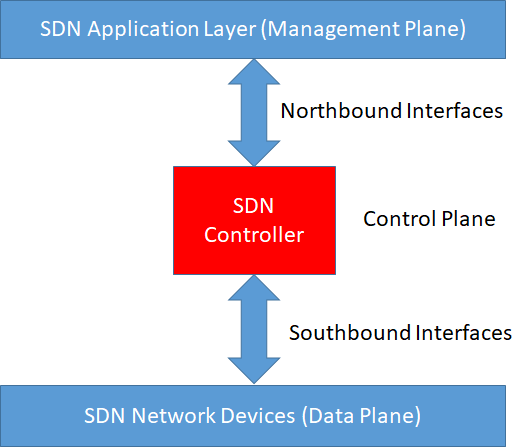
The following figure shows the SDN controller sitting between the management and data planes within the SDN infrastructure. This is a simplified diagram of the TOE's position in an SDN deployment. Other dependencies that are necessary to meet security requirements, such as an audit server, remote management interface, or source of certificate revocation information are not shown.


Figure 1: High-Level SDN Representation

The following elements of an SDN controller are outside the scope of this PP-Module and are therefore considered to be non-interfering with respect to security, even if they are included as part of a compliant product:

1.4 Use Cases

Requirements in this PP-Module are designed to address the security problems in at least the following use cases. These use cases are intentionally very broad, as many specific use cases exist for an SDN controller These use cases may also overlap with one another. An SDN controller's functionality may even be effectively extended by privileged applications installed on it. However, these are out of scope of this PP.
[USE CASE 1] Standalone Physical Device
The TOE is a single physical appliance that provides SDN controller functionality.
[USE CASE 2] Virtual Device
The TOE is a virtual machine that provides SDN controller functionality. The TOE boundary is either limited to the virtual machine or includes the hypervisor and underlying physical hardware, depending on whether or not the hypervisor may include virtual machines that are not part of the SDN controller.
[USE CASE 3] Cluster (stand-alone or virtual)
Regardless of whether the TOE is physical, virtual, or both, it includes multiple distinct instances that are combined into a distributed cluster.
[USE CASE 4] Hyper-Converge
The TOE amalgamates various computing resources into a single unit for storage-centric, server-centric, or hybrid (storage-server) workloads.

2 Conformance Claims

Conformance Statement

An ST must claim exact conformance to this PP-Module.

The evaluation methods used for evaluating the TOE are a combination of the workunits defined in [CEM] as well as the Evaluation Activities for ensuring that individual SFRs and SARs have a sufficient level of supporting evidence in the Security Target and guidance documentation and have been sufficiently tested by the laboratory as part of completing ATE_IND.1. Any functional packages this PP claims similarly contain their own Evaluation Activities that are used in this same manner.
CC Conformance Claims

This PP-Module is conformant to Part 2 (extended) and Part 3 (conformant) of Common Criteria CC:2022, Revision 1.
PP Claim

This PP claims conformance to the following Protection Profiles:

The following PPs and PP-Modules are allowed to be specified in a PP-Configuration with this PP-Module:
Package Claim

This PP-Module is not conformant to any Functional or Assurance Packages.

3 Security Problem Definition

The security problem is described in terms of the threats that the TOE is expected to address, assumptions about the operational environment, and any organizational security policies that the OS is expected to enforce.

3.1 Threats

T.INSECURE_API
Insecure application programming interfaces (APIs) and user interfaces can provide attackers with opportunities to inject malicious code to the TOE or to retrieve sensitive information from it. Executing improper or unauthorized API functions or providing malicious input to achieve unintended or improper results from proper or authorized API functions can compromise network services and sensitive data leakage can take place through insecure interfaces.

Recommendations above to adjust threat name for more specificity and clarify the description.
T.ATTACKER_ACCESS
An attacker may attempt to exploit services and functionality to intercept communications and mount attacks against machines in the network.

Threat kept as-is but this seems unnecessary. Unless there are SDN-specific threat cases (such as the API threat listed above), this just seems like an extension of threats already defined in the NDcPP, and it should be fine for module SFRs to map back to threats from the base PP.

3.2 Assumptions

All assumptions from the Base-PP also apply to the TOE’s environment when it includes this PP‐Module in its conformance claims. This document does not define any additional assumptions.

3.3 Organizational Security Policies

An organization deploying the TOE is expected to satisfy the organizational security policy listed below in addition to all organizational security policies defined by the claimed Base-PP.

This document does not define any additional OSPs.

4 Security Objectives

4.1 Security Objectives for the Operational Environment

All environmental security objectives from the Base-PP also apply to the TOE’s environment when it includes this PP‐Module in its conformance claims.

5 Security Requirements

This chapter describes the security requirements which have to be fulfilled by the product under evaluation. Those requirements comprise functional components from Part 2 and assurance components from Part 3 of [CC]. The following conventions are used for the completion of operations:

5.1 Collaborative Protection Profile for Network Devices Security Functional Requirements Direction

In a PP-Configuration that includes the NDcPP, the TOE is expected to rely on some of the security functions implemented by the Network Device as a whole and evaluated against the NDcPP. The following sections describe any modifications that the ST author must make to the SFRs defined in the NDcPP in addition to what is mandated by Section 5.2 TOE Security Functional Requirements.

5.1.1 Modified SFRs

The SFRs listed in this section are defined in the NDcPP and relevant to the secure operation of the TOE.

5.1.1.1 Trusted Path/Channels (FTP)

FTP_ITC.1: Inter-TSF Trusted Channel

This SFR has been modified from its definition in the NDcPP to define external interfaces to environmental entities that are particular to this specific technology type.

The text of the requirement is replaced with:

FTP_ITC.1.1 The TSF shall be capable of using [selection: IPsec, SSH, TLS, DTLS, HTTPS] to provide a trusted communication channel between itself and authorized IT entities supporting the following capabilities: audit server, northbound components, southbound components, [selection: authentication server, external east/west components [assignment: other capabilities], no other capabilities] that is logically distinct from other communication channels and provides assured identification of its end points and protection of the channel data from disclosure and detection of modification of the channel data.

FTP_ITC.1.2 The TSF shall permit [selection: the TSF, the authorized IT entities] to initiate communication via the trusted channel.

FTP_ITC.1.3 The TSF shall initiate communication via the trusted channel for [assignment: list of services for which the TSF is able to initiate communications].

Application Note: This PP-Module modifies this SFR to allow for the specification of any northbound, southbound, or east/west environmental components with which the TSF may implement protected communications. A conformant TOE may implement a distributed east/west configuration rather than the east/west entities being in the OE; in this case, the ST would define the TOE boundary as a distributed TOE in accordance with the NDcPP and use FPT_ITT.1 to define the interface between east/west distributed TOE components.

5.2 TOE Security Functional Requirements

The following section describes the SFRs that must be satisfied by any TOE that claims conformance to this PP-Module. These SFRs must be claimed regardless of which PP-Configuration is used to define the TOE.

5.2.1 Security Audit (FAU)

FAU_GEN.1/SDN Audit Data Generation (SDN)

The SDN controller must have maximum auditing and logging of all unauthorized API usage, especially API usage attempts from users that are not in the API roles.

This will be populated as needed by the audit events for other SFRs

The TSF shall implement functionality to generate audit data of the following SDN auditable events:
  1. Startup and shutdown of the audit functions;
  2. All auditable events for [not specified] level of audit;
  3. All unauthorized usage of all API endpoints, including create, read, update, and delete.
  4. All authorized usage of all API endpoints, including create, read, update, and delete.
  5. Full HTTP REST request parameters and values of any API requests sent to the SDNC controller API.
  6. All HTTP Response Codes returned from any HTTP API requests sent to the SDNC controller API.
  7. All error codes and error messages from usage of the API.
  8. [all auditable events for mandatory SFRs specified in Table t-audit-mandatory, selected SFRs in Table t-audit-sel-based].
The TSF shall record within the SDN audit data at least the following information:
  1. Date and time of the event, type of event, subject identity, (if relevant) the outcome (success or failure) of the event; and
  2. For each audit event type, based on the auditable event definitions of the functional components included in the PP-Module/ST, [Additional Audit Record Contents as specified in Table t-audit-mandatory, Table t-audit-sel-based].
Application Note:

This SFR mandates that audit data be generated for startup and shutdown of the audit functions, which is a duplicate of FAU_GEN.1.1 in the Base-PP. If the TOE has one single audit mechanism, then the events used to conform to the Base-PP requirement also suffice here. Startup and shutdown of the audit functions in the context of the SDN controller portion of the TOE only need to be logged separately if the SDN controller has a different logging mechanism from what the Base-PP uses. Note also that in many cases the startup and shutdown of the audit functions cannot be forced on its own because the audit functions may be operational by default. In this case, logging for startup and shutdown of the TOE itself is sufficient. The purpose of this part of the requirement is to ensure that a malicious user cannot disable auditing to evade detection of other malicious use of the TOE.

The auditable events for the 'not specified' level of audit is intended to communicate that this PP-Module does not claim one of the pre-defined audit levels specified in CC Part 2; this is inherently satisfied by demonstrating that the TSF generates appropriate audit data for all events that are explicitly required by the PP-Module.

>The evaluator shall verify that the TSS identifies the auditable events generated by the TOE, and that they include the auditable events specified in this SFR along with the required audit data. The evaluator shall also verify that the TSS identifies the mechanism used for generating audit events such that it can be determined whether the auditable events required by this PP-Module use the same audit mechanism as what the Base-PP requires for FAU_GEN.1 or whether there are alternate mechanisms that are used.

The requirement in the Base-PP to ensure that all auditable events can be transmitted to the operational environment via a secure channel is applicable to the entire TOE, even when PP-Modules are claimed. Therefore, if the TSF does have any audit mechanisms that are used specifically to generate audit records for this PP-Module's auditable events, the evaluator shall ensure that these mechanisms are discussed in the context of the Base-PP's requirements for protection of audit data in transit, and at rest if applicable.

Guidance
The evaluator shall verify that the operational guidance identifies the auditable events that are generated by the TOE in support of this SFR and includes representative audit records of each event to demonstrate the format of each record. The evaluator shall verify that each sample audit record includes the fields required for each auditable event per FAU_GEN.1.2/SDN.
Tests
For each auditable event, the evaluator shall perform actions that are intended to cause a record of the event to be generated and verify that this occurs and that the required fields are present and accurate. If the audit mechanism used to generate any event differs from the mechanism(s) claimed in the Base-PP for FAU_GEN.1, the evaluator shall also perform the associated test activities for other claimed FAU class requirements to verify that the audit data is transferred to an external entity over the claimed trusted channel and that if audit data is stored locally, that it has the appropriate data at rest protections applied.

5.2.2 User Data Protection (FDP)

FDP_ACC.1 Subset Access Control

The TSF shall enforce the [API access control policy] on [all APIs used to access the TSF].
The evaluator shall examine the TSS to verify that it defines the TOE's API access control policy in terms of subjects (the users, groups, or machine entities that interact with APIs), objects (the APIs used to access the TSF, operations (invocation, modification, or some other function that can be done against the object), and any attributes that may govern the enforcement of the policy. Operations may also include the ability to limit the scope of particular API access; for example, a user may be authorized to invoke an API to configure one segment of a network but may be prohibited from configuring a different one.
Guidance
The evaluator shall review the operational guidance to verify that it describes the TOE's API access control policy in terms of the subjects, objects, operations, and attributes specified in the ST, as well as which elements of this policy are enforced by default versus being configurable options. For any configurable elements of the API access control policy, the evaluator shall verify that the operational guidance describes how to perform this configuration.
Tests
There are no test activities for this component.

FDP_ACF.1 Security Attribute-Based Access Control

  1. API Validation: The SDN controller must perform validation of API calls against the API templates.
  2. API Validation: The SDN controller must block API calls that fail validation.
  3. API Validation: The SDN controller must ensure that API calls conform to the API templates, and block any API calls that do not conform.


The TSF shall enforce the [API access control policy] to objects based on the following: [supported operations that can be performed on or by API objects, the validity of the API call being issued, whether the API call is authorized based on the subject's role].
The TSF shall enforce the following rules to determine if an operation among controlled subjects and controlled objects is allowed: [an API call that is valid with respect to an allowlisted API template can manipulate an object if allowing this manipulation has been configured].
The TSF shall explicitly authorize access of subjects to objects based on the following additional rules: [an allowlist explicitly authorizes the API request].
Application Note: This does not explicitly assert that the request is valid with respect to the template, nor does it explicitly assert that the object being accessed can have the desired action performed on it.
The TSF shall explicitly deny access of subjects to objects based on the following additional rules: [assignment: rules, based on security attributes, that explicitly deny access of subjects to objects].
Application Note: The intent of this requirement is to give the ST author the ability to define a denylist that takes priority over the rules defined in FDP_ACF.1.2 and FDP_ACF.1.3. It may be the case that no explicit denylist is supported and the defined rules are followed in order with access being denied as a default condition if not otherwise specified by a rule. If this is the case, the ST author may complete the assignment with "no additional rules."
The evaluator shall verify that the TSS describes the TOE's API access control policy in sufficient detail to conclude, for each API, the operations that can be performed on or by the API, and the authorization required to perform those operations. If the TOE implements explicit allowlisting or denylisting to override any default or configurable policy rules, the evaluator shall verify that these are described. In cases where multiple contradictory rules exist to define authorizations, the evaluator shall verify that the TSS describes the precedence in which these rules are prioritized.
Guidance

For each API, the evaluator shall verify that the operational guidance identifies, for each API, the mechanism that exist to control access to that API, and how to perform such configuration. The evaluator shall also verify that the operational guidance defines any default policy rules that may exist. The evaluator shall also verify that the operational guidance describes the ordering of rule processing such that it is clear what behavior is followed in the event that multiple contradictory rules exist. If this is configurable (e.g. because rules are enforced in a configurable priority order), the evaluator shall verify that the operational guidance provides instructions on how to perform this configuration.

Additionally, the evaluator shall verify that each API is defined in terms of the operations that can be performed by or against them and the valid parameters for these operations.

Tests
The evaluator shall perform the following tests:
  • Test FDP_ACF.1:1: Default policy test: the evaluator shall review the operational guidance to determine what default policy rules (if any) are enforced by the TOE. For each such rule, the evaluator shall attempt to access the TOE's APIs in a manner prohibited by the default policy rule and verify that access is prohibited as expected. The evaluator shall then access these APIs as a subject with sufficient authorization and verify that the requested access is permitted.
  • Test FDP_ACF.1:2: Configured policy test: For each API policy element that is configurable (e.g., by determining what users or groups are authorized to access a particular API), the evaluator shall follow the instructions in the operational guidance to configure positive and negative test scenarios where access is allowed and rejected. The evaluator shall then access the TOE as subjects that are and are not authorized to access the particular API and verify that the TSF allows or rejects the access as configured.
  • Test FDP_ACF.1:3: Contradictory policy test: For each situation identified in the ST where contradictory rules may exist (e.g. an operation is both allowlisted and denylisted), the evaluator shall apply these contradictory rules to the API, attempt to access the API in such a way that their authorization to do so is ambiguous (i.e. one rule permits the action and one rejects it), and verify that whether or not the attempt is authorized resolves in the manner specified in the TSS. If this functionality is configurable (e.g., the rules are enforced in a set order), the evaluator shall follow the steps necessary to change the priority of their enforcement, re-attempt the same access, and verify that the attempt resolves in the manner specified by the new configuration.
  • Test FDP_ACF.1:4: Validity test: For each API, the evaluator shall connect a network traffic generator to the API and configure it to inject bad data into API requests that follow operations to legitimately assume a role that is authorized to invoke the API (in other words, attempt to perform an invalid operation as a valid subject). "Bad data" in this case is determined by the operational guidance's definition for what values are acceptable for the parameters of a particular API. In all cases, attempts to invoke an API using invalid data shall fail.

5.2.3 Security Management (FMT)

FMT_API_EXT.1 Management of API Behavior

API Call Templates: The SDN controller must have API templates that define how API calls must be performed to access API objects.

The TSF shall provide the ability to define the following API templates [assignment: list of API templates] against the following API objects [assignment: list of API objects].
The TSF shall permit API templates to be defined if they meet the following specified rules: [assignment: rules determining allowable templates].
The evaluator shall verify that the TSS identifies the API templates that can be applied to API objects, consistent with the claims made in FMT_API_EXT.1.1. The evaluator shall verify that the TSS describes any rules that are enforced on the definition of API templates.
Guidance
The evaluator shall examine the operational guidance to verify that the guidance identifies the API templates that can be applied to API objects as well as the administrative permissions necessary on the TOE to apply these. If additional templates may be defined per FMT_API_EXT.1.2, the evaluator shall verify that the operational guidance specifies the rules that are applied to allowable templates, both in terms of syntax (i.e., what constitutes a valid template) and authorization (i.e., what role or other attribute permits an administrator to perform this function).
Tests
The evaluator shall perform the following tests:
  • Test FMT_API_EXT.1:1: For each API template that can be applied to API objects, the evaluator shall verify that a sufficiently privileged administrator on the TOE is able to apply the template to the supported objects.
  • Test FMT_API_EXT.1:2: [Conditional: the TOE supports the definition of additional templates] The evaluator shall follow the operational guidance to define a new API template that is consistent with the defined rules for both syntax and authorization and verify that the template is successfully defined.
  • Test FMT_API_EXT.1:3: [Conditional: the TOE supports the definition of additional templates] If the ability to define additional templates is restricted based on administrative role or other attribute, the evaluator shall access the TOE as an insufficiently privileged administrator to define new API templates and verify that there is no mechanism by which a new template can be defined.
  • Test FMT_API_EXT.1:4: [Conditional: the TOE supports the definition of additional templates] The evaluator shall access the TOE with an administrator account that is sufficiently privileged to define additional API templates and verify that a template is not created if it is invalid with respect to its syntax or composition.

FMT_MOF.1/SDN Management of Functions Behavior (SDN)

Manipulation Control: The SDN controller must let the administrator specify how the allowed API objects can be manipulated.

The TSF shall restrict the ability to [modify the behaviour of] the functions [API access function as defined by FDP_ACC.1, API validity function as defined by FMT_API_EXT.1] to [API Administrator].
Application Note: The restriction of modifying API access and validity functions to the API Administrator is intended to imply that the API User does not have the ability to modify API functions. The API User role having read-only access to these functions is not precluded by this requirement, as this requirement only relates to the ability to modify the behavior of the API.
The evaluator shall examine the TSS to verify that it identifies the API access and API validity functions provided by the TOE and verify that an API Administrator is the only subject that is authorized to modify the behavior of these functions (e.g., by determining the subjects that are authorized to access a particular function). Note that the "API Administrator" role is a necessary but not sufficient condition to be authorized to perform management functions; if the TSF implements more granular controls (e.g., different API Administrators have access to different sets of functions based on role or other subject attribute), the evaluator shall verify that the TSS includes sufficient data to determine that it fully describes the authorizations needed to perform management functions against the TOE's APIs.
Guidance
The evaluator shall examine the operational guidance to verify that it describes the TOE's claimed management functions and the privileges required to execute those functions.
Tests
For each claimed management function, the evaluator shall access the TOE as a legitimate user that lacks privileges to perform the function, attempt to perform the function, and verify that it fails (or that there is no mechanism by which an attempt can even be made). If multiple conditions define the ability to perform the function, the evaluator shall repeat this activity as needed to verify that the absence of each condition is sufficient to prevent the execution of the function. The evaluator shall then access the TOE with all necessary authorities to perform the function and verify that it is successful.

FMT_SMF.1/SDN Specification of Management Functions (SDN)

Allowlisting: The SDN controller must let the administrator be able to allowlist API templates so that configuration attempts from all other APIs not in the allowlist is blocked.

The TSF shall be capable of performing the following management functions: [API access control as defined by FDP_ACF.1, API validity as defined by FMT_API_EXT.1].
Application Note: API access control refers to configuring the allowlist for the permitted API templates. API validity refers to the ability to defining the templates for how API calls must be performed to access API objects. The intent of this requirement is for the TSF to have the ability to define both when and how a given API can be invoked.
The evaluator shall verify that the TSS identifies each management function that can be performed by the TOE, whether that is to execute a given function as defined by FDP_ACC.1, or to modify the behavior of how the function is executed as defined by FMT_MOF.1/SDN.
Guidance
The evaluator shall examine the operational guidance to verify that it provides instructions on how to perform each management specified in this SFR.
Tests
For each specified management function, the evaluator shall access the TOE as a subject that is sufficiently privileged to perform the function, execute the function, and verify that executing the function has the intended effect.

FMT_SMR.2/SDN Restrictions on Security Roles (SDN)

This could also just be done as a Modified SFR to FMT_SMR.2 in the NDcPP but it may be cleaner just to do it as its own iteration here.

  1. RBAC: The SDN controller must provide an API user role and API administrator role for role-based access control
  2. RBAC: The SDN controller must require that only administrators in the API administrator role can perform API calls.


The TSF shall maintain the roles: [API User, API Administrator].
The TSF shall be able to associate users with roles.
The TSF shall ensure that the conditions [API User and API Administrator roles cannot be held simultaneously] are satisfied.
The evaluator shall verify that the TSS defines the roles available to subjects on the TOE, and that these may be categorized into API User and API Administrator roles. The TOE does not need to implement roles with these specified names, but based on the description of the TOE's privilege model it should be clear how the roles and permissions on the TOE map to the concept of an API User that may only execute functions and an API Administrator that has the ability to modify the behavior of those functions.
Guidance
The evaluator shall verify that the operational guidance identifies the administrative roles available for subjects on the TOE and the mechanism by which subjects are associated with roles. The evaluator shall also verify that this identifies how the API User and API Administrator role cannot be held simultaneously (e.g., because a user may only have one role and these are defined as two separate roles; because write privilege and execute privilege cannot be held by the same subject for any given API).
Tests
The evaluator shall follow the operational guidance to associate subjects with the roles defined by the TOE to verify that subjects may be given an API User role or an API Administrator role. The evaluator shall attempt to assign a subject to both roles and verify that this fails or that no mechanism exists to attempt this.

5.3 TOE Security Functional Requirements Rationale

The following rationale provides justification for each SFR for the TOE, showing that the SFRs are suitable to address the specified threats:
Table 1: SFR Rationale
ThreatAddressed byRationale
T.INSECURE_​API

6 Consistency Rationale

6.1 Collaborative Protection Profile for Network Devices

6.1.1 Consistency of TOE Type

When this PP-Module is used to extend the NDcPP, the TOE type for the overall TOE is still a network device. The TOE boundary is simply extended to include SDN controller functionality that is provided by the network device.

6.1.2 Consistency of Security Problem Definition

The threats defined by this PP-Module (see section 3.1) supplement those defined in the NDcPP as follows:
Table 2: Consistency of Security Problem Definition (NDcPP base)
PP-Module Threat, Assumption, OSPConsistency Rationale
T.INSECURE_API
T.ATTACKER_ACCESS

6.1.3 Consistency of OE Objectives

TBD

6.1.4 Consistency of Requirements

This PP-Module identifies several SFRs from the NDcPP that are needed to support Software Defined Networking Controller functionality. This is considered to be consistent because the functionality provided by the NDcPP is being used for its intended purpose. The rationale for why this does not conflict with the claims defined by the NDcPP are as follows:
Table 3: Consistency of Requirements (NDcPP base)
PP-Module RequirementConsistency Rationale
Modified SFRs
FTP_ITC.1This PP-Module expands the Base-PP SFR to define additional entities for trusted channels.
Additional SFRs
This PP-Module does not add any requirements when the NDcPP is the base.
Mandatory SFRs
FAU_GEN.1/SDN
FDP_ACC.1
FDP_ACF.1
FMT_API_EXT.1
FMT_MOF.1/SDN
FMT_SMF.1/SDN
FMT_SMR.2/SDN
Optional SFRs
This PP-Module does not define any Optional requirements.
Objective SFRs
This PP-Module does not define any Objective requirements.
Implementation-dependent SFRs
This PP-Module does not define any Implementation-dependent requirements.
Selection-based SFRs
This PP-Module does not define any Selection-based requirements.

Appendix A - Optional SFRs

A.1 Strictly Optional Requirements

This PP-Module does not define any Strictly Optional SFRs or SARs.

A.2 Objective Requirements

This PP-Module does not define any Objective SFRs.

A.3 Implementation-dependent Requirements

This PP-Module does not define any Implementation-dependent SFRs.

Appendix B - Selection-based Requirements

This PP-Module does not define any Selection-based SFRs.

Appendix C - Entropy Documentation and Assessment

This appendix describes the required supplementary information for the entropy source used by the OS.
The documentation of the entropy source should be detailed enough that, after reading, the evaluator will thoroughly understand the entropy source and why it can be relied upon to provide sufficient entropy. This documentation should include multiple detailed sections: design description, entropy justification, operating conditions, and health testing. This documentation is not required to be part of the TSS.

C.1 Design Description

Documentation will include the design of the entropy source as a whole, including the interaction of all entropy source components. Any information that can be shared regarding the design should also be included for any third-party entropy sources that are included in the product.
The documentation will describe the operation of the entropy source to include, how entropy is produced, and how unprocessed (raw) data can be obtained from within the entropy source for testing purposes. The documentation should walk through the entropy source design indicating where the entropy comes from, where the entropy output is passed next, any post-processing of the raw outputs (hash, XOR, etc.), if and where it is stored, and finally, how it is output from the entropy source. Any conditions placed on the process (e.g., blocking) should also be described in the entropy source design. Diagrams and examples are encouraged.
This design must also include a description of the content of the security boundary of the entropy source and a description of how the security boundary ensures that an adversary outside the boundary cannot affect the entropy rate.
If implemented, the design description shall include a description of how third-party applications can add entropy to the RBG. A description of any RBG state saving between power-off and power-on shall be included.

C.2 Entropy Justification

There should be a technical argument for where the unpredictability in the source comes from and why there is confidence in the entropy source delivering sufficient entropy for the uses made of the RBG output (by this particular OS). This argument will include a description of the expected min-entropy rate (i.e. the minimum entropy (in bits) per bit or byte of source data) and explain that sufficient entropy is going into the OS randomizer seeding process. This discussion will be part of a justification for why the entropy source can be relied upon to produce bits with entropy.
The amount of information necessary to justify the expected min-entropy rate depends on the type of entropy source included in the product.
For developer-provided entropy sources, in order to justify the min-entropy rate, it is expected that a large number of raw source bits will be collected, statistical tests will be performed, and the min-entropy rate determined from the statistical tests. While no particular statistical tests are required at this time, it is expected that some testing is necessary in order to determine the amount of min-entropy in each output.
For third-party-provided entropy sources, in which the OS vendor has limited access to the design and raw entropy data of the source, the documentation will indicate an estimate of the amount of min-entropy obtained from this third-party source. It is acceptable for the vendor to 'assume' an amount of min-entropy, however, this assumption must be clearly stated in the documentation provided. In particular, the min-entropy estimate must be specified and the assumption included in the ST.
Regardless of type of entropy source, the justification will also include how the DRBG is initialized with the entropy stated in the ST, for example by verifying that the min-entropy rate is multiplied by the amount of source data used to seed the DRBG or that the rate of entropy expected based on the amount of source data is explicitly stated and compared to the statistical rate. If the amount of source data used to seed the DRBG is not clear or the calculated rate is not explicitly related to the seed, the documentation will not be considered complete.
The entropy justification shall not include any data added from any third-party application or from any state saving between restarts.

C.3 Operating Conditions

The entropy rate may be affected by conditions outside the control of the entropy source itself. For example, voltage, frequency, temperature, and elapsed time after power-on are just a few of the factors that may affect the operation of the entropy source. As such, documentation will also include the range of operating conditions under which the entropy source is expected to generate random data. It will clearly describe the measures that have been taken in the system design to ensure the entropy source continues to operate under those conditions. Similarly, documentation shall describe the conditions under which the entropy source is known to malfunction or become inconsistent. Methods used to detect failure or degradation of the source shall be included.

C.4 Health Testing

More specifically, all entropy source health tests and their rationale will be documented. This includes a description of the health tests, the rate and conditions under which each health test is performed (e.g., at start, continuously, or on-demand), the expected results for each health test, and rationale indicating why each test is believed to be appropriate for detecting one or more failures in the entropy source.

Appendix D - Bibliography

Appendix E - Acronyms

Table 4: Acronyms
AcronymMeaning
ABACAttribute-Based Access Control
AESAdvanced Encryption Standard
ANSIAmerican National Standards Institute
APIApplication Programming Interface
appApplication
APTAdvanced Persistent Threats
ASLRAddress Space Layout Randomization
Base-PPBase Protection Profile
CCCommon Criteria
CEMCommon Evaluation Methodology
CESGCommunications-Electronics Security Group
CLICommand-Line Interface
CMCCertificate Management over CMS
CMSCryptographic Message Syntax
CNCommon Names
cPPCollaborative Protection Profile
CRLCertificate Revocation List
CRUDCreate, Read, Update, Delete
CSAComputer Security Act
CSPCritical Security Parameters
DARData At Rest
DEPData Execution Prevention
DESData Encryption Standard
DHEDiffie-Hellman Ephemeral
DNSDomain Name System
DRBGDeterministic Random Bit Generator
DSSDigital Signature Standard
DTDate/Time Vector
DTLSDatagram Transport Layer Security
EAPExtensible Authentication Protocol
ECDHEElliptic Curve Diffie-Hellman Ephemeral
ECDSAElliptic Curve Digital Signature Algorithm
EPExtended Package
ESREquivalent Series Resistance
ESTEnrollment over Secure Transport
FIPSFederal Information Processing Standards
FPFunctional Package
HMACHash-based Message Authentication Code
HTTPHypertext Transfer Protocol
HTTPSHypertext Transfer Protocol Secure
IETFInternet Engineering Task Force
IPInternet Protocol
ISOInternational Organization for Standardization
ITInformation Technology
ITSEFInformation Technology Security Evaluation Facility
MFAMulti-Factor Authentication
MITMMan-in-the-Middle
NATNetwork Address Translation
NFCNear Field Communication
NIAPNational Information Assurance Partnership
NISTNational Institute of Standards and Technology
OCSPOnline Certificate Status Protocol
OEOperational Environment
OIDObject Identifier
OMBOffice of Management and Budget
OSOperating System
OWASPOpen Worldwide Application Security Project
PIIPersonally Identifiable Information
PINPersonal Identification Number
PKIPublic Key Infrastructure
PPProtection Profile
PP-ConfigurationProtection Profile Configuration
PP-ModuleProtection Profile Module
RBACRole-Based Access Control
RBGRandom Bit Generator
RESTRepresentational State Transfer
RFCRequest for Comment
RNGRandom Number Generator
S/MIMESecure/Multi-purpose Internet Mail Extensions
SANSubject Alternative Name
SARSecurity Assurance Requirements
SARSecurity Assurance Requirement
SDNSoftware Defined Networking
SFRSecurity Functional Requirements
SFRSecurity Functional Requirement
SHASecure Hash Algorithm
SIPSession Initiation Protocol
STSecurity Target
SWIDSoftware Identification
TLSTransport Layer Security
TOETarget of Evaluation
TSFTOE Security Functionality
TSFITSF Interface
TSSTOE Summary Specification
URIUniform Resource Identifier
URLUniform Resource Locator
USBUniversal Serial Bus
VMVirtual Machine
VPNVirtual Private Network
XCCDFeXtensible Configuration Checklist Description Format
XORExclusive Or

Appendix F - Bibliography

Table 5: Bibliography
IdentifierTitle
[CC]Common Criteria for Information Technology Security Evaluation -
[CEM]Common Methodology for Information Technology Security Evaluation -
[OMB] Reporting Incidents Involving Personally Identifiable Information and Incorporating the Cost for Security in Agency Information Technology Investments, OMB M-06-19, July 12, 2006.