Version: 2.0
2026-03-10
National Information Assurance Partnership
| Version | Date | Comment |
|---|---|---|
| 1.0 | 2015-08-14 | Release - first version released |
| 2.0 | 2026-03-17 | Updated for CC:2022 |
The scope of this PP-Module is to describe the security functionality of an Enterprise Session Controller (ESC) in terms of [CC] and to define functional and assurance requirements for such products. This PP-Module is intended for use with the following Base-PPs:
This Base-PP is valid because a device that implements an ESC is a specific type of network device, and there is nothing about the implementation of an ESC that would prevent any of the security capabilities defined by the Base-PP from being satisfied. This PP-Module does not mandate a particular architecture; the TOE may be either standalone or distributed as permitted by the Base-PP.
Assurance | Grounds for confidence that a TOE meets the SFRs [CC]. |
Base Protection Profile (Base-PP) | Protection Profile used as a basis to build a PP-Configuration. |
Collaborative Protection Profile (cPP) | A Protection Profile developed by international technical communities and approved by multiple schemes. |
Common Criteria (CC) | Common Criteria for Information Technology Security Evaluation (International Standard ISO/IEC 15408). |
Common Criteria Testing Laboratory | Within the context of the Common Criteria Evaluation and Validation Scheme (CCEVS), an IT security evaluation facility accredited by the National Voluntary Laboratory Accreditation Program (NVLAP) and approved by the NIAP Validation Body to conduct Common Criteria-based evaluations. |
Common Evaluation Methodology (CEM) | Common Evaluation Methodology for Information Technology Security Evaluation. |
Direct Rationale | A type of Protection Profile, PP-Module, or Security Target in which the security problem definition (SPD) elements are mapped directly to the SFRs and possibly to the security objectives for the operational environment. There are no security objectives for the TOE. |
Extended Package (EP) | A deprecated document form for collecting SFRs that implement a particular protocol, technology, or functionality. See Functional Packages. |
Functional Package (FP) | A document that collects SFRs for a particular protocol, technology, or functionality. |
Operational Environment (OE) | Hardware and software that are outside the TOE boundary that support the TOE functionality and security policy. |
Protection Profile (PP) | An implementation-independent set of security requirements for a category of products. |
Protection Profile Configuration (PP-Configuration) | A comprehensive set of security requirements for a product type that consists of at least one Base-PP and at least one PP-Module. |
Protection Profile Module (PP-Module) | An implementation-independent statement of security needs for a TOE type complementary to one or more Base-PPs. |
Security Assurance Requirement (SAR) | A requirement to assure the security of the TOE. |
Security Functional Requirement (SFR) | A requirement for security enforcement by the TOE. |
Security Target (ST) | A set of implementation-dependent security requirements for a specific product. |
Target of Evaluation (TOE) | The product under evaluation. |
TOE Security Functionality (TSF) | The security functionality of the product under evaluation. |
TOE Summary Specification (TSS) | A description of how a TOE satisfies the SFRs in an ST. |
Audit Log | A persistent record of security-relevant events such as administrative access, administrative actions performed, system failures, and the establishment and termination of remote communications. |
Call Detail Record | A log of call metadata that can be used to determine characteristics of a call, such as its length and involved parties, without recording any of its content. |
Call Processing | The act of translating a dialed phone number into an attempt to establish a connection with the appropriate party; this is in contrast to the actual transmission of voice/video media over a call. |
Enterprise Session Controller | A type of network device that is responsible for establishment, processing, and termination of Voice/Video over IP (VVoIP) calls. |
Service Provider | A third-party telecommunications company that is responsible for providing commercial service and connectivity to the worldwide telephone network. |
Session Border Controller | A type of network device that resides on the edge of a VVoIP network that is responsible for filtering corrupted or potentially malicious traffic and preventing it from entering or leaving the network. |
System Log | A live display of system characteristics that can be viewed on demand to diagnose system performance in real-time. This data is typically only stored for a short period of time if at all. |
Telecommunications Device | In this PP-Module, used to refer generally to any piece of infrastructure equipment that the ESC may connect to other than a VVoIP Endpoint, which could include equipment such as a call conferencing server or Session Border Controller. |
Trunking | The concept of connecting multiple networks together; analogous to the use of a T1 line in a legacy telephone network. |
VVoIP Endpoint | A VVoIP-capable phone or software application that a human user can use to make or receive a voice or video call. |
The Target of Evaluation (TOE) that is defined by the combination of the NDcPP and this PP-Module is a network device, either a physical or virtual appliance with a non-modifiable operating system
An ESC is a privately-owned telecommunication switch where its primary function is to set up, process, and terminate voice and video calls over an enterprise-wide Internet Protocol (IP) network. ESC operation is analogous to the tasks of 1930’s telephone switchboard-operators, which is to patch (connect) together callers to callees. But today’s ESC executes switchboard operations automatically, while providing simultaneous connectivity to hundreds of callers virtually instantaneously. In addition to establishing, processing, and managing thousands of connected calls, most ESCs support auxiliary services such as VVoIP Conferencing, Voicemail, Chat, Telepresence, Encrypted Communications, and Protocol Translation for end-to-end connectivity of diverse endpoints.
ESCs are commonly known as Call Servers, Communications Servers, and Call-Processing Systems, and they vary in complexities and capabilities. The typical ESC can manage thousands of calls between diverse client devices such as VoIP-handsets, Softphones, Desktop Telepresence Systems, Room-size Video Telepresence Systems, and Mobile Devices. ESCs are normally installed within a SCIF or other entry-controlled environment, especially systems that can register numerous VVoIP endpoints. To protect the ESC, a Session Border Controller (SBC) is installed on the outer edge of the VVoIP network to help protect the ESC from external network attacks. Also note that a fairly robust ESC system includes many major components such as its own database, operating system (O/S), conferencing system, dial plan, network manager, call-signaling protocols (e.g. H.323, Session Initiation Protocol (SIP), SS7), and its own ‘Operations, Administration, and Management (OA&M)’ application system.
If any one of these major components is successfully attacked, then one can expect the entire ESC system to be negatively impacted. The intention of this PP-Module is to provide a list of security requirements needed by an ESC for protection of its functionality and protection of the VVoIP communications it is responsible for facilitating.
An ESC is a logical component of a physical hardware appliance that is responsible for establishing connectivity between VVoIP endpoints. The ESC is an advanced version of a legacy IP-PBX system. As a specific type of network device, an ESC TOE will be evaluated against both the NDcPP and this PP-Module. All functionality described by the SFRs are within the TOE boundary, as is the ability for the TSF to establish secure remote connections with trusted entities in the OE.
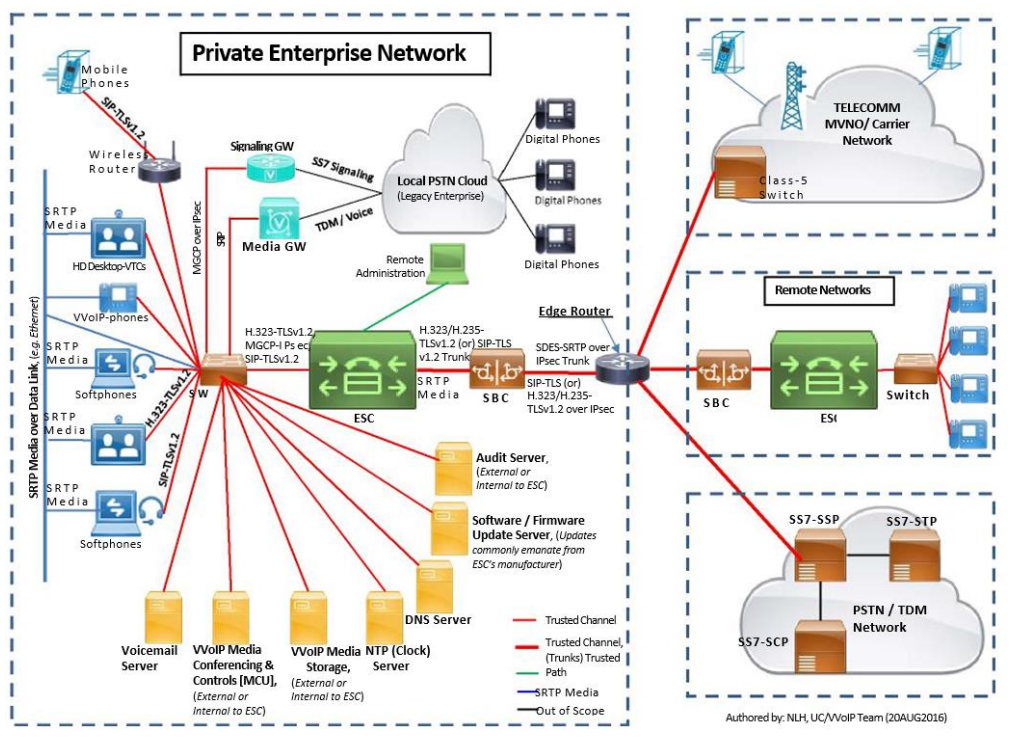
Figure 1 below shows a typical VVoIP infrastructure in which an ESC is deployed.
As can be seen from this figure, the ESC’s purpose is to provide an interface between VVoIP networks in order to connect calls. The ESC depends on or communicates with a number of services that are located within the internal network such as voicemail, conferencing, Network Time Protocol (NTP), Domain Name System, and software updates that are downloaded from VVoIP endpoint manufacturers and stored on the ESC for distribution to the clients.
Certain storage capabilities may be implemented exclusively within the TOE or within both the TOE and its OE (such as the TOE maintaining an internal audit log that is also written to an external audit server).
For connecting networks, the ESC relies on edge routing to handle lower-level communications between the networks and on a SBC to filter out potentially malicious activity.
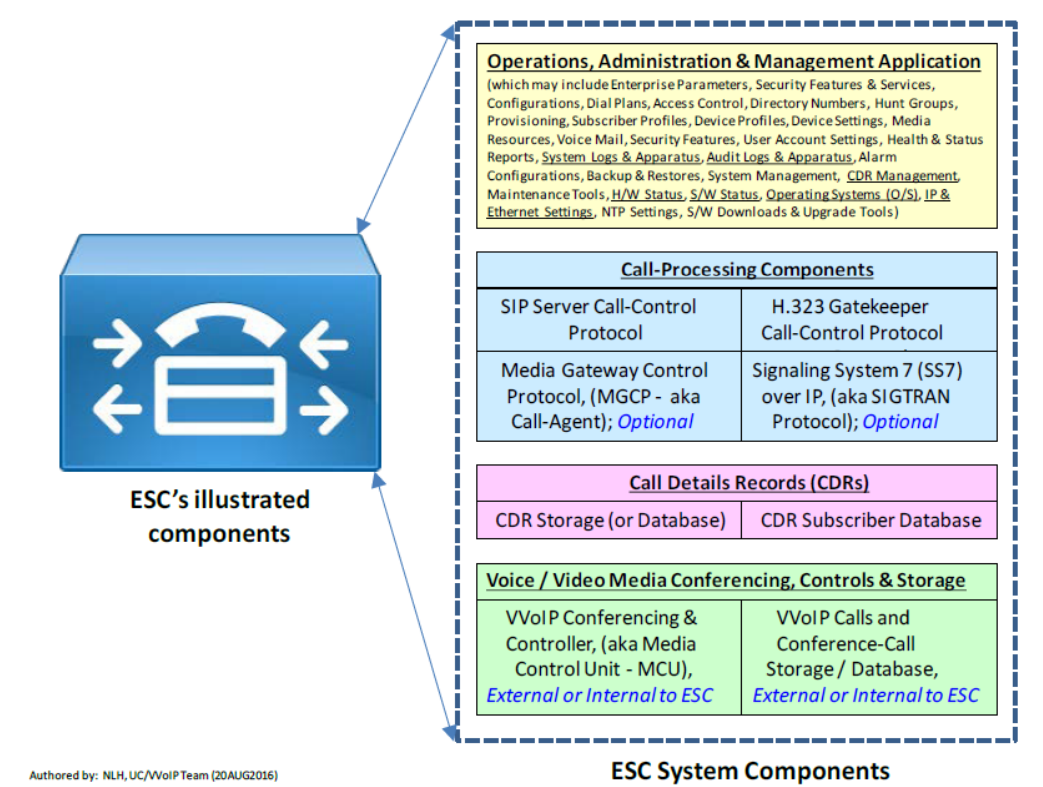
The ESC itself, which can be administered locally or remotely, consists of several different logical components, as shown in Figure 2 below.
As can be seen from the figure above, the ESC provides the following logical capabilities:
Requirements in this PP-Module are designed to address the security problem in the following use cases. Use cases are not mutually exclusive; a TOE may implement more than one of these use cases. The description of these use cases provide instructions for how the TOE and its OE should be made to support the functionality required by this PP-Module.
This PP-Module defines four potential use cases for the ESC TOE:
The security problem is described in terms of the threats that the TOE is expected to address, assumptions about its operational environment, and any organizational security policies that the TOE is expected to enforce.
The ESC is a network appliance that incorporates multiple components and protocols, and is designed with the purpose of connecting and managing calls that emanate from registered VVoIP endpoints. The ESC is also designed to provide centralized control of an enterprise-wide VVoIP communication network. As the central control system that manages and processes VVoIP calls from as many as 50,000 endpoints per node, it is critically important for the ESC to be protected because it is a single point of failure for tens of thousands of end-users.
As a centralized system the ESC is subject to attacks from the VVoIP endpoints that are registered to the ESC. Any VVoIP endpoint could be a threat to launch a malicious attack against the ESC. Therefore the ESC shall possess the security requirements needed for mitigating such a threat type.
Note that as PP-Module of the NDcPP, all threats, assumptions, and Organizational Security Policies (OSPs) defined there will also apply to an ESC TOE unless otherwise specified.
The Security Functional Requirements (SFRs) defined in this PP-Module will mitigate the threats that are defined in the PP-Module but will also mitigate some NDcPP threats in more comprehensive detail due to the specific capabilities provided by an ESC.
This PP defines no Assumptions beyond those defined in the claimed Base-PP(s).
All assumptions for the operational environment of the Base-PP also apply to this PP-Module. A.NO_THRU_TRAFFIC_PROTECTION is still operative, but only for the interfaces in the TOE that are defined by the Base-PP and not the PP-Module.The OE of the TOE implements technical and procedural measures to assist the TOE in correctly providing its security functionality (which is defined by the security objectives for the TOE). The security objectives for the OE consist of a set of statements describing the goals that the OE should achieve. This section defines the security objectives that are to be addressed by the IT domain or by non-technical or procedural means. The assumptions identified in Section 3 are incorporated as security objectives for the environment.
All objectives for the operational environment of the Base-PP also apply to this PP-Module. OE.NO_THRU_TRAFFIC_PROTECTION is still operative, but only for the interfaces in the TOE that are defined by the Base-PP and not the PP-Module.This PP-Module also defines the following additional environmental objective:
| Assumption or OSP | Security Objectives | Rationale |
| P.SECURED_PLATFORM | OE.SECURED_PLATFORM | In order to ensure that the ESC is not subject to compromise, it is important for the OS that it is installed on to be secure in terms of closing unnecessary interfaces and providing appropriate security functionality. However, it is necessary for this PP-Module to make this an organizational policy in the scenario where the TOE uses a commercial third-party OS because the ESC vendor is not responsible for providing the OS and therefore has no control over its inherent functionality or administrative configuration. |
This section instructs the ST author on what selections must be made to certain SFRs contained in the NDcPP in order to mitigate the threats defined in this PP-Module or to mitigate a threat from the NDcPP in a more specific or restrictive manner than what it specifies.
Full assurance activities are not repeated for the requirements in this section; only the additional testing needed to supplement what has already been captured in the Supporting Documents for the NDcPP is included.
This SFR is optional in the NDcPP but is mandated by this PP-Module because the ESC is expected to maintain audit data internal to the TOE which must be protected from unauthorized access.
Application Note: Both the “audit data” (FAU_GEN.1 as defined in the Base-PP) and “system log” data (FAU_GEN.1/Log as defined in this PP-Module) are expected to be protected from unauthorized access. This SFR applies to all data related to the behavior of the TOE regardless of how it is categorized or where it is stored.
This SFR is modified from its definition in the Base-PP to mandate support exclusively for NTP v4.
The text of FCS_NTP_EXT.1.2 is replaced with:
FCS_NTP_EXT.1.2 The TSF shall use only the following NTP version: [NTP v4 (RFC 5905)].
Application Note: This SFR is selection-based in the Base-PP but is mandatory for a TOE that conforms to this PP-Module because the refinement to FPT_STM_EXT.1 requires this SFR to be claimed in all cases.
This SFR has been refined from the NDcPP to permit the NTP v4 selection only. No other parts of the SFR are modified.
This SFR is modified from its definition in the Base-PP to mandate the selection for using NTP as the TOE's time source. Any element not specified in this section is unchanged from its definition in the Base-PP.
The text of FPT_STM_EXT.1.2 is replaced with:
FPT_STM_EXT.1.2 The TSF shall [synchronize time with an NTP server].
Application Note: This SFR has been refined from the NDcPP to permit the NTP server selection only. No other parts of the SFR are modified.
| Requirement | Auditable Events | Additional Audit Record Contents |
|---|---|---|
| FAU_GEN.1/CDR | ||
| No events specified | N/A | |
| FAU_GEN.1/Log | ||
| No events specified | N/A | |
| FAU_SAR.1/Log | ||
| No events specified | N/A | |
| FAU_STG.2/CDR | ||
| No events specified | N/A | |
| FAU_VVR_EXT.1 | ||
| No events specified | N/A | |
| FDP_IFC.1 | ||
| No events specified | N/A | |
| FDP_IFF.1 | ||
| No events specified | N/A | |
| FDP_RIP.1 | ||
| No events specified | N/A | |
| FIA_UAU.2/TC | ||
| Successful or failed authentication of trunk connected network component |
| |
| FIA_UAU.2/VVoIP | ||
| Authentication of external VVoIP endpoint/device |
| |
| Successful or failed registration of VVoIP endpoint/device | ||
| FMT_CFG_EXT.1 | ||
| No events specified | N/A | |
| FMT_SMF.1/ESC | ||
| Enabling/disabling VVoIP endpoint/device features |
| |
| Modification of TOE Call Detail Records (CDR) |
| |
| FPT_FLS.1/ESC | ||
| No events specified | N/A | |
| FTP_ITC.1/ESC | ||
| No events specified | N/A |
| Event | Additional System Log Record Contents |
|---|---|
| Current IP connections | Network interface card (NIC); Status (up or down). |
| CPU usage | Utilization percentage of TOE CPU(s). |
| Memory usage | Percentage and/or amount of free memory available for use. |
| Disk and file storage capacity | Percentage and/or amount of available space remaining for each disk or disk partition on the TOE. |
| Fan status (conditional) | Fan identification; Status (on or off). |
| Power status (conditional) | Status (on or off). |
Unlike audit data (see FAU_GEN.1), system log data is used primarily for real-time analysis of system behavior. This data is expected to be treated as non-persistent data by the TOE.
The ST author is expected to identify the sampling interval for the information presented in the system log so that it is clear to the evaluator how often updates to that information will be presented to an administrator
Logging of power status is optional and is only intended for TOEs that have multiple redundant power supplies. Logging of fan status is also optional.
This SFR defines additional management functions for the TOE beyond what is defined in the Base-PP as FMT_SMF.1. The TOE may have all management functionality implemented in the same logical interface; it is not necessary for “network device management” and “enterprise session controller management” to be implemented in separate interfaces.
The TOE developer is encouraged, but not required, to provide a more sophisticated password strength policy than what is prescribed by FIA_PMG_EXT.1 as defined in the NDcPP. This may include the ability for an administrator to configure the metrics used to define an acceptable password. At minimum, the minimum password length must be configurable. If "have” is selected in FAU_VVR_EXT.1.1, then "Ability to enable/disable voice and video recordings for any registered VVoIP endpoint" must be selected.
The selection “Ability to configure NTP” must be included in the ST if the TOE uses NTP for timestamp configuration. If selected, FCS_NTP_EXT.1 from the NDcPP must be claimed as well.
If “Ability to specify the set of audited events” is selected, FAU_SEL.1 must be claimed.
The following rationale provides justification for each SFR for the TOE,
showing that the SFRs are suitable to address the specified threats:
| Threat | Addressed by | Rationale |
|---|---|---|
| T.MALICIOUS_TRAFFIC | FAU_GEN.1/CDR | This SFR mitigates the threat by requiring the TSF to generate call detail records of VVoIP communications. |
| FAU_GEN.1/Log | This SFR mitigates the threat by generating real-time diagnostic activity for the TOE’s behavior that can be used to determine if it is experiencing conditions that could lead to a failure state. | |
| FAU_STG.2/CDR | This SFR mitigates the threat by requiring the TSF to securely store call detail records. | |
| FAU_STG.2/VVR (selection-based) | This SFR mitigates the threat by requiring the TSF to securely store call detail records, if generated by the TSF. | |
| FAU_VVR_EXT.1 | This SFR mitigates the threat by allowing the TOE to claim whether or not it performs voice/video recording of VVoIP communications. | |
| FAU_VVR_EXT.2 (selection-based) | This SFR mitigates the threat by defining when voice and video recordings are generated by the TSF, how they are stored, and how they are uniquely identified for future access. | |
| FCS_NTP_EXT.1 (modified from Base-PP) | This SFR mitigates the threat by requiring the TSF to support NTPv4 communications to obtain reliable time data that is used for establishment of valid cryptographic channels and accurate recording of call metadata. | |
| FDP_IFC.1 | This SFR mitigates the threat by defining an enterprise session controller policy to broker VVoIP endpoint communications. | |
| FDP_IFF.1 | This SFR mitigates the threat by defining the rules enforced by the enterprise session controller policy. | |
| FDP_RIP.1 | This SFR mitigates the threat by ensuring the permanent erasure of residual data so that a decommissioned or refurbished device cannot be used to disclose TSF data without authorization. | |
| FIA_UAU.2/TC | This SFR mitigates the threat by requiring authentication of telecommunications devices that are connected to the TOE before the TSF will interact with them. | |
| FIA_UAU.2/VVoIP | This SFR mitigates the threat by requiring authentication of VVoIP endpoints that are connected to the TOE before the TSF will interact with them. | |
| FPT_STM_EXT.1 (modified from Base-PP) | This SFR mitigates the threat by requiring the TSF to synchronize with an NTP server for reliable time data that is used for establishment of valid cryptographic channels. | |
| FPT_TUD_EXT.1/VVoIP (implementation-dependent) | This SFR mitigates the threat by optionally allowing the TOE to distribute software/firmware updates to connected VVoIP endpoints. | |
| FTP_ITC.1/ESC | This SFR mitigates the threat by defining the trusted channels used for protection of signaling and media data used in VVoIP and SIP trunking communications. | |
| T.NETWORK_DISCLOSURE | FCS_NTP_EXT.1 (modified from Base-PP) | This SFR mitigates the threat by requiring the TSF to support NTPv4 communications to obtain reliable time data that is used for establishment of valid cryptographic channels. |
| FDP_IFC.1 | This SFR mitigates the threat by defining an enterprise session controller policy to broker VVoIP endpoint communications. | |
| FDP_IFF.1 | This SFR mitigates the threat by defining the rules enforced by the enterprise session controller policy. | |
| FIA_UAU.2/TC | This SFR mitigates the threat by requiring authentication of telecommunications devices that are connected to the TOE before the TSF will interact with them. | |
| FIA_UAU.2/VVoIP | This SFR mitigates the threat by requiring authentication of VVoIP endpoints that are connected to the TOE before the TSF will interact with them. | |
| FPT_STM_EXT.1 (modified from Base-PP) | This SFR mitigates the threat by requiring the TSF to synchronize with an NTP server for reliable time data that is used for establishment of valid cryptographic channels. | |
| FPT_TUD_EXT.1/VVoIP (implementation-dependent) | This SFR mitigates the threat by optionally allowing the TOE to distribute software/firmware updates to connected VVoIP endpoints. | |
| FTP_ITC.1/ESC | This SFR mitigates the threat by defining the trusted channels used for protection of signaling and media data used in VVoIP and SIP trunking communications. | |
| T.UNAUTHORIZED_CLIENT | FAU_GEN.1/Log | This SFR mitigates the threat by requiring the TSF to generate a real-time system log of its own diagnostic details. |
| FAU_SAR.1/Log | This SFR mitigates the threat by defining what users are able to review the real-time system log. | |
| FAU_SEL.1 (selection-based) | This SFR mitigates the threat by optionally allowing an administrator to suppress the generation of certain audit records. | |
| FAU_STG.2 (modified from Base-PP) | This SFR mitigates the threat by requiring all stored audit data to be protected against unauthorized access. | |
| FCS_NTP_EXT.1 (modified from Base-PP) | This SFR mitigates the threat by requiring the TSF to support NTPv4 communications to obtain reliable time data that is used for establishment of valid cryptographic channels and accurate recording of log data. | |
| FDP_IFC.1 | This SFR mitigates the threat by defining an enterprise session controller policy to broker VVoIP endpoint communications. | |
| FDP_IFF.1 | This SFR mitigates the threat by defining the rules enforced by the enterprise session controller policy. | |
| FIA_UAU.2/TC | This SFR mitigates the threat by requiring authentication of telecommunications devices that are connected to the TOE before the TSF will interact with them. | |
| FIA_UAU.2/VVoIP | This SFR mitigates the threat by requiring authentication of VVoIP endpoints that are connected to the TOE before the TSF will interact with them. | |
| FMT_SMF.1/ESC | This SFR mitigates the threat by defining the authorized management functions supported by the TOE. | |
| FPT_STM_EXT.1 (modified from Base-PP) | This SFR mitigates the threat by requiring the TSF to synchronize with an NTP server for reliable time data that is used for establishment of valid cryptographic channels and accurate log data. | |
| FPT_TUD_EXT.1/VVoIP (implementation-dependent) | This SFR mitigates the threat by optionally allowing the TOE to distribute software/firmware updates to connected VVoIP endpoints. | |
| FTP_ITC.1/ESC | This SFR mitigates the threat by defining the trusted channels used for protection of signaling and media data used in VVoIP and SIP trunking communications. |
| PP-Module Threat, Assumption, OSP | Consistency Rationale |
|---|---|
| T.MALICIOUS_TRAFFIC | The Base-PP does not define a threat for malicious traffic because all of its security-relevant external interfaces define the network device as the endpoint. This PP-Module defines interfaces where the TOE is facilitating a connection between two external entities, such that traffic between them will flow “through” the TOE as opposed to “to/from the TOE.” This threat is consistent with the Base-PP because it is only applied to the interfaces defined in this PP-Module where it is relevant; it does not apply to the interfaces defined in the Base-PP. |
| T.NETWORK_DISCLOSURE | The Base-PP does not define a threat for access to network resources because all of its security-relevant external interfaces define the network device as the endpoint. This PP-Module defines interfaces where the TOE is facilitating a connection between two external entities, such that traffic between them will flow “through” the TOE as opposed to “to/from the TOE.” This threat is consistent with the Base-PP because it is only applied to the interfaces defined in this PP-Module where it is relevant; it does not apply to the interfaces defined in the Base-PP. |
| T.UNAUTHORIZED_CLIENT | This threat is a specific instance of the T.WEAK_AUTHENTICATION_ENDPOINTS threat defined in the Base-PP because it refers to a scenario where an unauthorized client is able to communicate successfully with the TOE because the TSF is incapable of authenticating clients to determine which are or are not authorized. |
| P.SECURED_PLATFORM | The Base-PP does not define any policies that expect that environmental systems are configured in any specific manner. Therefore, it is expected that requiring environmental systems to be configured in a secure manner will not prevent the TSF from being fully implemented. |
The objectives for the TOE’s operational environment are consistent with the NDcPP based on the following rationale:
| PP-Module OE Objective | Consistency Rationale |
|---|---|
| OE.SECURED_PLATFORM | This objective expects the TOE to be configured in such a manner that the underlying OS on which the TOE runs cannot be used to alter the behavior of the TSF. This is consistent with the OE.NO_GENERAL_PURPOSE objective in the Base-PP that expects that general-purpose computing capability will be prohibited by the OS. This ensures that OE.SECURED_PLATFORM can be satisfied by the operational environment. |
| PP-Module Requirement | Consistency Rationale |
|---|---|
| Modified SFRs | |
| FAU_STG.2 | This PP-Module expands the scope of the Base-PP SFR to cover the audit data generated by ESC functionality. |
| FCS_NTP_EXT.1 | This PP-Module refines the Base-PP SFR to only permit the selection of NTP v4 while leaving the rest of the requirement unchanged. |
| FPT_STM_EXT.1 | This PP-Module refines the Base-PP SFR to restrict the selection of a time source to be an external NTP server. |
| Additional SFRs | |
| This PP-Module does not add any requirements when the NDcPP is the base. | |
| Mandatory SFRs | |
| FAU_GEN.1/CDR | The PP-Module iterates an SFR defined in the Base-PP to require the TOE to generate a type of audit record that is specific to the functions defined in this PP-Module. |
| FAU_GEN.1/Log | The PP-Module iterates an SFR defined in the Base-PP to require the TOE to generate a type of audit record that is specific to the functions defined in this PP-Module. |
| FAU_SAR.1/Log | This PP-Module requires the TOE to implement a mechanism for review of system log records that are defined by this PP-Module in FAU_GEN.1/Log and does not relate to the audit records required by the Base-PP. |
| FAU_STG.2/CDR | The PP-Module iterates an SFR defined in the Base-PP by protecting audit data required by this PP-Module in the same manner that the Base-PP defines for its own audit records. |
| FAU_VVR_EXT.1 | This SFR applies to recording voice and video call data, which is beyond the original scope of the Base-PP. |
| FDP_IFC.1 | This SFR applies to the TOE’s implementation of an enterprise session controller policy, which applies to the TOE’s through-traffic interfaces and is therefore beyond the original scope of the Base-PP. |
| FDP_IFF.1 | This SFR applies to the TOE’s implementation of an enterprise session controller policy, which applies to the TOE’s through-traffic interfaces and is therefore beyond the original scope of the Base-PP. |
| FDP_RIP.1 | This SFR applies to data wipe operations which is beyond the original scope of the Base-PP. The Base-PP defines FCS_CKM.6 for destruction of cryptographic data but this PP-Module extends the requirements for data destruction to entire disk storage locations. |
| FIA_UAU.2/TC | This SFR applies to authentication of external entities on the TOE’s through-traffic interfaces and is therefore beyond the original scope of the Base-PP. |
| FIA_UAU.2/VVoIP | This SFR applies to authentication of external entities on the TOE’s through-traffic interfaces and is therefore beyond the original scope of the Base-PP. |
| FMT_CFG_EXT.1 | This SFR requires the TOE to implement a secure default configuration. There is no inconsistency here with the Base-PP because the Base-PP’s functionality is not dependent on a particular default configuration. |
| FMT_SMF.1/ESC | This SFR requires the TOE to implement management functions that are specific to ESC functionality. This does not conflict with the Base-PP because these are all additional functions that go beyond what the Base-PP requires. |
| FPT_FLS.1/ESC | This SFR requires the TOE to take some specific action in the event of self-test failures or other hardware failures. This extends the functionality required by the Base-PP because the Base-PP defines the self-tests that the TOE must perform but does not define specific requirements for the TOE’s behavior when a self-test fails. |
| FTP_ITC.1/ESC | This SFR requires the TOE to implement trusted channels for VVoIP and SIP trunking communications. This is an iteration of the same Base-PP SFR that adds new external interfaces beyond the scope of the Base-PP. |
| Optional SFRs | |
| This PP-Module does not define any Optional requirements. | |
| Objective SFRs | |
| This PP-Module does not define any Objective requirements. | |
| Implementation-dependent SFRs | |
| FPT_TUD_EXT.1/VVoIP | This PP-Module extends the functionality required by the Base-PP by optionally allowing the TSF to perform software update activities for connected VVoIP endpoints and not just for the TOE itself. |
| Selection-based SFRs | |
| FAU_SEL.1 | This PP-Module optionally allows a conformant TOE to claim the ability to suppress the generation of audit events based on certain factors. This does not conflict with the Base-PP because if the administrators desires all required auditable events to be audited, they can choose to disable this function. |
| FAU_STG.2/VVR | This PP-Module optionally allows a conformant TOE to claim the ability to securely store voice/video recordings. This does not conflict with the Base-PP because the Base-PP already has the ability to define secured storage (e.g. through FAU_STG.2) so there is no expectation of availability that is being violated if this is claimed |
| FAU_VVR_EXT.2 | This PP-Module optionally allows a conformant TOE to claim the ability to generate and retain voice/video recordings of calls. This does not conflict with the Base-PP because the Base-PP already defines an audit mechanism via FAU_GEN.1 and also does not define any requirements that would prevent the generation of media recordings such as unobservability of user actions. |
This PP-Module does not define any Strictly Optional SFRs or SARs.
This PP-Module does not define any Objective SFRs.
| Requirement | Auditable Events | Additional Audit Record Contents |
|---|---|---|
| FPT_TUD_EXT.1/VVoIP | ||
| No events specified | N/A |
The TOE may either validate the update prior to storing it for delivery to registered VVoIP endpoints or it may provide the means to validate the update to the VVoIP endpoint itself by preserving the manufacturer’s integrity/authenticity mechanism and including that information in the update. In other words, either the TSF itself validates the update or it facilitates the ability of the VVoIP endpoint to do this by providing all information necessary to validate the update to the client.
It is typical behavior for ESCs to push software updates to registered VVoIP endpoint devices. However, many VVoIP endpoints have the ability to receive software updates from either an ESC or third-party update server. This SFR addresses the case where it is the ESC’s responsibility for delivery of software updates to registered VVoIP endpoints. For those scenarios where the VVoIP endpoint gets its upload from a separate server, then the ESC is not responsible for assuring FPT_TUD_EXT.1/VVoIP.
| Requirement | Auditable Events | Additional Audit Record Contents |
|---|---|---|
| FAU_SEL.1 | ||
| No events specified | N/A | |
| FAU_STG.2/VVR | ||
| No events specified | N/A | |
| FAU_VVR_EXT.2 | ||
| Voice/video recordings of completed calls | Unique identifying data specified in FAU_VVR_EXT.2.3. |
| Functional Class | Functional Components |
|---|---|
| Class FAU: Security Audit | FAU_VVR_EXT Voice and Video Recording |
| Class FMT: Security Management | FMT_CFG_EXT Secure by Default Configuration |
FAU_VVR_EXT.1, Recording Voice and Video Call Data, requires the TSF to specify whether or not it records voice and video call data.
FAU_VVR_EXT.2, Generation of Voice and Video Recordings, requires the TSF to store uniquely identified voice and video call recordings in a certain format and when certain conditions are met
The following actions could be considered for the management functions in FMT:
There are no auditable events foreseen.
| Hierarchical to: | No other components. |
| Dependencies to: | No dependencies. |
The following actions could be considered for the management functions in FMT:
The following actions should be auditable if FAU_GEN Security Audit Data Generation is included in the PP/ST:
| Hierarchical to: | No other components. |
| Dependencies to: | FAU_VVR_EXT.1 Recording Voice and Video Call Data |
FMT_CFG_EXT.1, Secure by Default Configuration, requires credentials to be administratively-defined before allowing any other TSF-mediated security functionality and to enforce a deny-by-default posture on the TOE.
No specific management functions are identified.
There are no auditable events foreseen.
| Hierarchical to: | No other components. |
| Dependencies to: |
FIA_UAU.1 Timing of Authentication FMT_MTD.1 Management of TSF Data FMT_SMR.1 Security Roles |
The TOE does not require any additional supplementary information to describe its entropy source(s) beyond the requirements outlined in the Base-PP. As with other Base-PP requirements, the only additional requirement is that the entropy documentation also applies to the specific ESC capabilities of the TOE that require random data, in addition to any functionality required by the Base-PP.
This appendix lists requirements that should be considered satisfied by products successfully evaluated against this PP. However, these requirements are not featured explicitly as SFRs and should not be included in the ST. They are not included as standalone SFRs because it would increase the time, cost, and complexity of evaluation. This approach is permitted by [CC] Part 1, 8.2 Dependencies between components.
This information benefits systems engineering activities which call for inclusion of particular security controls. Evaluation against the PP-Module provides evidence that these controls are present and have been evaluated.| Requirement | Rationale for Satisfaction |
| FIA_UID.1 – Timing of Identification | FIA_UAU.2 (which is iterated in this PP-Module as FIA_UAU.2/TC and FIA_UAU.2/VVoIP) has a dependency on FIA_UID.1 because authentication of an external entity requires that entity to first identify itself so that its identity can be validated by the authentication process. This SFR has not been defined in this PP-Module because in both iterations of FIA_UAU.2, the entity being authenticated is a trusted IT product in the TOE’s operational environment that communicates with the TSF over a channel specified in FTP_ITC.1/ESC. FTP_ITC.1/ESC explicitly states that the channel itself provides ‘assured identification of its end points’ which implies that these entities are identified prior to the authentication behavior required by the iterations of FIA_UAU.2. |
| FMT_MSA.3 – Static Attribute Initialization |
FDP_IFF.1 has a dependency on FMT_MSA.3 to define the default security posture of security attributes for the purpose of information flow control enforcement. This SFR has not been defined by this PP-Module because the enforcement of FDP_IFF.1 is not dependent on the initial state of security attributes. For example, FDP_IFF.1.2 requires the TSF to determine if a communication attempt is valid before authorizing it. This is true regardless of whether the default value of security attributes associated with the connection attempt are permissive or restrictive; there is no difference in how the TSF determines “validity” in this case. The default values of security attributes do not cause the information flow control policy to behave differently for those rules that must always be enforced by the TSF. The ST author has the ability to define additional default-allow or default-deny rules through the assignments in FDP_IFF.1.4 and 1.5. The ability to specify this behavior in the policy itself implies a default security posture of the relevant security attributes that does not need to be explicitly re-stated in a separate SFR. |
| Acronym | Meaning |
|---|---|
| Base-PP | Base Protection Profile |
| CC | Common Criteria |
| CDR | Call Detail Record |
| CEM | Common Evaluation Methodology |
| cPP | Collaborative Protection Profile |
| EP | Extended Package |
| ESC | Enterprise Session Controller |
| FP | Functional Package |
| IP-PBX | Internet Protocol Private Branch Exchange |
| MGCP | Media Gateway Control Protocol |
| NDcPP | Collaborative Protection Profile for Network Devices |
| OA&M | Operations, Administration, and Management |
| OE | Operational Environment |
| OSP | Organizational Security Policies |
| PP | Protection Profile |
| PP-Configuration | Protection Profile Configuration |
| PP-Module | Protection Profile Module |
| SAR | Security Assurance Requirement |
| SBC | Session Border Controller |
| SFR | Security Functional Requirement |
| SIP | Session Initiation Protocol |
| ST | Security Target |
| TOE | Target of Evaluation |
| TSF | TOE Security Functionality |
| TSFI | TSF Interface |
| TSS | TOE Summary Specification |
| VVoIP | Voice/Video over IP |